



If you are asking what percentage does a lawyer take from a settlement, the answer is usually 33% to 40% in personal injury and similar civil claims handled on a contingency fee basis. In many cases, 33⅓% is common when a case settles early, while the percentage may increase if the case moves into litigation, trial preparation, or appeal. This fee structure is common because it allows injured clients to pursue compensation without paying large legal fees upfront.
That headline answer, however, is only part of the story. The percentage your lawyer takes is not always the same as the amount you actually keep. Case costs, medical liens, insurance reimbursement claims, and the order in which deductions are made can all reduce your final payout. So if you want a complete answer to what percentage does a lawyer take from a settlement, you need to understand not only the attorney’s fee percentage, but also how the settlement is divided after all deductions.
This guide explains the standard fee ranges, the factors that change them, and what clients should know before signing any fee agreement.
What Percentage Does a Lawyer Take From a Settlement?
In most U.S. contingency-fee cases, a lawyer typically takes:
- 33% to 33⅓% if the case settles before a lawsuit becomes heavily contested
- 35% to 40% if litigation becomes more involved
- 40% or more in some trial or appeal-stage matters
This structure is especially common in personal injury cases because it gives people access to legal representation without requiring hourly payments from the start. Instead of paying upfront, the client agrees that the lawyer will receive a percentage only if money is recovered through a settlement or court award.
When people search what percentage does a lawyer take from a settlement, they usually want a quick answer, but the real issue is how much money will remain after every deduction is made. That is why understanding the full payout breakdown is just as important as knowing the attorney’s fee percentage.
Typical Lawyer Settlement Percentage Table
| Case Stage | Common Lawyer Fee Percentage | What It Usually Means |
| Early settlement | 33% to 33⅓% | The claim is resolved before heavy litigation |
| Active litigation | 35% to 40% | The case requires more formal legal work |
| Trial or appeal | 40% or more | The matter becomes more complex and time-intensive |
This table gives a general benchmark, but not every case follows the exact same structure. The final fee can depend on the written agreement, the type of case, the state, and the complexity of the dispute.
What Is a Contingency Fee?
A contingency fee is a legal payment arrangement where a lawyer receives a percentage of the client’s financial recovery instead of billing by the hour. In general, if there is no recovery, the lawyer does not earn the legal fee itself, although certain case expenses may still apply depending on the agreement.
This fee model is common in personal injury law because it lowers the financial barrier for people who need legal help after an accident or injury. Rather than paying thousands of dollars upfront, the client and lawyer agree that legal fees will come from the final settlement or verdict.
That said, “no fee unless you win” does not always mean “no financial responsibility at all.” Filing fees, expert witness costs, medical records, and investigation expenses may still be part of the case. This is why anyone researching what percentage does a lawyer take from a settlement should read the fee agreement carefully before signing.
Key Features of a Contingency Fee
- No large upfront attorney fee in most cases
- A lawyer gets paid only if money is recovered
- The percentage may increase if the case goes further
- Expenses may still be charged separately
- Final payout depends on the full deduction structure
Standard Lawyer Percentage From a Settlement
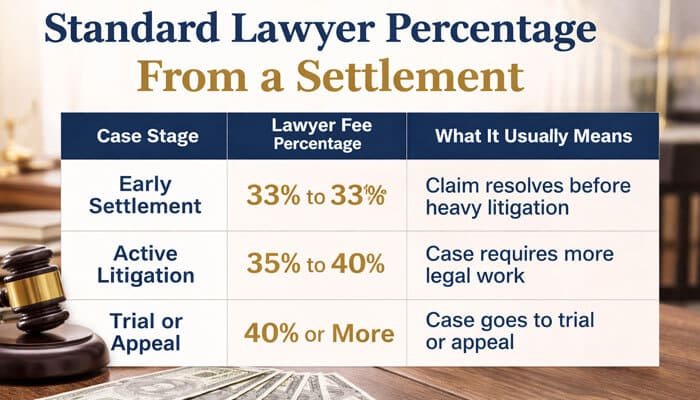
For most personal injury claims, the standard range is still one-third to 40%.
That means the fee might look like this:
| Settlement Amount | Example Fee at 33% | Estimated Amount Left Before Other Deductions |
| $10,000 | $3,300 | $6,700 |
| $50,000 | $16,500 | $33,500 |
| $100,000 | $33,000 | $67,000 |
These examples are helpful, but they only show the attorney’s share. They do not show the client’s final take-home amount after costs, liens, and other deductions are removed.
This is where many readers misunderstand what percentage does a lawyer take from a settlement. The lawyer’s percentage may seem straightforward, but the final amount you receive can vary significantly depending on how the case is structured and what additional expenses are involved.
Why the Percentage Can Change
The exact answer to what percentage does a lawyer take from a settlement depends on several important factors. Not every case is handled the same way, and not every attorney uses the exact same fee structure.
In simple cases, the fee may stay closer to one-third. In more complex cases involving litigation, expert testimony, or appeals, the percentage may rise because the attorney is investing more time, skill, and financial risk into the claim.
Main Reasons Lawyer Fees May Increase
- The case moves from negotiation into litigation
- The claim involves serious or permanent injuries
- Expert witnesses are needed
- Liability is disputed
- There are multiple defendants
- The lawyer advances major case costs
- The case goes to trial or appeal
1. Case Stage
A lawyer may charge one percentage if the case settles early and a higher percentage if the case moves deeper into litigation. Early settlements usually require less preparation, while contested lawsuits often demand more strategy, time, and court involvement.
This difference is important because many clients assume the fee will stay the same from beginning to end. In reality, the stage of the case can directly affect what percentage does a lawyer take from a settlement.
2. Case Complexity
A straightforward insurance claim and a disputed catastrophic injury lawsuit are not the same. Cases involving severe injuries, multiple defendants, unclear liability, or expert testimony often require substantially more work.
Because these claims are more demanding, lawyers may charge a higher percentage to reflect the increased effort and risk. Complexity is one of the biggest reasons the answer to what percentage does a lawyer take from a settlement is not always identical from one case to another.
3. Attorney Experience and Firm Structure
Some law firms advance substantial litigation costs and absorb more financial risk than others. A firm with strong resources, expert access, and trial experience may structure fees differently than a smaller practice.
Clients should not evaluate a lawyer based only on the percentage. The value may also come from negotiation ability, communication, reputation, and success in maximizing the overall settlement amount.
State and Case-Type Rules
State rules can vary, and certain categories of cases may have additional restrictions or approval requirements. Some legal matters also follow different fee standards depending on the type of claim involved.
That means what percentage does a lawyer take from a settlement can sometimes depend on jurisdiction as much as it depends on the lawyer’s own policy.
Do Lawyer Fees Change by State?
Yes. This is one of the most overlooked parts of the conversation.
The common 33% to 40% range is a general U.S. rule of thumb, but it is not a universal number in every state or every type of case. Some jurisdictions have specific requirements, limitations, or court oversight that can affect attorney fees.
That means your lawyer’s percentage may depend on where the case is filed, what type of case it is, and how the written fee agreement is structured. For readers searching what percentage does a lawyer take from a settlement, this is a critical point because local law can influence the final answer.
Lawyer Fee Percentages by Case Type
This section helps explain why not every settlement follows the exact same fee model. Different practice areas can involve different risks, rules, and compensation methods.
Understanding the type of case is essential because the answer to what percentage does a lawyer take from a settlement in a personal injury claim may not be the same in other legal matters.
| Case Type | Typical Fee Structure | Notes |
| Personal injury | Usually contingency-based | Commonly around one-third to 40% |
| Workers’ compensation | May be limited or approved differently | Rules vary by state |
| Class actions | Often court-supervised | Fees may be reviewed before approval |
| Mass torts | Can involve structured fee arrangements | Often more complex than single-plaintiff cases |
| Criminal defense | Usually not contingency-based | Often hourly or flat fee |
| Family law | Usually not contingency-based | Contingency fees are generally restricted |
1. Personal Injury Cases
These are the classic contingency-fee matters. Car accidents, slip and fall cases, wrongful death claims, and product liability lawsuits often use the one-third to 40% range.
Because these cases are often tied to insurance negotiations and damage recovery, contingency arrangements are especially common. This is the case category most readers mean when they ask what percentage does a lawyer take from a settlement.
2. Workers’ Compensation Cases
Workers’ compensation fees are often treated differently and may be subject to approval rules or separate limits depending on the state. In some situations, the attorney’s fee may be capped or reviewed before it is finalized.
That means workers’ compensation claims may not follow the same structure as standard personal injury lawsuits. Clients should always ask how fees are calculated in their specific claim type.
3. Class Actions and Mass Torts
Class actions and mass tort claims may involve court-supervised fee approval and a more structured payout system. These cases can be far more complex because they often involve large groups of claimants and multiple layers of administration.
As a result, the answer to what percentage does a lawyer take from a settlement may look different in these cases than it does in a typical one-on-one injury claim.
4. Criminal Defense and Family Law
These are important exceptions. Contingency fees are generally not used in criminal defense and many domestic-relations matters.
That matters because many readers assume all legal services can be priced as a percentage of the outcome. In reality, fee structures depend heavily on the area of law.
When Contingency Fees Are Not Allowed
Contingency fees are generally not allowed for:
- Criminal defense
- Many domestic relations matters, such as fees tied to securing a divorce or the amount of alimony or support
This is a crucial point because people often assume that any lawyer can simply take a percentage from the final result. That is not how legal billing works across every practice area.
The fee structure depends on the type of case, the ethical rules involved, and sometimes the laws of the state. So when discussing what percentage does a lawyer take from a settlement, it is important to remember that contingency fees are common, but not universal.
How Settlement Money Is Actually Divided
The real question is not only what percentage does a lawyer take from a settlement, but also how much of the settlement the client actually keeps.
A typical settlement may be divided among:
- Attorney’s contingency fee
- Filing and litigation costs
- Medical bills or medical liens
- Insurance reimbursement claims
- Other negotiated deductions
This is why a settlement amount on paper can look much larger than the final amount received by the client. The gross recovery and the net recovery are not the same thing.
A professional article on what percentage does a lawyer take from a settlement should always explain this distinction clearly, because many readers focus only on the fee percentage and ignore the other deductions that affect the final payout.
Settlement Breakdown Table
| Settlement Item | Example Amount |
| Total settlement | $100,000 |
| Attorney fee at 33% | $33,000 |
| Case costs | $5,000 |
| Medical liens/reimbursements | Varies |
| Estimated client remainder | Depends on deductions |
This simple view helps readers understand where the money goes. Even when the lawyer’s percentage looks clear, the final client payout can still change based on several layers of deductions.
How to Calculate What You Actually Keep
Here is a practical formula:
Net settlement = total settlement – attorney fee – case costs – liens – reimbursements
This simple formula helps readers move beyond the headline fee percentage and focus on the real outcome. In many cases, the net amount kept by the client matters far more than the advertised settlement figure.
Example 1: $100,000 Settlement, 33% Fee, $5,000 Costs
If the lawyer calculates the fee on the full settlement:
- Settlement: $100,000
- Lawyer fee at 33%: $33,000
- Costs: $5,000
- Estimated remainder before liens: $62,000
Example 2: Costs Deducted First
- Settlement: $100,000
- Costs: $5,000
- Remaining amount: $95,000
- Lawyer fee at 33%: $31,350
- Estimated remainder before liens: $63,650
Fee Calculation Comparison Table
| Scenario | Settlement | Costs First? | Lawyer Fee | Estimated Remainder Before Liens |
| Example 1 | $100,000 | No | $33,000 | $62,000 |
| Example 2 | $100,000 | Yes | $31,350 | $63,650 |
That difference is meaningful. It shows why the written agreement matters so much and why clients should ask how deductions are applied.
Anyone researching what percentage does a lawyer take from a settlement should also ask whether costs are deducted before or after the attorney’s fee is calculated, because that small detail can change the final payout by thousands of dollars.
Medical Liens and Insurance Reimbursement Explained
This is one of the most overlooked reasons clients receive less money than expected.
A health care lien is a legally enforceable claim against a personal injury settlement. That means healthcare providers, insurers, or others with reimbursement rights may be paid from the settlement before the client receives the remaining funds.
So even if a lawyer takes only 33%, your actual recovery can still shrink significantly if there are:
- Unpaid hospital bills
- Provider liens
- Health insurance reimbursement claims
- Accident-related medical balances
This is why a good attorney does more than negotiate the gross settlement amount. A strong lawyer may also work to reduce liens and reimbursement claims in order to improve the client’s final net recovery.
For people asking what percentage does a lawyer take from a settlement, this is a major point: the attorney’s fee is only one part of the financial picture.
Do You Still Pay if You Lose?
In a classic contingency arrangement, the lawyer typically does not earn the attorney fee unless money is recovered.
However, you may still be responsible for certain expenses, depending on the contract. These can include:
- Court filing fees
- Deposition costs
- Investigation expenses
- Expert witness charges
- Medical record fees
This should be clearly spelled out in the written fee agreement. Clients should never assume that “no win, no fee” automatically means there are no financial obligations at all.
That is why it is smart to ask detailed questions before signing. If you are researching what percentage does a lawyer take from a settlement, you should also ask what happens financially if the case does not succeed.
What Happens If You Change Lawyers Mid-Case?
If you change lawyers during a case, the original attorney may still be entitled to a portion of the settlement for the work already done. This could affect the final amount you receive, as the prior lawyer may claim a share based on the progress they made.
- Lawyer’s compensation: The previous attorney may claim compensation based on the work completed.
- Impact on settlement: Changing lawyers may impact how much the new lawyer and the original lawyer receive from the settlement.
- Important to ask: Always clarify how previous fee claims are handled when changing lawyers to avoid confusion over what percentage a lawyer takes from a settlement.
Contingency Fee vs Hourly Fee vs Flat Fee
Understanding different fee structures helps readers see why contingency billing is unique.
| Fee Type | How It Works | Best Known For |
| Contingency fee | A lawyer takes a percentage of the recovery | Personal injury and civil compensation claims |
| Hourly fee | Lawyer bills for each hour worked | Ongoing legal work and disputes |
| Flat fee | A lawyer charges a fixed amount | Predictable legal services |
1. Contingency Fee
The lawyer takes a percentage of the recovery. This is common in personal injury and similar civil cases.
This model works best when the client is seeking financial compensation and cannot or does not want to pay legal fees upfront.
2. Hourly Fee
The lawyer bills for each hour worked. This remains one of the most common fee structures in legal services.
Hourly billing is often used in matters where there may not be a direct financial recovery, such as business disputes, contract work, or ongoing legal advisory services.
3. Flat Fee
The lawyer charges one fixed amount for a defined service. This is common for predictable legal tasks such as drafting documents or handling routine filings.
This comparison helps readers understand that contingency fees are not the default in every legal matter. So when people ask what percentage does a lawyer take from a settlement, the first step is determining whether the case is even the kind that uses a settlement-based fee.
Questions to Ask Before Signing a Fee Agreement
Before signing, ask these questions:
| Question | Why It Matters |
| What percentage does the lawyer take from a settlement? | The fee may change at settlement, trial, or appeal |
| Are costs deducted before or after the fee is calculated? | This can change your final payout |
| What expenses might I owe even if I lose? | Some costs may still apply |
| Will medical liens be negotiated? | This can increase your net recovery |
| Will I receive a final written settlement statement? | You need a full payout breakdown |
These questions matter because the true answer to what percentage does a lawyer take from a settlement is never complete without understanding the written terms behind the fee.
Common Mistakes People Make About Lawyer Settlement Fees
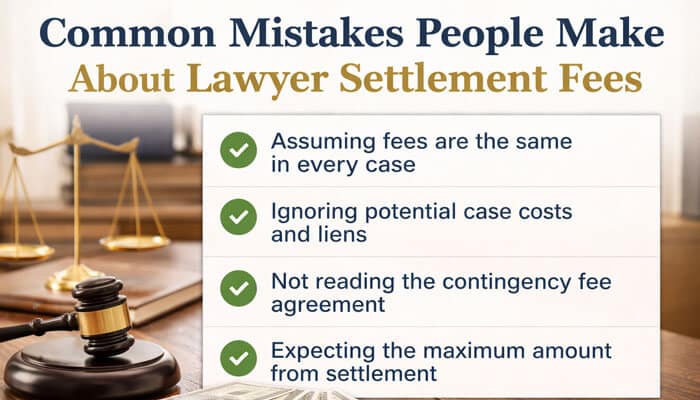
People often misunderstand the answer to what percentage does a lawyer take from a settlement because they focus only on the fee and ignore everything else.
Common mistakes include:
- Looking only at the percentage and ignoring case costs
- Not checking whether costs come out before or after the fee
- Forgetting that medical liens can reduce the final payout
- Assuming “no win, no fee” always means zero financial exposure
- Signing the agreement without asking for a sample payout breakdown
- Failing to compare fee structure with the lawyer’s actual experience and communication style
These mistakes can lead to disappointment and confusion later in the process. A settlement may look strong on paper, but without understanding deductions, the client may have unrealistic expectations.
That is why a high-quality article about what percentage does a lawyer take from a settlement should focus on the client’s net outcome, not just the lawyer’s advertised percentage.
Final Answer: What Percentage Does a Lawyer Take From a Settlement?
In most personal injury and similar contingency-fee cases, a lawyer usually takes 33% to 40% of the settlement.
One-third is the most common benchmark, but the actual percentage can vary depending on the stage of the case, the type of claim, the lawyer’s agreement, state rules, costs, and any medical or insurance liens attached to the recovery.
Final Key Takeaways
- 33% to 40% is the most common range
- One-third is a common starting point for early settlements
- Fees can increase if the case goes to trial or appeal
- Costs and liens can reduce what the client actually keeps
- The written agreement matters just as much as the percentage
- Net payout is more important than headline settlement value
A lawyer may take around one-third of your settlement, but your real take-home amount depends on the full deduction structure, not just the fee percentage.
This is the clearest way to explain what percentage does a lawyer take from a settlement without oversimplifying the issue. The legal fee matters, but the final amount you keep matters even more.
Conclusion
Understanding what percentage does a lawyer take from a settlement is essential before hiring an attorney or agreeing to resolve a claim. While the standard contingency fee is often around 33% to 40%, that number alone does not tell you how much money you will actually receive.
Costs, expert fees, lien claims, and reimbursement rights can all reduce the final payout, and the fee agreement should clearly explain how those deductions are handled. The smartest way to evaluate a lawyer is not just to ask for the percentage, but to ask for a clear explanation of the full payout math.
If you want the best outcome, do not only ask what percentage does a lawyer take from a settlement. Also ask how much of the settlement you are likely to keep after every deduction is made. That is the information that truly determines the value of your case.
What Percentage Does a Lawyer Take From a Settlement? FAQs
1. What percentage does a lawyer take from a settlement in personal injury cases?
In personal injury cases, lawyers typically take 33% to 40% of the settlement amount. The percentage often depends on when the case is settled — 33% for early settlements and 40% for more complex cases that go to trial.
2. Why do lawyer fees change depending on the case stage?
The percentage a lawyer takes from a settlement can increase as the case becomes more complex. If the case moves from settlement negotiations to litigation or trial, the lawyer may charge a higher fee (up to 40% or more) to cover the additional time, work, and resources involved.
3. How are lawyer fees calculated from a settlement amount?
Lawyer fees are typically calculated as a percentage of the settlement amount, which usually falls between 33% and 40%. The fee percentage may be higher if the case goes to trial or involves additional complexities, such as expert witnesses or disputed liability.
4. Can I negotiate a lower percentage with my lawyer?
Yes, you can negotiate the percentage a lawyer takes from your settlement, especially if your case involves a large potential settlement or if the lawyer has a flexible fee structure. However, more complex or high-risk cases may justify a higher fee percentage.
5. What expenses can be deducted from my settlement before the lawyer’s fee?
Before the lawyer’s contingency fee is applied, various expenses may be deducted from the settlement, such as court filing fees, expert witness costs, and medical liens. These expenses can affect the final payout, even though they are separate from the lawyer’s fee.
Disclaimer: This article is for general informational purposes only and is not legal advice. Attorney fee rules vary by state, case type, and the facts of each case. For legal advice about your own matter, speak with a qualified attorney in your jurisdiction.