


In legal terminology, Latin phrases continue to play a significant role, and one of the most important among them is “in absentia.” Understanding the absentia meaning in law is essential for students, legal professionals, and anyone interested in court procedures and criminal justice systems.
The term is commonly used in legal documents, court judgments, and international cases, particularly when a person is not physically present during legal proceedings. In modern legal systems, this concept plays a crucial role in ensuring that justice is not delayed simply because a party fails to appear.
This article provides a complete and easy-to-understand explanation of the meaning in law, including its meaning, legal conditions, rights of the accused, types, real-world examples, and its importance across different legal systems.
What Is Absentia in Law?
The term absentia originates from Latin and means “in the absence.” In legal contexts, it refers to situations where a person is not physically present during court proceedings, yet the legal process continues.
Absentia is most commonly used in criminal law, but it can also apply to judgments, pleas, and investigations. The main goal is to prevent delays in justice while ensuring that legal procedures remain fair and lawful.
Key Situations Where Absentia Applies
- The accused does not appear in court
- A court issues a decision without attendance
- Legal proceedings continue despite the absence
Key Features of Absentia Meaning in Law
- Latin legal term used widely in legal systems
- Applies to trials, hearings, and judicial decisions
- Involves the absence of a party (usually the accused)
- Requires strict legal safeguards
- Balances efficiency of justice with fairness
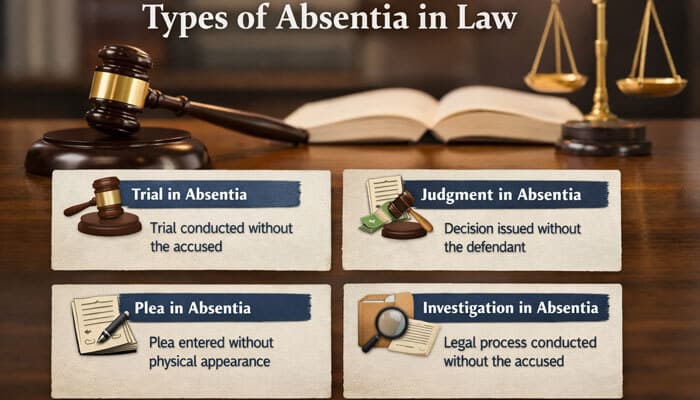
Types of Absentia in Law
Absentia is not limited to just trials. It can appear in multiple legal contexts:
- Trial in absentia—Trial conducted without the accused
- Judgment in absentia—Decision issued without the presence of the defendant
- Plea in absentia—Plea entered without physical appearance
- Investigation in absentia – Legal process conducted without the accused
This broader classification shows that absentia is a wider procedural concept, not just a courtroom scenario.
Trial in Absentia Explained
A trial in absentia occurs when a court conducts proceedings without the accused being physically present.
Common Reasons
- The accused is absconding
- The person refuses to attend court
- The accused is outside the jurisdiction
- Proper notice was given, but ignored
Courts use this mechanism to ensure cases are not delayed unnecessarily.
Legal Conditions for Trial in Absentia
Courts must follow strict conditions before proceeding:
- Proper notification must be given to the accused
- Absence must be voluntary or intentional
- The accused may have legal representation
- Courts must ensure fair trial rights
Why These Conditions Matter
| Condition | Purpose |
| Notification | Ensures awareness of proceedings |
| Voluntary absence | Prevents unfair trials |
| Legal representation | Protects defense rights |
| Fair trial safeguards | Maintains justice |
Legal Principles Behind Absentia
Even though absentia proceedings exist, they are carefully regulated because:
- The accused has a right to be present at trial
- Courts must ensure fair trial and due process
- Legal systems must balance justice vs absence
In many jurisdictions, trials in absentia are allowed only when the absence is intentional or voluntary.
Rights of the Accused in Absentia Cases ️
Even if the accused is absent, important legal rights still apply:
- Right to be present
- Right to defend oneself
- Right to legal representation
- Principle of “audi alteram partem” (hear the other side)
This principle is a core part of natural justice and ensures that no one is condemned without being heard.
Right to Retrial or Appeal
A key protection in absentia cases is the ability to challenge the decision:
- The accused may request a retrial after appearing in court
- Courts may allow an appeal against a judgment in absentia
- Some legal systems require retrial to protect fairness
This ensures that justice is not permanently denied due to absence.
Legal Rationale: Why Absentia Exists
Absentia proceedings exist for practical and legal reasons:
- Prevent accused persons from escaping justice
- Avoid delays caused by non-appearance
- Ensure continuity of legal proceedings
- Balance judicial efficiency with individual rights
Without such provisions, individuals could misuse the system simply by avoiding court appearances.
Absentia in Different Legal Systems
| Legal System | Approach |
| Common Law (USA, UK) | Strict, limited use |
| Civil Law (Europe) | More flexible |
| International Law | Used in serious crimes, often allows retrial |
Examples of Absentia in Law
- A criminal suspect flees the country, and the court conducts a trial in absentia
- A defendant skips hearings, leading to a judgment in absentia
- A person is sentenced without being physically present
Example sentence:
“The accused was convicted in absentia after failing to appear in court.”
Advantages and Disadvantages of Absentia Proceedings
| Advantages | Disadvantages |
| Prevents delay in justice | Risk of wrong conviction |
| Allows courts to proceed despite the absence | Lack of defense opportunity |
| Useful in handling fugitives | Potential human rights concerns |
| Ensures continuity of legal process | May conflict with principles of natural justice |
Statutory and Legal References
Absentia is supported and regulated by legal frameworks:
- USA: Federal Rules of Criminal Procedure (Rule 43)
- India: Bharatiya Nagarik Suraksha Sanhita (BNSS) 2023
- Europe: Article 6 – Right to Fair Trial
These references strengthen the legal authority and credibility of absentia proceedings.
Is Trial in Absentia Fair or Unfair?
This is a debated issue:
- Fair when absence is voluntary, and rights are protected
- Unfair when the accused is unaware or unable to defend
Courts must ensure a careful balance between efficiency and justice.
Related Legal Terms
| Term | Meaning |
| Trial in absentia | Trial conducted without the accused |
| Default judgment | Decision due to absence |
| Ex parte | Legal action involving one party |
| Plea in absentia | Plea entered without presence |
Why Absentia meaning in law Important

Understanding the absentia meaning in law is important because it:
- Explains how courts handle missing defendants
- Highlights the balance between justice and rights
- Prevents misuse of legal processes
- Appears frequently in legal exams and real cases
Conclusion
The absentia meaning in law refers to legal proceedings conducted without the presence of a person, most commonly the accused, under clearly defined legal conditions. This concept plays a crucial role in ensuring that justice is not delayed simply because an individual chooses not to appear in court.
At the same time, understanding the absentia meaning in law also highlights the importance of balancing judicial efficiency with fundamental rights such as fair trial, legal representation, and the opportunity to be heard. Modern legal systems address these concerns by imposing strict safeguards, allowing retrials, and ensuring due process is maintained.
As a result, absentia remains a vital yet carefully regulated legal mechanism that reflects both the effectiveness and fairness of contemporary justice systems.
Absentia Meaning in Law FAQs
1. What does absentia meaning in law?
Absentia in law refers to legal proceedings conducted in the absence of a person, typically the accused in criminal cases. The legal process continues despite their absence, provided that certain conditions are met, such as proper notification and intentional absence.
2. What is a trial in absentia?
A trial in absentia occurs when a court conducts a trial without the accused being physically present. This typically happens if the accused avoids or refuses to attend court. The court ensures that the trial remains fair and lawful, with legal safeguards in place.
3. Is trial in absentia legal?
Yes, trial in absentia is legal in many countries, but it is subject to strict conditions. The accused must be properly informed of the proceedings, and their right to a fair trial must be safeguarded to ensure justice.
4. Can a person appeal a judgment in absentia?
Yes, most legal systems allow the accused to appeal or request a retrial in absentia cases. After the accused appears in court, they may challenge the judgment, ensuring fairness and the protection of their legal rights.
5. Why is Absentia Meaning in Law important?
The absentia concept is important in law because it prevents unnecessary delays in justice. It ensures that legal proceedings continue even when an individual deliberately avoids court, while still balancing the need for fairness and the right to a fair trial.
Disclaimer: The information in this article is for general purposes only and should not be considered legal advice. Laws vary by jurisdiction and may change over time. For specific legal concerns, please consult a qualified attorney.
