


If you’re researching a food poisoning lawsuit, you’re probably asking a practical question:
- Can you sue for food poisoning?
- How much can you get from a food poisoning lawsuit?
- How do you win a food poisoning lawsuit?
- Do I actually need a lawyer?
This guide explains how food poisoning claims work in the United States, what affects settlement amounts, and when hiring a lawyer makes sense — without hype or unrealistic promises.
Can You Sue for Food Poisoning in the United States?
Yes — you can file a lawsuit for food poisoning in the U.S. under certain conditions.
Most food poisoning lawsuits are based on one of these legal theories:
- Negligence (improper food handling or storage)
- Strict product liability (defective or contaminated food product)
- Breach of warranty (unsafe food sold to consumers)
These cases are usually filed against:
- Restaurants
- Grocery stores
- Caterers
- Food manufacturers
- Distributors
But here’s the key:
Getting sick alone is not enough.
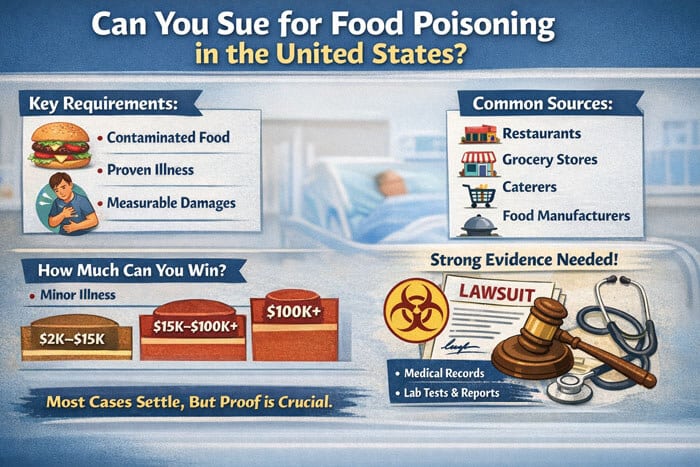
You must show that:
1. The food was contaminated
2. The contamination caused your illness
3. You suffered measurable damages (medical bills, lost income, etc.)
Without proof, the case is very difficult to win.
What Counts as “Food Poisoning” Legally?
Food poisoning lawsuits often involve bacteria such as:
- Salmonella
- E. coli
- Listeria
- Norovirus
Severe cases may involve hospitalization, kidney complications, or long-term health damage.
Mild stomach upset lasting 24 hours typically does not result in a strong lawsuit.
Food Poisoning Lawsuit Settlement Amounts
One of the most searched questions is:
“How much can you get from a food poisoning lawsuit?”
There is no fixed amount, but here are realistic ranges in the U.S.:
| Severity of Illness | Typical Settlement Range |
| Mild illness, no hospitalization | $2,000 – $15,000 |
| Hospitalization required | $15,000 – $100,000+ |
| Long-term complications | $100,000 – several hundred thousand |
| Death (wrongful death claim) | Highly case-specific |
What Affects Food Poisoning Lawsuit Settlement Amounts?
Settlement amounts depend on:
- Medical expenses
- Lost wages
- Length of recovery
- Permanent injury
- Strength of lab confirmation
- Whether multiple victims are involved
- State laws on damages
Large “million-dollar” payouts are rare and usually involve catastrophic injury or widespread outbreaks.
How Do You Win a Food Poisoning Lawsuit?
To win a food poisoning lawsuit, you must prove causation.
That is the hardest part.
Strong evidence usually includes:
- Medical records confirming bacterial infection
- Lab testing of stool samples
- Health department investigation
- Other confirmed cases linked to the same source
- Proof you consumed the specific food
Weak cases often involve:
- No doctor visit
- No lab confirmation
- Multiple possible food sources
- Long delay before seeking treatment
Courts require more than suspicion.
Can You Sue a Restaurant for Food Poisoning?
Yes. restaurants are common defendants in food poisoning lawsuits.
Restaurants can be liable for:
- Undercooked meat
- Improper refrigeration
- Cross-contamination
- Unsanitary food handling
- Employees working while sick
However, proving the illness came from that specific restaurant can be difficult unless:
- Multiple people got sick
- A health department investigation confirms contamination
How Much Can You Win From a Food Poisoning Lawsuit?
This depends heavily on medical impact.
Courts look at:
- Economic damages (medical bills, lost wages)
- Non-economic damages (pain and suffering)
- In rare cases, punitive damages (gross misconduct)
Most individual food poisoning lawsuits settle before trial.
Trial verdicts are less common and unpredictable.
State Law Matters More Than Most People Realize
Food poisoning lawsuits are governed primarily by state law, not federal law.
Each state has different rules on:
- Statute of limitations (often 1–3 years)
- Damage caps
- Comparative negligence rules
- Evidence standards
For example:
In some states, you may have only 1 year to file.
- In others, you may have up to 3 years.
- Some states cap non-economic damages.
- Others do not.
This is why jurisdiction awareness is critical.
If you wait too long, your claim may be permanently barred.
Do You Need a Lawyer for a Food Poisoning Lawsuit?
This depends on the severity of your case.
You might handle it yourself if:
- Medical bills are small
- The illness was short-term
- A business is willing to negotiate informally
You usually need a lawyer if:
- Hospitalization occurred
- Long-term injury developed
- A child or elderly person was harmed
- The business denies responsibility
- Multiple victims are involved
Most food poisoning attorneys work on contingency (they take a percentage of recovery).
Typical contingency fees range from 30%–40%.
If your damages are small, hiring a lawyer may not make financial sense.
Common Misconceptions About Food Poisoning Lawsuits
Myth: If I got sick, I automatically win.
Fact: Not true. Proof of source and causation is required.
Myth: Every case is worth six figures.
Fact: Severe cases can be. Most are not.
Myth: A bad Yelp review is evidence.
Fact: It isn’t legal proof.
Myth: I can wait a few years.
Fact: Statutes of limitation can expire quickly.
What to Do If You Think You Have a Case
If you suspect food poisoning:
1. Seek medical treatment immediately
2. Ask for lab testing
3. Save receipts and food packaging
4. Report to your local health department
5. Document symptoms and missed work
Early documentation significantly strengthens potential claims.
How the Legal Process Usually Works
A typical food poisoning lawsuit follows this pattern:
1. Medical diagnosis
2. Evidence collection
3. Claim filed
4. Insurance investigation
5. Settlement negotiations
6. Lawsuit filed (if no settlement)
7. Discovery process
8. Possible trial
Most cases resolve in settlement.
Litigation can take 1–3 years if it proceeds to court.
When a Food Poisoning Lawsuit May Not Be Worth It
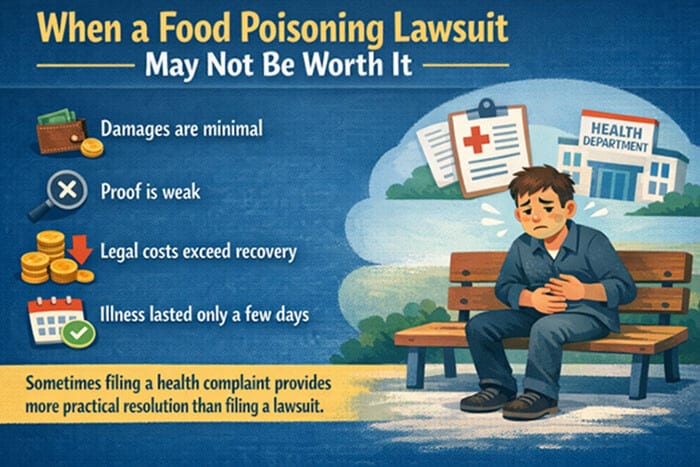
You may decide not to pursue legal action if:
- Damages are minimal
- Proof is weak
- Legal costs exceed recovery
- Illness lasted only a few days
Sometimes filing a health complaint provides more practical resolution than filing a lawsuit.
Quick Summary
- Yes, you can sue for food poisoning in the U.S.
- Strong proof is required.
- Settlement amounts vary widely.
- Most cases settle before trial.
- State law affects deadlines and damage limits.
- Severe cases usually require a lawyer.
- Minor cases may not justify legal action.
Final Thoughts
A food poisoning lawsuit is possible — but only when you can clearly prove the source, the contamination, and your damages.
The biggest mistake people make is assuming illness alone guarantees compensation.
If your injuries were serious, speaking with a local attorney familiar with your state’s product liability laws may help you understand your options.
If your case was mild, careful documentation and direct communication with the business may be enough.
Disclaimer: This article provides general legal information about food poisoning lawsuits in the United States. It is not legal advice. Laws vary by state.
FAQs: Food Poisoning Lawsuit
1. Can you sue for food poisoning without going to the doctor?
Technically yes, but it is extremely difficult to win. Courts require medical evidence. Without documentation, proving your case is challenging.
2. How much can you win from a food poisoning lawsuit?
It depends on severity. Mild cases may settle for a few thousand dollars. Severe cases with long-term injury can reach six figures. Most cases fall somewhere in between.
3. Can you file a lawsuit for food poisoning against a grocery store?
Yes. Grocery stores can be liable if contaminated food was sold. These cases often involve product liability laws.
4. How long does a food poisoning lawsuit take?
If settled early, several months.
If litigated, often 1–3 years.
5. What if multiple people got sick?
Cases involving multiple victims are often stronger because they help prove contamination. These may become group or consolidated lawsuits.
6. Do restaurants usually settle food poisoning claims?
Many do, especially when evidence is strong. Businesses often prefer settlement over public litigation.