



If you have ever asked what is a surety bond jail, you are not alone. Every year, thousands of families face this exact question after a loved one is arrested. A surety bond jail is a legal arrangement that allows a defendant to secure their release from custody while awaiting trial, without paying the full bail amount set by the judge. Instead of paying, say, $20,000 upfront, the defendant pays just 10% to a licensed bail bondsman, who then guarantees the full amount to the court.
Understanding what is a surety bond jail can make a frightening situation feel far more manageable. Three parties are always involved: The defendant, a bail bondsman (the surety), and the court. The bondsman assumes the financial risk and ensures the defendant returns for all scheduled court dates. If the defendant skips bail, the bondsman must pay the full amount and has legal tools to recover it.
This complete guide walks you through every aspect of the surety bond jail system: how it works, what it costs, who is involved, what happens if someone skips bail, and when the agreement ends.
What Is a Surety Bond Jail?
So, what is a surety bond jail in plain language? Think of it like a co-signer on a loan. When someone is arrested, a judge sets a bail amount, a sum of money the defendant must pay as a guarantee they will return for trial. Most people cannot afford to pay $10,000, $50,000, or $100,000 out of pocket. A surety bond jail arrangement solves this problem.
In a surety bond jail system, a licensed bail bondsman steps in as the financial guarantor. The bondsman pays the full bail to the court and charges the defendant a non-refundable fee, typically 10% of the total bail. The defendant walks out of jail, often within hours, while their case is still ongoing. That entire arrangement, the agreement, the bondsman’s guarantee, and the defendant’s release, is exactly what is a surety bond jail.
Here is a real-world example: Your friend is arrested, and the judge sets bail at $20,000. Your friend contacts a bail bondsman. The bondsman charges $2,000 (10%) and posts the full $20,000 with the court. Your friend is released the same day. That is the surety bond jail process in action.
| Key Fact | Detail |
| Typical bondsman fee | 10% of total bail (non-refundable) |
| Parties in every surety bond | 3 – defendant, bondsman, court |
| Typical release time after bond posted | 1 to 6 hours |
| Is the fee refundable? | No, under any circumstances |
The Difference Between Bail and Bond
Many people use the terms bail and bond interchangeably, but they mean different things in the legal system. Understanding this distinction is key to understanding the surety bond jail system.
Bail is the amount of money a judge orders the defendant to pay as a financial guarantee of their return to court. The court sets this number based on the specifics of the case.
A bond is the mechanism through which that bail is paid. When a bondsman provides a surety bond, they are substituting their financial guarantee for the full cash amount.
In plain terms: bail is what you owe the court; a bond is how you pay it without having all the cash upfront.
How Does a Surety Bond Jail Actually Work?
To fully understand what is a surety bond jail, you need to understand the role of bail itself. When someone is arrested, they appear before a judge within 24 to 72 hours. The judge decides whether the defendant can be released while awaiting trial, and if so, sets a bail amount. This amount acts as a financial guarantee; if you pay it, the court trusts you will come back.
The challenge is that bail amounts are often set very high. This is precisely where the surety bond jail system was designed to help. Rather than requiring the full amount, a licensed bondsman pays it on behalf of the defendant. The defendant pays the bondsman a 10% premium, and in return, the bondsman guarantees the court that the defendant will appear at every hearing.
When people ask what is a surety bond jail and how the money flows, here is the answer: If the defendant appears at all court dates and the case concludes, the bondsman gets their full bail money back from the court. The bondsman’s profit is the 10% premium they collected at the start. If the defendant skips bail, the bondsman loses the full amount, which is why they take the role very seriously.
Another way to think about what is a surety bond jail: It is a trust-based financial contract. The court trusts the bondsman. The bondsman trusts the defendant. And the defendant’s freedom depends on keeping that trust intact.
A surety bond jail is not just about money – it is about trust. The bondsman trusts the defendant to show up. The court trusts the bondsman to make sure they do.
The 3 Parties in Every Surety Bond Jail Agreement
Every surety bond jail agreement involves exactly three parties. If even one is missing, the bond cannot exist. Here is who they are and what role each one plays:
| Party | Who They Are | Their Role | What They Risk |
| Principal (Defendant) | The person arrested and held in jail | Pays 10% fee; must appear in court on all dates | Losing collateral; returning to jail |
| Surety (Bail Bondsman) | A licensed bail agent or bond company | Pays full bail to the court; guarantees appearance | Losing the full bail amount if the defendant flees |
| Obligee (Court / Judge) | The court that set the bail amount | Sets bail; holds the bond; releases it when the case ends | Nothing financially protected either way |
The word ‘surety’ means a person or entity that takes on responsibility for someone else’s obligation. In a surety bond jail situation, the bondsman is the surety, the one whose own money is on the line to guarantee the defendant follows through on their promise to the court.
Step-by-Step: How the Surety Bond Jail Process Works
Now that you know what is a surety bond jail at a conceptual level, here is the complete step-by-step process from arrest to release. This walkthrough will give you a clear picture of how a surety bond jail works in practice.
- Arrest: The defendant is taken to a local jail, booked, photographed, and fingerprinted.
- Bail Hearing: Within 24 to 72 hours, a judge sets a bail amount based on the crime, flight risk, criminal history, and community ties.
- Contact a Bail Bondsman: The defendant or their family calls a licensed bail bondsman. Many are available 24/7 since arrests happen at all hours.
- Pay the 10% Premium and Provide Collateral: The bondsman reviews the charges, the defendant’s background, and their likelihood of appearing in court before agreeing to take the case. They can and do refuse.
- Bondsman Posts the Surety Bond: The bondsman officially posts the surety bond with the court, guaranteeing the full bail amount. Much of this paperwork can now be completed electronically.
- Defendant Is Released: Once the bond is posted, jail staff process the release. This typically takes 1 to 6 hours.
- Defendant Must Follow All Court Conditions: The defendant must attend every court date, respect travel restrictions, and comply with any other court-imposed requirements.
- Bond Is Discharged: When the case concludes through a verdict, plea deal, or dismissal, the surety bond jail agreement ends. The court releases the bail to the bondsman, and all collateral is returned.
This eight-step sequence represents exactly how a surety bond jail works from start to finish. Understanding each step helps you move quickly and confidently if you ever need to use this system.
What Does a Bondsman Actually Evaluate Before Agreeing to Help?
Many people assume a bail bondsman will automatically take any case. That is not true. A bondsman is putting their own money at risk, so they carefully assess each situation before agreeing. Understanding this helps you know what to expect on that first call.
A bondsman typically considers the following before accepting a case:
- The severity of the charges and the likelihood of conviction
- The defendant’s employment history and community ties
- Whether the defendant has a prior history of missing court dates
- The defendant’s criminal record and any prior bond forfeitures
- Whether the co-signer has sufficient financial standing or collateral
- The size of the bail relative to their current bond portfolio risk
If a bondsman believes the defendant is a serious flight risk, they may decline the case, require additional collateral, or charge a higher premium (up to 15% in some states). Shopping around to multiple bondsmen is perfectly acceptable.
What Monitoring and Check-In Requirements Can a Bondsman Impose?
Once your loved one is released, the bond agreement does not simply sit on a shelf. Because the bondsman is financially liable for the full bail amount until the case closes, they have the right and often the obligation to monitor the defendant’s compliance.
Common monitoring requirements during the bond period include:
- Regular phone or in-person check-ins with the bondsman’s office (weekly or monthly)
- GPS ankle monitoring in high-risk or high-bail cases
- Travel restrictions – the defendant may be required to stay within the state or county
- Drug or alcohol testing if relevant to the charges
- Employment verification to confirm community stability
- Notification requirements if the defendant changes their address or phone number
These are not optional suggestions. Violating monitoring requirements gives the bondsman grounds to revoke the bond even before a court date is missed.
The Indemnity Agreement: What Co-Signers Actually Sign

One of the most overlooked and consequential parts of the surety bond process is the indemnity agreement. Many co-signers sign this document without fully understanding what they are agreeing to. That can be a devastating mistake.
An indemnity agreement is a legal contract between the co-signer and the bail bondsman. By signing it, the co-signer agrees to be personally responsible for the full bail amount if the defendant fails to appear in court.
What the Indemnity Agreement Typically Covers:
- The co-signer’s full financial liability for the bond amount
- Authorization for the bondsman to seize any pledged collateral
- The co-signer’s right to contact the bondsman with concerns about the defendant
- The co-signer’s right to withdraw from the bond by surrendering the defendant
- Conditions under which the bondsman can revoke the bond
Always read the indemnity agreement carefully and, if possible, have an attorney review it before signing. The financial liability is real and enforceable.
Co-Signer Rights: Can You Cancel a Bail Bond?
Yes. A co-signer has the legal right to withdraw from a surety bond agreement at any time. This is called surrendering the defendant, and it ends the co-signer’s liability going forward
but it has serious consequences for the defendant.
When a co-signer surrenders a defendant, the bondsman brings the defendant back to jail. The co-signer’s liability for the bond then ends. However, the defendant loses their freedom and must remain in custody for the rest of their case, or until new bail arrangements are made, often by a different co-signer.
When Co-Signers Typically Exercise This Right:
- The defendant is missing court dates or threatening to flee
- The defendant is violating the conditions of their release
- The defendant is engaging in new criminal activity
- The co-signer’s financial situation changes and they can no longer bear the risk
IMPORTANT: A co-signer who surrenders a defendant may still be responsible for fees already paid to the bondsman. The 10% premium is never refunded.
How Much Does a Surety Bond Jail Cost?
One of the first questions people have when learning what is a surety bond jail is how much it will cost. The answer depends on the total bail amount set by the judge. Here is a clear breakdown:
| Total Bail Set by Judge | Premium at 10% | Premium at 15% (some states) | Refundable? |
| $5,000 | $500 | $750 | No |
| $10,000 | $1,000 | $1,500 | No |
| $25,000 | $2,500 | $3,750 | No |
| $50,000 | $5,000 | $7,500 | No |
| $100,000 | $10,000 | $15,000 | No |
The 10% premium is non-refundable under any circumstances. Even if all charges are dropped the next morning, that money is gone. It is the bondsman’s fee for the financial risk they accepted.
Many bondsmen offer payment plans for families who cannot afford the full premium upfront. Always ask about this option it is more common than most people realize.
How to Get Bail Reduced: Lowering the Cost
If the bail amount set by the judge seems disproportionately high, defendants and their attorneys can file a motion to reduce bail. A lower bail amount directly reduces how much the family must pay the bondsman for a surety bond jail arrangement, making this a critical step that many families overlook.
Common Arguments Used to Reduce Bail:
- The defendant has strong ties to the community, family, employment, and long-term residence
- The defendant has no prior criminal history or past failure-to-appear incidents
- The current bail amount creates an undue financial hardship relative to the charge
- The defendant is not a flight risk based on passport status or other factors
- The charge does not warrant such a high bail amount compared to similar cases
A bail reduction hearing typically takes place within a few days of the original bail hearing. If successful, even a modest reduction, say from $50,000 to $30,000, can cut the bondsman’s premium from $5,000 to $3,000, saving the family $2,000 immediately.
Types of Bonds: How Surety Bond Jail Compares to Other Options
When researching what is a surety bond jail, it helps to understand how it compares to other types of bonds. A surety bond is the most commonly used because most defendants simply cannot afford to pay full bail in cash.
| Bond Type | How It Works | Cost | Best For |
| Surety Bond Jail (Most Common) | Bondsman pays full bail; defendant pays 10% fee | 10% of bail (non-refundable) | People who cannot pay the full bail in cash |
| Cash Bond | Defendant or family pays full bail in cash to the court | 100% of bail (refundable if defendant appears) | Those with sufficient cash who want a full refund |
| Property Bond | Real estate used as collateral for bail | No upfront cash; property at risk | Property owners who lack liquid cash |
| Personal Recognizance (PR) | Released on a signed promise; no money posted | Free | Low-risk defendants with no criminal history |
The surety bond jail option stands apart because it makes release affordable and realistic. A cash bond requires 100% upfront, which most families cannot access quickly. A property bond takes time to process. Personal recognizance is rarely granted except in low-risk cases. That is why the surety bond jail system remains the go-to solution for ordinary families across the United States.
What Is Collateral in a Surety Bond Jail Agreement?
When bail amounts are very high, understanding what is a surety bond jail also means understanding collateral. In addition to the 10% premium, a bondsman may require collateral, something of value that can be seized if the defendant fails to appear in court.
Collateral protects the bondsman in a surety bond jail agreement. If the defendant skips bail and the bondsman loses the full amount to the court, they can use the collateral to recover their losses. Common types include:
- Real estate (home or land): A lien is placed on the property until the case ends.
- Vehicles: Cars, trucks, motorcycles, or boats.
- Jewelry and valuables: Gold, diamonds, or expensive watches.
- Bank accounts or savings: Cash held in trust as security.
- Investment accounts: Stocks, bonds, or retirement accounts (varies by state).
The good news: If the defendant complies with all court conditions and attends every hearing, all collateral is returned in full when the case closes. The bondsman retains only the original 10% fee.
What Happens If Someone Skips Bail?
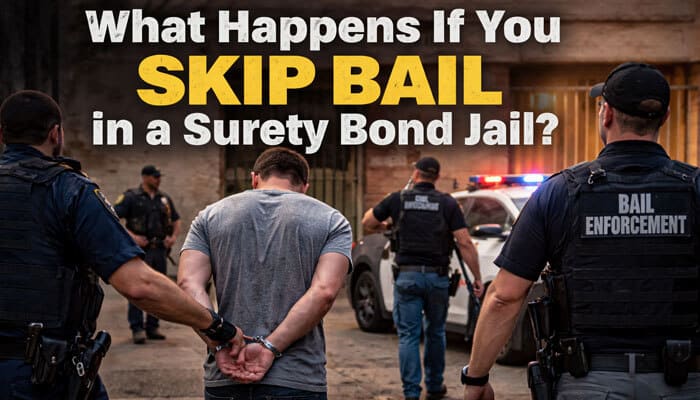
This is the most critical section for anyone learning what is a surety bond jail, because what happens when someone skips bail is fast, serious, and devastating for everyone involved. Skipping bail, also called jumping bail or failure to appear, triggers an immediate chain of consequences in any surety bond jail arrangement.
1. The judge issues an arrest warrant: Law enforcement can arrest the defendant anywhere, at any time, without a separate hearing.
2. The bail bond is forfeited: The court declares the bond forfeited, meaning the bondsman is now liable for the full bail amount.
3. The bondsman hires a bounty hunter: The bondsman has a legal right to hire a bail enforcement agent to track down and return the defendant before the forfeiture is finalized.
4. Collateral is seized: If the defendant cannot be recovered in time, the bondsman seizes and sells any collateral to cover their losses.
5. Co-signers face financial consequences: Anyone who co-signed the surety bond jail agreement can be sued, have wages garnished, and face property liens.
6. Additional criminal charges follow: Skipping bail is itself a crime, adding new charges on top of the original ones.
7. Future bail becomes nearly impossible: Courts treat prior bail-jumpers as extreme flight risks, making future release very unlikely.
This is why anyone considering a surety bond jail arrangement must think very carefully before co-signing for someone else.
Bond Revocation: When the Bondsman Cancels the Bond
Most people focus on what happens when a defendant skips bail. Fewer people know that a bondsman can proactively revoke a bond even before any court date is missed if they believe the defendant is becoming a flight risk.
A bondsman may revoke the bond if the defendant:
- Fails to comply with required check-ins or monitoring conditions
- Is arrested on new criminal charges
- Violates travel restrictions or leaves the jurisdiction without permission
- Threatens to flee or is observed taking steps to disappear (e.g., withdrawing large amounts of cash, abandoning their residence)
- Engages in behavior that the bondsman believes increases their financial risk
When a bondsman revokes a bond, they surrender the defendant back to the court. The defendant returns to custody, and the co-signer’s liability for future forfeiture ends. However, the 10% premium is never refunded.
Pros and Cons of a Surety Bond Jail
Like any major legal and financial decision, choosing a surety bond involves clear trade-offs. Here is an honest summary:
Pros of a Surety Bond Jail
- Affordable release: You pay only 10% of the total bail, making freedom possible for families without large cash reserves.
- Fast process: With modern technology, arrangements can be made by phone or online, with release typically within 1 to 6 hours.
- Defendant maintains normal life: The defendant can keep their job, care for their family, and prepare their defense from home.
- Payment plans available: Many bondsmen offer flexible payment options, making even the 10% fee manageable in cases of financial hardship.
- Collateral returned: As long as the defendant complies with all conditions, all collateral is returned in full when the case ends.
Cons of a Surety Bond Jail
- Non-refundable fee: The 10% premium is never returned, even if the case is dismissed or the defendant is found innocent.
- Risk to co-signers: Anyone who co-signs takes on serious financial liability if the defendant does not appear.
- Collateral at risk: If the defendant skips bail, property or savings can be seized and sold.
- Ongoing oversight: The bondsman has the right to monitor the defendant and can revoke the bond if they believe flight is likely.
- Not available everywhere: States such as Illinois, Kentucky, Oregon, and Wisconsin have abolished commercial bail bonds.
Weighing these factors carefully is essential before entering into any surety bond jail agreement.
State-by-State Variations: Where Surety Bonds Are Not Available
Commercial surety bond jail arrangements are legal in most U.S. states, but a significant number have either banned or heavily restricted the practice. Knowing your state’s rules is essential before pursuing this path.
| State | Commercial Bail Bond Status | Alternative System |
| Illinois | Banned since 1963 | Defendants post 10% directly with the court refundable |
| Kentucky | Banned since 1976 | Courts use non-commercial supervised release programs |
| Oregon | Banned since 1974 | Pretrial services and personal recognizance dominate |
| Wisconsin | Banned since 1979 | Cash bail paid directly to the court is the norm |
| New Jersey | Heavily reformed (2017) | Pretrial risk assessment system replaced most cash bail |
| All other states | Commercial bonds permitted | Standard 10% surety bond system applies |
In states where commercial bail bonds are banned, defendants can often deposit a percentage of bail directly with the court, and unlike a bondsman’s fee, this amount is refundable if the defendant makes all court appearances. Always consult a local attorney to understand the exact rules in your jurisdiction.
When Does a Surety Bond Jail Agreement End?
A common question from people learning what is a surety bond jail is: Does the bond last forever? No, a surety bond jail agreement has a clear endpoint, tied directly to the resolution of the criminal case. The agreement is officially discharged in one of the following situations:
- The case goes to trial and concludes with a verdict, guilty or not guilty.
- The defendant accepts a plea deal, and the judge accepts it.
- The charges are dismissed by the prosecutor or the court.
- The bondsman surrenders the defendant back to custody, ending their bond obligation.
Once the surety bond jail agreement ends, the court releases the full bail amount back to the bondsman and all collateral is returned to the co-signer or defendant. The bondsman’s profit is the 10% non-refundable premium collected at the start of the arrangement.
How Does a Judge Set Bail in a Surety Bond Jail Case?
Before a surety bond jail can even come into play, a judge must set a bail amount. Understanding what judges consider explains why some bail amounts are dramatically higher than others and why some defendants are denied bail entirely.
| Factor | How It Affects Bail |
| Severity of the crime | Violent or serious offenses lead to much higher bail amounts |
| Criminal history | Prior convictions or previous bail violations increase bail significantly |
| Flight risk | No local ties, no employment, or prior history of fleeing results in higher bail |
| Community ties | Strong family connections and stable employment often lower bail |
| Financial resources | Wealthy defendants may face higher bail to ensure it serves as a real deterrent |
| Public safety risk | If the judge considers the defendant dangerous, bail may be denied entirely |
Who Needs to Know What Is a Surety Bond Jail?
Anyone who has a family member or friend arrested should understand what is a surety bond jail. You do not need to be a legal expert to navigate this system, but you do need to understand the basics before signing anything.
Knowing what is a surety bond jail is especially important for:
- Family members of someone who has just been arrested and is waiting for a bail hearing.
- Anyone is asked to co-sign a bail bond on behalf of a friend or relative.
- Defendants who want to understand their rights and financial obligations before agreeing to a bond.
- Anyone trying to understand whether a surety bond, cash bond, or property bond is the best option for their situation.
Final Thoughts
What is a surety bond jail? It is an essential tool in the U.S. criminal justice system that helps defendants who cannot afford full bail secure their release. By paying a 10% fee to a bail bondsman, the defendant can avoid staying in jail while awaiting trial, offering both the courts and families a practical solution without draining resources.
Now that you understand what is a surety bond jail, you can navigate this complex process with confidence. Whether you’re the defendant, a concerned family member, or a co-signer, knowing the ins and outs of surety bonds ensures you make informed decisions and seek expert legal advice before taking action.
What is a Surety Bond Jail FAQs
1. What is a Surety Bond Jail and How Does It Work?
A surety bond jail allows a defendant to pay 10% of the bail amount to a bail bondsman, who guarantees the full bail to the court for release.
2. How Much Does a Surety Bond Jail Cost?
A surety bond jail costs 10% of the total bail amount, which is non-refundable, e.g., $1,000 for a $10,000 bail.
3. Who Are the Parties Involved in a Surety Bond Jail Agreement?
The three parties are the defendant, the bail bondsman (surety), and the court (obligee) that sets the bail.
4. What Happens If You Skip Bail in a Surety Bond Jail Agreement?
The bondsman pays the full bail and may seize collateral, hire a bounty hunter, and pursue legal action against the co-signer.
5. Is Collateral Required in a Surety Bond Jail Agreement?
Collateral may be required for high bail amounts, such as property or vehicles, and is returned when the case concludes.
Disclaimer
This article is for informational and educational purposes only. It does not constitute legal advice. Always consult a licensed attorney and a licensed bail bondsman in your jurisdiction for guidance specific to your situation.