


When a case is appealed to a higher court, it doesn’t mean the judges are re-examining all the evidence again. Instead, appellate judges focus on specific legal questions to decide whether the trial court made fair decisions. Understanding what appellate judges look for when they review a case helps lawyers, students, and everyday readers know how appeals work and what matters most in appellate law.
What Is an Appellate Court?
An appellate court is a higher court that reviews decisions made by a lower court (trial court). Appellate judges do not hold new trials. They review records and arguments to determine if legal mistakes were made that affected the outcome.
Why Do People Appeal?
People appeal when they believe a trial court:
- Made a legal error
- Misinterpreted the law
- Did not follow proper procedures
- Allowed unfair evidence
The goal of an appeal is to correct mistakes and ensure justice.
What Appellate Judges Look For When They Review a Case
Appellate judges focus on legal fairness and correctness, not whether they personally agree with the original verdict.
Here’s what they look for:
1. Errors of Law
Appellate judges check whether the lower court misapplied legal rules.
For example:
- Was the judge wrong about what the law says?
- Did they interpret a statute incorrectly?
When reviewing legal errors, appellate courts typically apply de novo review, meaning they review the law without deference to the trial court’s interpretation.
2. Errors of Procedure
Judges check if trial procedures were fair and followed correctly.
Examples:
- Was evidence wrongly allowed?
- Were jury instructions incorrect?
- Did the court ignore rules of procedure?
Procedural errors can significantly affect the fairness of a trial, and appellate judges carefully examine whether such errors impacted the overall outcome.
3. Abuse of Discretion
Appellate judges evaluate whether the trial judge’s decisions were reasonable.
This applies to decisions like:
- Granting or denying a motion
- Allowing certain evidence
- Admitting expert testimony
If a decision was clearly unreasonable, it may be reversed. Appellate courts review these decisions under an abuse of discretion standard, where they only overturn a ruling if it was arbitrary or unreasonable.
4. Constitutional Issues
Appellate judges examine whether someone’s fundamental rights were violated.
Examples include:
- Right to a fair trial
- Right to counsel
- Freedom of speech
When constitutional issues are at stake, appellate judges apply heightened scrutiny to ensure the protection of individual rights and liberties.
5. Interpretation of Precedent
Judges consider whether the lower court followed previous higher court decisions. Precedent refers to earlier court decisions that must be followed unless there’s a strong reason not to.
Appellate judges ensure that trial courts apply the correct legal standards set by prior decisions, maintaining consistency in the law.
Harmless Error vs. Reversible Error
Not every mistake in a trial leads to a reversal of the decision. Appellate courts distinguish between harmless errors and reversible errors.
| Type of Error | Meaning | Result | Example |
| Harmless Error | Mistake didn’t affect the outcome of the case | Decision stands (affirmed) | Minor procedural mistake that did not affect the trial’s outcome |
| Reversible Error | Mistake significantly affected the outcome | Decision may be overturned (reversed) or case remanded | A legal mistake, such as improper jury instructions, affecting the verdict |
How Appellate Courts Review Different Issues
Different legal errors are reviewed under different standards of review:
| Type of Error | Standard of Review | What It Means |
| Legal Errors | De novo | Judges review fresh — no deference to trial court. |
| Factual Findings | Clearly erroneous | Trial judge’s facts stand unless clearly wrong. |
| Discretion Calls | Abuse of discretion | Only reversed if judge made unreasonable decision. |
The Appellate Review Process — Step by Step
1. Notice of Appeal
The appealing party files a notice to begin the appeal.
2. Record on Appeal
The official trial court record is prepared and sent to the appellate court.
3. Briefs by Lawyers
- Appellant’s brief argues why the trial was wrong.
- Respondent’s brief argues why it was correct.
4. Oral Argument (if held)
Lawyers explain their cases and answer judges’ questions.
5. Judgment and Opinion
The appellate judges issue a written opinion explaining their decision.
Role of Appellate Briefs
In most appeals, the decision is made primarily based on the written briefs submitted by both parties. Appellate judges rely heavily on:
- Legal reasoning: Clear arguments that demonstrate how the law applies to the facts of the case.
- Case citations: Precedents and legal authorities that support the arguments being made.
- Clear structure: A well-organized and coherent presentation of the issues, facts, and legal arguments.
A strong, persuasive brief can often lead to a favorable outcome even if oral argument is not held.
Possible Outcomes of an Appeal
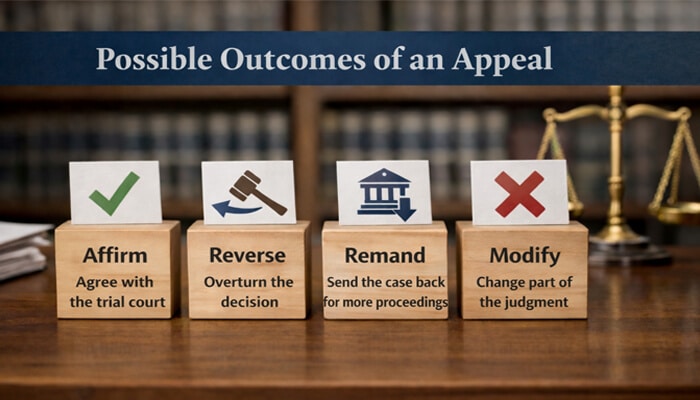
Appellate judges can:
- Affirm – Agree with the trial court
- Reverse – Overturn the decision
- Remand – Send the case back for more proceedings
- Modify – Change part of the judgment
What Appellate Judges Don’t Do
- They do not retry the case.
- They do not re-weigh evidence.
- They do not listen to new witnesses.
Their job is purely review, not re-trial.
Important Legal Terms Simplified
| Legal Term | Plain Explanation |
| Appellant | The person who appeals the case. |
| Respondent | The person who defends the appeal. |
| Brief | Written legal argument submitted to the court. |
| Record | All documents and transcripts from the trial. |
| Opinion | Written explanation of the appellate decision. |
Why It Matters
Understanding what appellate judges look for when they review a case helps:
- Clients know what to expect after trial
- Lawyers craft better appeals
- Students learn how higher courts function
Appellate review protects fairness in the legal system and ensures rules are followed properly.
Wrapping Up
Appellate judges serve a vital role in the justice system. When they review a case, their job is to make sure the law was applied correctly and fairly. They focus on legal errors, procedure, constitutional rights, and whether the trial judge’s decisions were reasonable.
By understanding what appellate judges look for when they review a case, readers can better grasp how appeals work and why precise legal arguments are essential.
What Appellate Judges Look For When They Review a Case FAQs
1. What Appellate Judges Look For When They Review a Case
Appellate judges focus on legal errors, procedural fairness, and constitutional rights, not on re-evaluating the facts.
2. Do appellate courts listen to new evidence?
No, appellate courts do not hear new evidence; they review the trial court’s record.
3. How do appellate judges decide if a trial court’s decision was wrong?
Appellate judges apply various standards of review, like de novo for legal errors and abuse of discretion for procedural decisions.
4. What is the role of an appellate brief?
An appellate brief presents legal arguments and precedents, which often determine the outcome of an appeal.
5. Can an appellate court reverse a trial court’s decision?
Yes, an appellate court can reverse, affirm, remand, or modify the trial court’s decision.
6. What is the difference between a harmless error and a reversible error?
A harmless error does not affect the outcome, while a reversible error significantly alters the case result.
7. What happens after an appeal is filed?
After an appeal is filed, the record is reviewed, briefs are submitted, and oral arguments may be heard before a judgment is made.
Disclaimer
This article is for general informational purposes only. It is not intended as legal advice. Every case is unique, and outcomes may vary. Please consult a qualified attorney for advice specific to your situation.
