



If you are researching the class action lawsuit statute of limitations, you are likely asking a very practical question:
How long do I have to file — or join — a class action before I lose my rights?
In the United States, there is no single deadline that applies to all class actions. The time limit depends on:
- The type of claim (fraud, product liability, wage violations, civil rights, etc.)
- Whether the case is filed in federal or state court
- The state whose law applies
- When the legal injury legally “accrued”
This guide explains how the statute of limitations works in class actions, how long you may have to sue, how to join a class action lawsuit, and how long these cases usually take.
What Is the Statute of Limitations in a Class Action Lawsuit?
A statute of limitations to sue is the legal deadline for filing a lawsuit.
In a class action, this deadline usually applies to:
- The person filing the lawsuit (the named plaintiff), and
- The people who may later become part of the class.
Most federal class actions are governed procedurally by Federal Rules of Civil Procedure Rule 23, but Rule 23 does not set the time limit itself. Instead, the statute of limitations comes from:
- State law (for most injury and contract claims)
- Federal statutes (for federal claims)
Common Time Limits (General Ranges)
These vary by state, but typical examples include:
- Personal injury: 1–3 years
- Fraud: 2–6 years
- Breach of contract: 3–6 years
- Civil rights claims: Often tied to state personal injury limits
There is no universal “class action deadline.”
When Does the Clock Start?
One of the most misunderstood issues in class action law is when the statute of limitations begins to run.
In many cases, the clock starts when:
- The injury occurred, OR
- The plaintiff reasonably discovered the injury
This is called the “discovery rule.”
Example
If a defective product caused harm in 2021, but you reasonably discovered the defect in 2023, the limitations period may start in 2023 — depending on state law.
Courts look at facts, not assumptions.
Does Filing a Class Action Pause the Deadline?
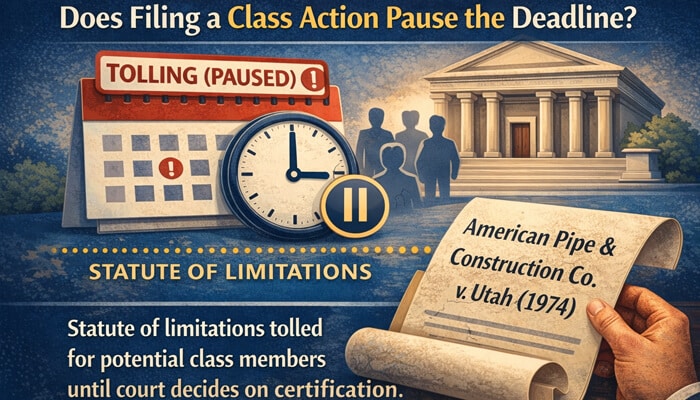
Yes — sometimes.
In 1974, the U.S. Supreme Court decided American Pipe & Construction Co. v. Utah, which created an important rule:
When a class action is filed, the statute of limitations is “tolled” (paused) for potential class members while the court decides whether to certify the class.
This protects individuals from filing duplicate lawsuits while waiting to see if the class is approved.
However:
- Tolling rules can vary.
- Some state courts apply different interpretations.
- Tolling may not apply indefinitely.
This is a legally technical area, and outcomes depend on jurisdiction.
How Many Years Back Can a Class Action Lawsuit Go?
There is no automatic “look-back” period.
A class action can only go back as far as the applicable statute of limitations allows.
For example:
- If a state has a 3-year limitation for consumer fraud,
- And the lawsuit was filed in 2026,
- Claims before 2023 may be barred — unless tolling or another exception applies.
Courts analyze this claim-by-claim.
Federal vs State Differences in Class Action Statute of Limitations
Although many class actions are filed in federal court, the statute of limitations to sue usually comes from the underlying law — often state law. This creates important distinctions.
| Issue | Federal Court Class Action | State Court Class Action |
| Governing Procedure | Follows Federal Rules of Civil Procedure Rule 23 | Follows state civil procedure rules |
| Source of Statute of Limitations | Federal statute (if federal claim) OR state law (if state claim in federal court) | State statute |
| Tolling Rule | Generally follows American Pipe & Construction Co. v. Utah for class tolling | Some states follow American Pipe; others apply modified or narrower tolling rules |
| Civil Rights Claims (42 U.S.C. §1983) | Borrow state personal injury statute of limitations | Typically not filed in state court unless under state civil rights laws |
| Securities Claims | Often have specific federal limitation periods | Rarely handled purely under state law today |
| Variation Between States | Less variation for federal claims | High variation — deadlines can differ significantly from state to state |
How to Join a Class Action Lawsuit
If you are wondering how to join a class action lawsuit, it depends on the type of class:
1. Opt-Out Class Actions (Most Common)
You are automatically included if you meet the criteria unless you opt out.
You typically:
- Receive a notice by mail or email
- Do nothing to remain in the class
- File a claim form if there is a settlement
2. Opt-In Class Actions
Some cases (like certain wage claims) require you to affirmatively join by filing paperwork before a deadline. Missing that deadline may exclude you permanently.
Important
Even if the statute of limitations has technically expired, tolling may apply if a class action was filed earlier.
However, once the class is denied certification or resolved, deadlines may resume quickly.
What Happens If You Miss the Statute of Limitations?
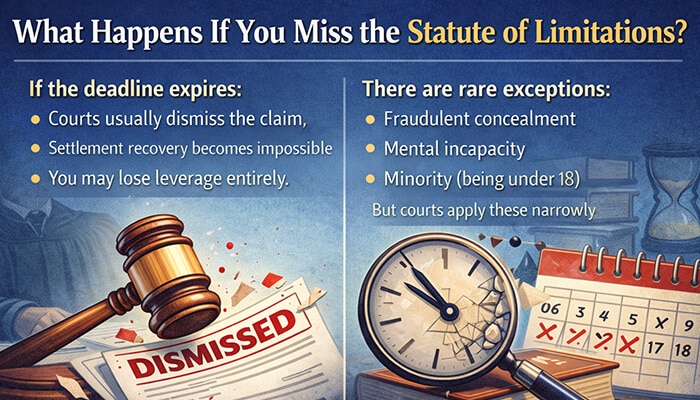
If the deadline expires:
- Courts usually dismiss the claim.
- Settlement recovery becomes impossible.
- You may lose leverage entirely.
There are rare exceptions:
- Fraudulent concealment
- Mental incapacity
- Minority (being under 18)
But courts apply these narrowly.
Deadlines are taken seriously.
How Long Does a Class Action Lawsuit Take?
This is a separate issue from the statute of limitations.
If you’re asking how long does a class action lawsuit take, most cases follow this timeline:
- Filing of complaint
- Motion to dismiss (months)
- Discovery (1–2 years)
- Class certification decision
- Settlement or trial
Many class actions last:
- 2–5 years
- Complex cases can take longer
Certification disputes often determine how long a case proceeds.
Class actions are procedurally complex by design.
Common Misconceptions About Class Action Deadlines
Myth: There is one national deadline.
Fact: False. It depends on the claim and jurisdiction.
Myth: If someone else files, I don’t need to worry.
Fact: Partially true, but only while tolling applies.
Myth: Class actions go back forever.
Fact: Incorrect. They are limited by statutory time periods.
Do You Need a Lawyer for a Statute of Limitations Issue?
You may not need a lawyer simply to remain in a certified class action.
However, you should consider consulting one if:
- You believe your claim may be time-barred
- You want to opt out and file individually
- You are unsure when your injury legally accrued
- You received a notice and do not understand your rights
Statute of limitations disputes can be technical and fact-specific.
In straightforward settlement participation, legal representation is often unnecessary.
In contested or individual claims, it may be critical.
Practical Next Steps If You Are Concerned About Deadlines
- Identify the legal claim involved.
- Determine the state law controlling the claim.
- Confirm when the injury occurred or was discovered.
- Check whether a class action has already been filed.
- Review any notice deadlines carefully.
Do not assume time remains simply because others are involved.
Summary
The class action lawsuit statute of limitations depends on:
- The underlying legal claim
- The state or federal law involved
- When the injury was discovered
- Whether tolling applies
There is no universal deadline.
If you are considering filing or joining a class action, understanding the time limits early can prevent permanent loss of rights.
Disclaimer: This article provides general legal information about U.S. class action procedures. Laws vary by state and by claim type. It is not legal advice.