

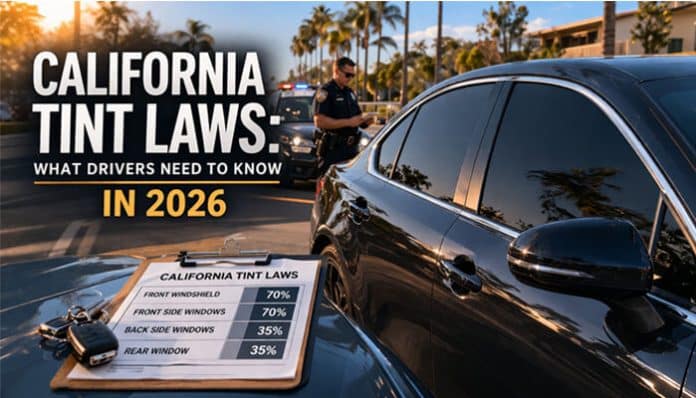

California tint laws are stricter than many drivers expect, especially for the windshield and the two front side windows. If you want privacy, heat reduction, and glare control without getting stopped or cited, you need to understand the actual rule structure under California Vehicle Code § 26708, not just shop talk or outdated forum advice.
California Vehicle Code § 26708 generally prohibits material placed on the windshield or side or rear windows, and separately prohibits material that obstructs or reduces the driver’s clear view. The statute then creates limited exceptions for the topmost portion of the windshield, certain rear windows, compliant clear film on the front side windows, and specific medical or sun-shading situations. The current version of § 26708 was amended by SB 506 and became effective on January 1, 2026.
That means the answer to “what are the tint laws in California” is not simply “70% on the front and anything goes in the back.” The real rule is more nuanced. California tint laws depend on which window you are tinting, how much visible light still passes through, whether the material is clear and transparent, whether the vehicle has dual mirrors, and whether a valid medical or sun-screening exception applies.
California Tint Laws at a Glance
| Window | Legal Status in California |
| Windshield | Full tint is generally not legal; only a limited top strip may be allowed |
| Front side windows | Only very light, clear, compliant transparent material is allowed |
| Rear side windows | Generally allowed |
| Rear window | Generally allowed if the vehicle has dual side mirrors |
What Are the California Tint Laws?
California’s primary tint rule appears in Vehicle Code section 26708. In general, the law prohibits material placed on the windshield or windows if it obstructs or reduces the driver’s clear view. At the same time, the code creates exceptions for certain rear windows, very light transparent materials, and some medical situations.
In practical terms, California tint laws work like this:
- The windshield cannot have ordinary dark tint across the full glass.
- The front driver and front passenger windows are heavily restricted.
- The rear side windows are generally allowed to have darker tint.
- The rear window is generally permitted if the vehicle has outside mirrors on both sides.
That is why California tint laws often confuse drivers. The law is not based on a single percentage across the whole vehicle. It depends on where the tint is installed and whether that tint meets California’s specific legal standards.
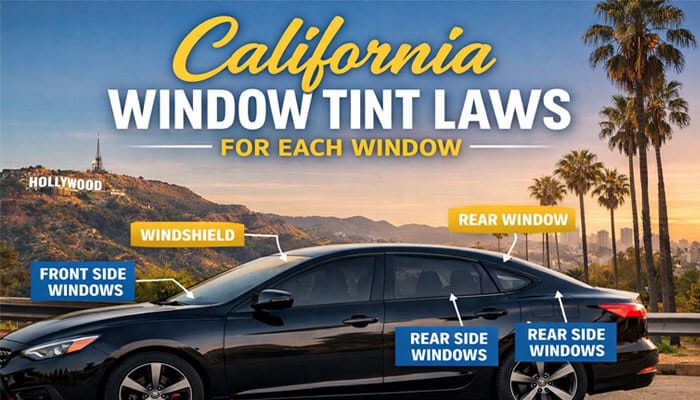
California Window Tint Laws for Each Window
1. Windshield
Under California tint laws, the windshield is the most restricted area. California Vehicle Code § 26708 generally bans materials on the windshield, but subdivision (c) allows transparent material on the topmost portion if the legal conditions are met. Those conditions include the 29-inch placement rule, a ban on red or amber color, no opaque lettering, and no extra reflected glare compared with untinted glass.
This is why full windshield tint is usually where drivers get into trouble. Even light film on the entire windshield can fall outside the statute unless it qualifies under a separate medical exception for clear, colorless, and transparent material.
2. Front Side Windows
This is where California tint laws are much stricter than in many other states. Section 26708(d) allows only clear, colorless, and transparent material on the front side windows, and that material must have 88% minimum visible light transmittance. On top of that, the glazing with the material applied still must meet federal standards, including 70% minimum light transmittance. The driver must also carry a certificate from the installer or manufacturer showing compliance.
In practical terms, the law does not allow dark front-window tint just because a shop says it is common. California law is built around maintaining strong visibility through the front side glass.
3. Rear Side Windows
For anyone asking is it illegal to have tinted windows, the answer is not automatically yes. Rear side windows are treated differently. The statute lists side windows that are to the rear of the driver among the exceptions. That is why a darker tint is usually discussed as being permissible in the back of the vehicle.
4. Rear Window
The rear window is also treated more leniently, but there is an important condition. If the rear window or windows are used this way, the vehicle must have outside mirrors on both the left and right sides positioned so the driver can see the highway for at least 200 feet to the rear through each mirror.
Factory Tint vs Aftermarket Tint
Factory tint usually means the glass itself was manufactured with shading built into it. This is common on many SUVs, vans, and trucks, especially on the rear windows. Aftermarket tint, by contrast, is film applied to the glass after the vehicle is made. California’s window tint statutes specifically address material that is placed, displayed, installed, affixed, or applied to the windshield or windows, which is why aftermarket film often creates a legal issue.
This distinction matters because many drivers assume that if their vehicle came with darker rear glass from the factory, the same darkness must also be legal on the front side windows. That is not how California law works. Factory rear privacy glass on certain vehicles is common, but applying dark aftermarket film to restricted windows can still violate the code.
Is 15 Tint Legal in California?
If you are asking is 15 tint legal in California, the answer depends on the window.
Front Side Windows
No. 15% tint is generally not legal on the front driver or front passenger windows because it is much darker than the very light transparent material California allows.
Rear Side Windows
Yes, a darker tint is generally allowed on the rear side windows because those windows are treated differently under California law.
Rear Window
Usually yes, as long as the vehicle has compliant side mirrors on both the left and right sides.
So, if someone asks whether 15 tint is legal in California, the accurate answer is that it is not legal on the front side windows, but may be legal on the rear windows, depending on the vehicle setup.
Is 35 Tint Legal in California?
The same window-by-window rule applies here.
Front Side Windows
No. 35% tint is generally not legal on the front side windows in California.
Rear Side Windows
Generally allowed.
Rear Window
Usually allowed if the vehicle has mirrors on both sides.
This is why the question of what percent tint is legal in California cannot be answered with one number. California is much stricter for the windshield and front side windows than for the rear side windows and rear window.
What Percent Tint Is Legal in California?
This is one of the most searched questions around California tint laws, and it deserves a precise answer.
For the front side windows, California law points to a compliant setup where:
- The material itself has 88% minimum visible light transmittance, and
- The glazing with the material applied still meets federal rules, including 70% minimum light transmittance.
For the rear side windows, the statute provides an exception, so they are not governed by the same front-window limit.
For the rear window, a darker tint is generally allowed if dual outside mirrors are installed as required.
For the windshield, only the top-most portion may have a qualifying transparent material under the statutory conditions, unless a separate medical exception applies.
Windshield Rules Under California Tint Laws
The windshield is one of the most restricted areas under California tint laws. California does not generally allow a fully tinted windshield.
A limited transparent strip at the top of the windshield may be allowed if it meets specific legal conditions. Under the code, the strip must be placed high enough on the windshield, cannot be red or amber, and cannot distort the driver’s vision or reflect more light than untreated glass. The statute also sets a placement rule tied to the measurement from the driver’s seat.
So when people ask is it illegal to have tinted windows in California, the windshield is one of the clearest examples: full dark windshield tint is generally not legal.
Reflective and Mirrored Tint Rules
Another missing issue in many tint guides is reflective tint. California tint laws are not only concerned with darkness. It also addresses whether material on the glass creates unsafe glare or changes the visual character of the glass in a way the code does not allow.
For example, section 26708 limits windshield strip material so it cannot reflect sunlight or headlights more than the untreated windshield, and section 26708.5 generally prohibits material that alters color or reduces light transmittance unless specifically allowed by law. In practical terms, that means highly reflective or mirrored tint is especially risky, particularly on the windshield and front side windows.
Sedan vs SUV, Van, and Truck Tint Differences
A lot of confusion comes from the fact that different vehicle types often appear to have different tint setups from the factory.
Sedans typically have clearer rear windows unless the owner adds tint. SUVs, vans, and some trucks often come with darker rear privacy glass from the manufacturer. This leads drivers to assume that the law is based on vehicle style rather than window location. In reality, California’s rules still turn mainly on which windows are behind the driver and which are next to the front seat, along with mirror requirements for the rear window.
That means an SUV with darker rear factory glass may still have strict limits on the front driver and front passenger windows, just like a sedan. The rear-window flexibility does not erase the restrictions on the front side windows.
Medical Exemptions in California
California tint laws do allow limited medical-related exceptions, but they are narrower than many online summaries suggest.
The front-side sun-screening exception is tied to devices that meet the requirements of California Vehicle Code § 26708.2.
Under section 26708(b)(10), certain sun-screening devices may be installed on the side windows to the left and right of the driver if the driver or a front-seat passenger has documentation signed by a licensed physician and surgeon, or by a licensed optometrist for a visual condition, stating that the person must be shaded from the sun. The statute also says those devices cannot be used in the dark. Under section 26708(e), clear, colorless, and transparent material may be used in some circumstances if the material meets the law’s transmission requirements and the driver carries a certificate signed by a licensed dermatologist stating that ultraviolet exposure should be avoided because of a medical condition.
That is important because many drivers assume that a medical reason automatically makes any tint legal. In reality, California’s medical exceptions still depend on documentation, compliance, and the exact wording of the statute.
Can You Get Pulled Over for Tinted Windows in California?
Yes. If your tint violates California’s equipment laws, you can be stopped and cited.
This is especially common when tint appears on:
- The windshield
- The front driver window
- The front passenger window
The 2026 California Uniform Bail and Penalty Schedule includes entries for violations of Vehicle Code section 26708(a)(1) and 26708(a)(2), which is why illegal tint is not just a theoretical issue. It is an enforceable equipment violation under California law.
How Officers Usually Judge Illegal Tint
In real-world enforcement, an officer usually notices tint because it appears to make the cabin difficult to see into, reduces visible clarity through the front glass, or looks inconsistent with the front-window restrictions under California law. The problem is often not just a number on a tint box. It is whether the material appears unlawful on a window that California treats as restricted.
That is why many tint stops involve the windshield or front side windows rather than the rear side windows. If the tint appears to reduce visibility on the windows most directly tied to driver sight lines, a stop and citation is much more likely. This is a practical inference from how section 26708 focuses on obstructed or reduced driver view.
How Much Is a Tint Ticket in California?
If you are wondering how much is a tint ticket in California, the answer can vary depending on how the citation is written and whether the violation is treated as correctable.
The 2026 California Uniform Bail and Penalty Schedule lists section 26708 entries at $193 total bail in one listing and $25 total fee in another, depending on how the violation is categorized and whether it is handled as a correctable fix-it matter. California Courts also explains that correctable violations are resolved by fixing the issue, showing proof, and paying the required fee.
This is why drivers often see inconsistent answers online. The exact amount can depend on how the officer marks the citation and how the court processes the violation.
What Happens After a Tint Ticket?
This is one of the most useful practical topics for readers. In many cases, a tint citation may function like a correctable equipment violation, which means the driver may be able to remove or fix the unlawful tint, obtain proof of correction, and pay the required correction fee. California Courts’ self-help guidance says a fix-it ticket is a correctable offense and explains that the person must fix the issue, show proof, and pay the fee. Some local California court materials also specifically reference tinted-window citations being resolved through signed-off correction, plus the fee when the citation is issued as correctable.
That means the practical outcome after a tint stop is often not just “pay the fine.” It can also involve:
- removing or correcting the illegal tint
- obtaining proof of correction
- submitting that proof to the court
- paying the correction fee if the ticket was marked as correctable
Still, not every citation is handled the same way, so drivers should read the notice carefully and follow the court instructions on the ticket.
Is It Illegal to Have Tinted Windows in California?
No, tinted windows are not completely illegal in California.
What matters is which windows are tinted.
| Window Area | Status |
| Rear side windows | Generally allowed |
| Rear window | Generally allowed with dual side mirrors |
| Windshield | Generally restricted or prohibited |
| Front driver window | Generally restricted or prohibited |
| Front passenger window | Generally restricted or prohibited |
So if your goal is full compliance with California tint laws, the safest approach is to avoid dark aftermarket tint on the windshield and front side windows unless you clearly qualify for a lawful exception and have the required documentation.
Legal vs Illegal Tint in California
To make the rules easier to scan, here is the practical legal-versus-illegal breakdown.
Generally Legal or More Likely to Be Legal
- Darker tint on the rear side windows
- Tint on the rear window if the vehicle has dual side mirrors
- Very light, compliant, transparent material on the front side windows if it meets the code
- Approved material used under a valid statutory medical exception
Generally Illegal or High Risk
- Full dark tint on the windshield
- Dark aftermarket tint on the front driver window
- Dark aftermarket tint on the front passenger window
- Highly reflective or mirrored tint on restricted windows
- Tint was installed without the required supporting documentation, where the statute requires it
This comparison is one of the easiest ways to understand California tint laws without reading the statutory language line by line.
Before You Tint Your Car in California
Before installing tint, drivers should use a simple checklist:
- Confirm which windows you want tinted
- Ask whether the glass is factory-tinted or whether film will be added afterward
- Verify the product’s visible light transmission
- Ask whether the front window material is actually compliant with California law
- Request any required installer or manufacturer certificate
- Confirm that your vehicle has the proper dual mirror setup if tinting the rear window
- Make sure a claimed medical exemption actually fits the statute and is properly documented
This small checklist can help drivers avoid the most common and expensive mistakes, especially when shops advertise tint packages without clearly explaining California’s front-window restrictions. The Bureau of Automotive Repair also specifically notes that it handles complaints related to window tint installation, which shows this is a real consumer issue in California.
A Note About Inspection Confusion
Some readers search for whether an illegal tint will cause an “inspection failure.” In California, the official statewide system most drivers deal with is Smog Check, which is focused on emissions compliance for registration and renewal in applicable cases. California also has separate vehicle safety systems inspections in certain situations, such as specific registration contexts, but tint law compliance is still mainly discussed as a road-use and equipment-law issue under the Vehicle Code rather than a simple annual tint inspection rule for all passenger cars.
For readers, the safest takeaway is this: even if you are thinking in terms of “inspection,” illegal tint can still matter because it can lead to traffic stops, correction requirements, or court handling if it violates the code.
Common Mistakes Drivers Make With California Tint Laws
Many drivers get cited because they rely on general tint charts or information from other states. That often leads to mistakes such as:
- Assuming a tint percentage legal in another state is also legal in California
- Believing that shop-installed tint is automatically legal
- Confusing factory glass with aftermarket film
- Assuming a medical issue allows any darkness level of tint
Understanding these points can help you avoid tickets and avoid spending money on tint that may need to be removed later.
Final Thoughts on California Tint Laws
The most important thing to understand about California tint laws is that legality depends on window location, not just tint percentage. California gives drivers more flexibility for rear windows, but it is much stricter about the windshield and front side windows.
If you want the simplest summary:
- 15% tint on front windows: Not legal
- 35% tint on front windows: Not legal
- Rear side window tint: Generally allowed
- Rear window tint: Generally allowed with dual side mirrors
- Tint ticket cost: Often listed at $25 or $193, depending on how the violation is handled
If you want to stay compliant, the safest move is to be cautious with any aftermarket tint on the windshield or front side windows and verify the current rules before installation.
California Tint Laws FAQs
1. What are the tint laws in California?
California generally restricts tint on the windshield and front side windows, while rear side windows are generally allowed and the rear window is usually allowed if the vehicle has mirrors on both sides.
2. What are the California tint laws for front windows?
Front side windows may only have very light, clear, compliant transparent material. Ordinary dark aftermarket tint is generally not legal.
3. Is windshield tint legal in California?
A fully tinted windshield is generally not legal in California. Only a limited transparent strip at the top of the windshield may be allowed if it meets the legal conditions in the statute.
4. Do you have to remove illegal tint after a ticket?
In many cases, yes. A tint citation may be handled as a correctable violation, which can require removing or fixing the illegal tint, getting proof of correction, and paying the required fee.
5. Are rear side windows allowed to have dark tint in California?
Yes, rear side windows are generally allowed to have darker tint because they are treated differently under California law than the front side windows.
6. Is the rear window allowed to be tinted in California?
Yes, the rear window is generally allowed to be tinted if the vehicle has compliant outside mirrors on both sides.
7. Are California tint laws different for SUVs and trucks?
The law mainly depends on window location, not just vehicle type. SUVs, vans, and trucks may come with darker rear factory glass, but the front side windows are still heavily restricted under California law.
Disclaimer: This article is for general informational purposes only and should not be treated as legal advice. California tint laws can change, and enforcement may vary by situation and jurisdiction. Before installing or contesting window tint, review the current California Vehicle Code or consult a qualified attorney or licensed professional.
