

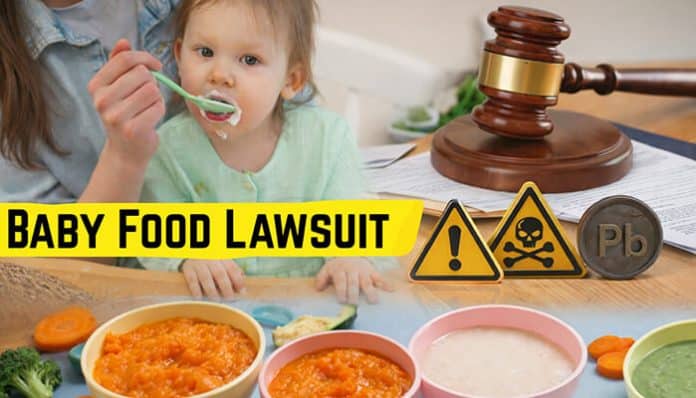

Parents searching for information about a baby food lawsuit are usually trying to answer one urgent question: Is baby food linked to autism or toxic metal exposure—and what does the law say?
Over the past several years, lawsuits have been filed across the United States alleging that certain manufacturers sold baby food containing elevated levels of heavy metals such as arsenic, lead, cadmium, and mercury. Plaintiffs claim prolonged exposure may have contributed to neurological harm, including autism spectrum disorder (ASD).
This article explains:
- What the baby food lawsuit is about
- The science behind heavy metals in baby food
- The status of the baby food autism lawsuit
- Whether the baby food lawsuit is legit
- When families consider hiring a law firm for baby food class action claims
This article provides general legal information and is not legal advice.
What Is the Baby Food Lawsuit About?
The baby food lawsuit refers to product liability claims filed against major baby food manufacturers. The lawsuits allege that companies knowingly sold baby food products containing measurable levels of toxic heavy metals without adequately warning consumers.
These cases gained national attention after a 2021 Congressional report raised concerns about heavy metals in baby food sold by several well-known brands.
The legal claims generally allege:
- Failure to warn
- Negligent manufacturing
- Strict product liability
- Breach of warranty
- Fraud or misrepresentation (in some cases)
Many lawsuits are consolidated in federal court as multidistrict litigation (MDL), which streamlines pretrial proceedings.
Heavy Metals in Baby Food: What Are the Concerns?
The lawsuits focus primarily on four metals:
| Heavy Metal | Alleged Risk in Infants |
| Arsenic | Neurodevelopmental harm, cancer risk |
| Lead | Cognitive impairment, behavioral issues |
| Cadmium | Kidney and bone toxicity |
| Mercury | Neurological damage |
Infants are particularly vulnerable because:
- Their brains are still developing
- They consume higher amounts relative to body weight
- Detoxification systems are immature
The central allegation in the toxic baby food lawsuit claims that long-term ingestion of contaminated products may increase the risk of autism spectrum disorder.
However, it is important to note that scientific debate continues regarding causation thresholds and exposure levels.
Baby Food Autism Lawsuit: What Is Being Alleged?
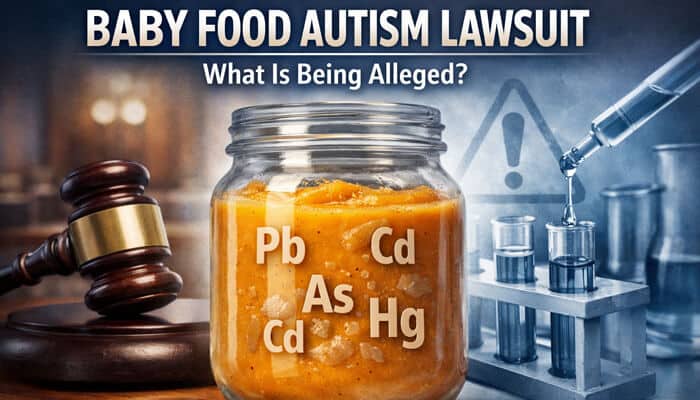
The baby food autism lawsuit specifically alleges that prolonged exposure to heavy metals in baby food contributed to the development of autism in children.
Plaintiffs typically argue:
- Manufacturers were aware of heavy metal presence.
- Internal testing revealed levels above recommended thresholds.
- Products were marketed as safe and healthy.
- No clear consumer warnings were provided.
Defense arguments generally include:
- Metals occur naturally in soil and crops.
- Levels were within regulatory guidance.
- Autism has multifactorial causes.
- Causation has not been scientifically proven.
Courts will ultimately determine whether expert testimony meets the legal standards required to proceed to trial.
What Must Plaintiffs Prove in a Toxic Baby Food Lawsuit?
To succeed in a product liability claim, plaintiffs generally must establish:
- The product was defective or unreasonably dangerous.
- The manufacturer failed to warn or acted negligently.
- The product caused the injury.
- The plaintiff suffered measurable damages.
Causation is typically the most difficult element. Courts require reliable expert testimony linking exposure to developmental outcomes.
Is the Baby Food Lawsuit Legit?
From a procedural standpoint, yes — these are real lawsuits filed in federal court. Many cases have been consolidated into multidistrict litigation (MDL) for coordinated pretrial proceedings.
However, “legit” in legal terms does not mean guaranteed success. Courts must evaluate:
- Scientific evidence linking exposure to developmental disorders
- Expert testimony on toxicology
- Regulatory standards
- Corporate knowledge and internal documents
As with many complex product liability cases, outcomes depend heavily on scientific causation evidence.
What Is Multidistrict Litigation (MDL) in the Baby Food Case?
Most federal baby food lawsuits have been centralized in MDL proceedings. An MDL allows similar cases from across the country to be handled together for efficiency.
This process:
- Reduces duplicate discovery
- Standardizes expert evidence
- Allows bellwether trials to test claims
If bellwether trials favor plaintiffs, settlement discussions often follow. If not, cases may be dismissed or returned to individual courts.
Baby Food Autism Lawsuit (2026 Update)
- As of early 2026, federal baby food autism lawsuits remain active and consolidated in multidistrict litigation (MDL) in the U.S. District Court for the Northern District of California.
- The litigation alleges that certain manufacturers sold baby food products containing elevated levels of arsenic, lead, cadmium, and mercury without adequate consumer warnings.
- The cases were influenced by a 2021 report from the U.S. House of Representatives Subcommittee on Economic and Consumer Policy, which raised concerns about internal testing and heavy metal levels.
- Hundreds of lawsuits have been filed nationwide, with additional claims continuing to be submitted.
- The MDL is currently focused on general causation, meaning plaintiffs must present admissible expert testimony linking heavy metal exposure to neurodevelopmental disorders such as autism spectrum disorder.
- The court is conducting expert admissibility review under federal standards (commonly referred to as Daubert review). These rulings will significantly affect whether cases proceed to bellwether trials.
- No global settlement has been announced, and no final liability determination has been made.
- In 2026, Virginia enacted legislation requiring baby food manufacturers to conduct heavy metal testing and publicly disclose results, reflecting increased regulatory scrutiny.
- The litigation remains ongoing, and future rulings on expert evidence are expected to shape the direction of the baby food autism lawsuit.
Who Qualifies for the Baby Food Lawsuit?
While eligibility varies by law firm and case development, common criteria include:
- Child diagnosed with autism spectrum disorder
- Regular consumption of specific baby food brands during infancy
- Medical documentation of diagnosis
- Evidence of product purchase or exposure timeline
Each case is evaluated individually. Not every autism diagnosis qualifies.
Do You Need a Law Firm for Baby Food Class Action Claims?
Parents often ask whether they need a law firm for baby food class action cases.
In complex product liability litigation involving medical causation:
- Expert testimony is required
- Federal procedural rules apply
- Scientific evidence must meet admissibility standards
These cases are not suitable for self-representation.
Most firms handling these claims work on contingency, meaning fees are paid only if compensation is recovered. However, families should understand:
- Litigation may take years
- No outcome is guaranteed
- Causation standards are high
Hiring counsel is typically considered when there is documented diagnosis and significant long-term impact.
How Long Could the Baby Food Lawsuit Take?
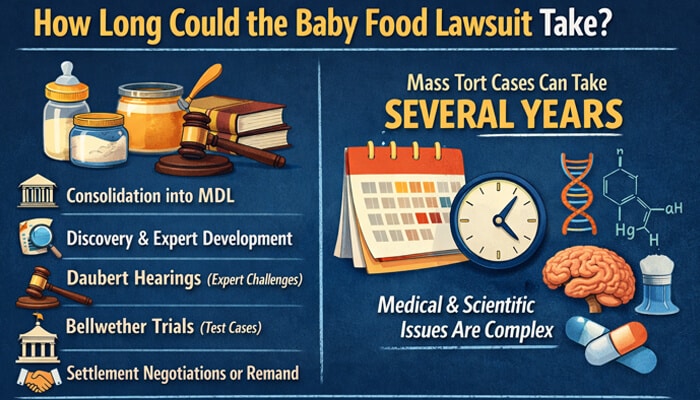
Mass tort litigation often spans several years.
Typical stages include:
- Consolidation into MDL
- Discovery and expert development
- Daubert hearings (expert admissibility challenges)
- Bellwether trials
- Settlement negotiations or remand
High-value product liability cases rarely resolve quickly because medical and scientific issues are complex.
What Is the Statute of Limitations?
The statute of limitations varies by state. In product liability cases involving minors, many states toll (pause) the statute until the child reaches majority, but rules differ.
Because MDL cases originate from different states, each plaintiff’s home state law typically governs limitation periods.
This is a jurisdiction-specific issue and one of the most important factors in case evaluation.
Common Misconceptions About the Toxic Baby Food Lawsuit
Misconception 1: All baby food contains illegal levels of metals.
Heavy metals occur naturally in soil. The dispute centers on acceptable exposure levels and corporate knowledge—not mere presence.
Misconception 2: A lawsuit means guilt.
Filing a lawsuit is an allegation, not proof of wrongdoing.
Misconception 3: Every autism diagnosis qualifies.
Plaintiffs must establish both exposure and medical causation.
What Compensation Is Being Sought?
Plaintiffs in the baby food autism lawsuit may seek:
- Medical expenses
- Therapy costs
- Special education services
- Future care needs
- Pain and suffering
- Punitive damages (in some jurisdictions)
Damages depend on state law and individual circumstances.
What Should Parents Do Now?
If you are researching the baby food lawsuit, consider these practical steps:
- Review your child’s medical records.
- Identify products regularly consumed during infancy.
- Monitor updates in the federal MDL proceedings.
- Consult a qualified product liability attorney for individualized assessment.
Avoid relying on social media summaries or marketing claims from law firm advertisements.
FAQs
1. What is the average payout for the baby powder lawsuit?
There is currently no established average payout for the baby food autism lawsuit. The cases are still in early MDL stages, and no global settlements or verdict benchmarks have been set. Any future compensation would depend on medical severity, proof of exposure, and state law.
2. Has anyone filed a claim in the baby food autism lawsuit?
Yes. Hundreds of claims have been filed and consolidated in federal multidistrict litigation following a 2021 report by the U.S. House of Representatives raising concerns about heavy metals in baby food.
3. Is it even possible to avoid heavy metals in baby food?
Completely avoiding heavy metals is difficult because elements like arsenic and lead occur naturally in soil. The issue in the lawsuits is whether exposure levels were excessive or improperly disclosed.
4. How to avoid heavy metals in baby food
Parents can reduce risk by offering a varied diet, limiting rice-based products, rotating grains, and following guidance from the U.S. Food and Drug Administration.
5. How Do I Know If My Child’s Autism Was Caused by Toxic Baby Food?
There is no simple test to prove causation. Courts require expert medical testimony showing documented exposure and a scientific link between heavy metals and the child’s diagnosis.
6. What Should I Do If I Think My Child Was Affected?
Consult your child’s doctor, gather medical records, identify products used, and speak with a qualified product liability attorney to evaluate potential legal options.
Final Thoughts on the Baby Food Lawsuit
The baby food lawsuit represents one of the most closely watched product liability litigations involving infant nutrition and heavy metals in baby food.
The cases raise serious questions about:
- Manufacturing oversight
- Regulatory standards
- Corporate transparency
- Scientific proof of causation
However, litigation is still ongoing. Courts—not headlines—will determine liability.
For now, the most responsible approach is to stay informed, rely on credible medical guidance, and seek qualified legal advice if the issue directly affects your family.
Disclaimer: This article provides general legal information for educational purposes only and does not constitute legal advice. Laws vary by state, and you should consult a qualified attorney regarding your specific situation.