

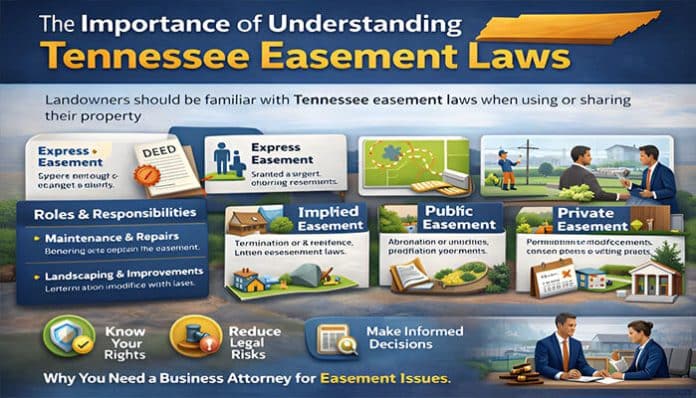

Landowners should be familiar with real estate laws when they wish to rent or lease a property to others. Tennessee property owners in the US should understand the laws properly while dividing or sharing the land for other purposes. Moreover, they should gather details about Tennessee easement laws from various sources, which will enable them to make informed decisions. Another benefit is that they can gain more insights into easement types, legal rights, and challenges, among other things.
Easements involve different types, and Tennessee easement laws provide a limited legal right to use land owned by someone else. For instance, a landowner can sign an easement contract with a local utility company to install power lines on their property. The easement provides the legal rights to use a property for various purposes, but does not provide ownership.
It is important for property owners and easement holders to know their rights in Tennessee because the laws might vary from one county to another. Moreover, they can avoid potential risks, including legal actions, to experience peace of mind.
What are Tennessee easement laws?
Property owners should understand the egress and ingress rights under Tennessee easement laws that allow them to make informed decisions. Egress rights refer to exiting a property, while ingress rights concern entering it.
Here are the key concepts followed in ingress and egress rights:
- Dominant and servient estates: A dominant estate holds the easement and is the main owner of a property, and the servient estate refers to an easement holder who holds the rights to use a property. The easement’s scope clearly outlines the permitted activities in a property, such as utilities, road travel, passage, etc.
- Appurtenant and in-gross easement: An appurtenant easement benefits a specific parcel of land, which is typically tied to the owner of the dominant estate. An in-gross easement benefits a person or entity rather than a property.
- Specifications and duration: Tennessee easements should clearly mention the location, means of access, customary use, and duration.
- Termination and modification: Termination and modification of an easement in Tennessee should follow the laws, including the court’s rules.
What are the primary forms of easements in Tennessee?
1. Express easement
An express easement refers to granting a right-of-way for ingress and egress through a deed or agreement. It is typically long-lasting and recordable. Sometimes, the agreement will become temporary in some cases. Recording an express easement with the county register of deeds allows future owners to protect their rights.
2. Implied easement
An implied easement arises based on prior use or common sense, even if no agreement exists. A court will create an implied easement for a person who is not the property owner.
- Easements by necessity: An easement by necessity occurs to a landlocked property if it has no reasonable access to a public road. For example, courts will often recognize an assessment by necessity when one parcel is landlocked and can only be accessed by crossing another parcel.
- Easements by prior use/prescriptive easements: An implied statement can also arise from continuous prior use. It happens from long, open, continuous, and adverse use under the claim of right. Tennessee courts determine the easement’s validity based on factors like duration, visibility, and continuity.
3. Public easement
A public easement is primarily meant to benefit the public, and the easement holder in this case is usually a local government or utility company. Some examples of public easements include sidewalks, roadways, parks, or waterlines.
4. Private easement
A private easement involves agreements between two parties that benefit both of them in various ways. Common scenarios of private easements involve fences, driveways, agreements for farming, etc.
Roles and responsibilities under Tennessee easement laws
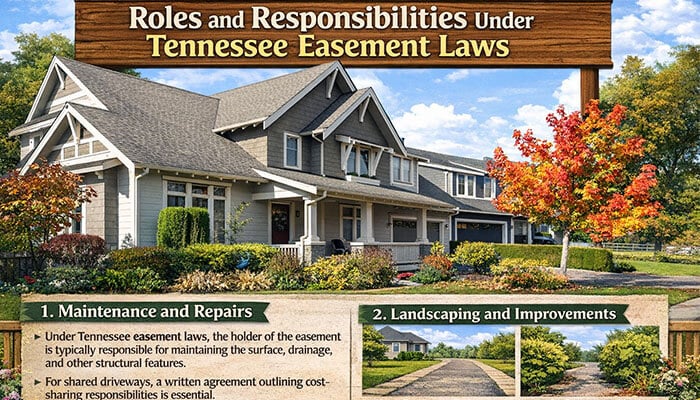
Proper owners should know the roles and responsibilities under Tennessee easement laws, which are applicable to both ingress and egress easements.
1. Maintenance and repairs
The easement agreements should often specify the maintenance of surface, drainage, and other structural features. A party that benefits from the easement must bear the cost to ensure that it is safe and usable for its intended purposes. If it is a shared drive, then a written agreement covering the cost allocation will help a lot to manage expenses effectively.
2. Landscaping and improvements
Landscaping and improvements shouldn’t interfere with the easement’s use. For instance, planting shrubs near a driveway should provide access to important structures or sightlines properly.
Creating and recording easements
Proper documentation is necessary for establishing easement rights in Tennessee. The process usually begins with a written agreement detailing the scope and location. It is important to record an express easement in the county land records, and it should be reflected in the property deeds.
Recording an express easement protects all parties by providing notice to future owners. On the other hand, implied easements require a court’s examination to assess the overall intent of the property owners at the time of transfer.
Here are some procedures followed in the creation and recording of easements:
1. Deed provisions
A written agreement signed by the property owner becomes enforceable by recording it in the local land records. It can establish the exact route, access method, and maintenance responsibilities.
2. Grant or reservation in a deed
A grant offers complete transfer rights to the easement without ownership, and a reservation preserves cross-access for the grantor.
Terminating or modifying an easement in Tennessee
A termination or modification of an easement in Tennessee occurs due to various factors, and property owners should learn the procedures properly. Some of them include change in use, property development, mutual agreement, obsolescence, disputes of litigation, etc.
1. Merger easement termination
Easement termination by merger occurs when a party acquires the ownership of a property and the easement. If the dominant and servient estates come under common ownership, then the easement is extinguished.
However, this type of termination needs certain documentation, which involves legal descriptions of the properties and evidence showing the consolidation of ownership. Aside from that, both parties should file an official notice with the local land records office to confirm the merger and the termination of an easement.
2. Release easement termination
Release of easement termination in Tennessee happens when an easement holder gives up their right to use or access a property by a written document. This formal procedure lets property owners relinquish their rights to an easement effectively by terminating it.
Here are some steps to follow in the release of the easement termination.
- Preparing a written document that clearly outlines the intent to end an easement
- Checking the local property office to know the specific requirements of local jurisdictions
- Signature of the easement holder in the release document
- Notarization after obtaining the necessary signatures
Filing and recording the release document with the local county register of deeds
3. Abandonment easement termination
Abandonment easement termination in Tennessee refers to intentional relinquishment of easement rights coupled with non-use. On the other hand, mere non-use of the easement is not sufficient to terminate an agreement. Instead, easement holders should provide strong evidence indicating reasons for the relinquishment.
4. Expiry of easement termination
An easement will come to an end when it reaches a specific duration. It typically occurs through a written agreement created by a property owner and an easement holder. Easement termination by expiration occurs when an agreement is set for a limited time, and the specified duration elapses.
5. Condemnation
An easement ends when the government exercises its power of eminent domain and takes over a part or all of the property for public use or benefit. Government acquisition of property can terminate an easement.
How to terminate or modify an easement agreement in Tennessee?
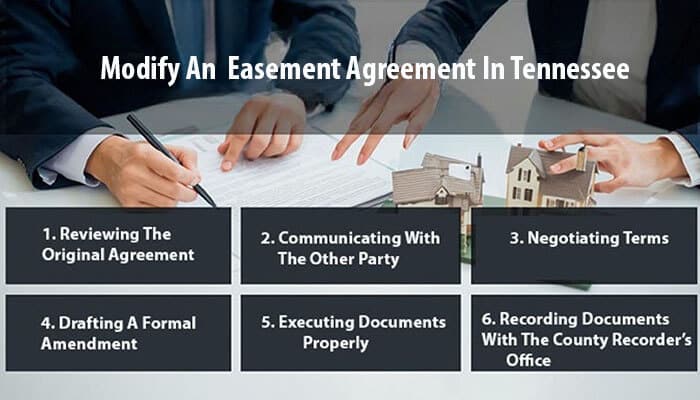
A termination or modification of an easement in Tennessee occurs due to various factors, and property owners should learn the procedures properly. Some of them include change in use, property development, mutual agreement, obsolescence, disputes of litigation, etc.
1. Reviewing the original agreement
Both the property owner and the easement holder should review the original agreement and any other related deeds. Some of the key points to notice include the scope and terms of the agreement, duration or expiration clauses, rights and obligations of both parties, etc.
2. Communicating with the other party
Open communication is critical while terminating or modifying an easement agreement in Tennessee. It is important to approach the other party holding rights under the easement to discuss intent.
3. Negotiating terms
Drafting a clear written proposal helps negotiations stay on track if both parties agree on modifications when necessary.
4. Drafting a formal amendment or release document
Both the property owner and the easement holder should prepare a written amendment agreement outlining modifications. For termination, drafting a release or quitclaim deed that relinquishes easement rights will help reduce mistakes.
5. Executing documents properly
Both parties should sign the amendment or termination documents in accordance with state requirements.
6. Recording documents with the county Recorder’s office
Recording documents with the county recorder’s office is an important step to follow while terminating or terminating an easement in Tennessee.
What are the common disputes in Tennessee easements, and how to resolve them?
Easement conflicts in Tennessee arise due to damage during construction, blockage, or disputes over maintenance responsibilities.
Resolution options include mediation and negotiation that help overcome complex issues effectively. In Tennessee, courts usually refer to the specific language of the easement, the surrounding property deeds, and established case laws that will decide the rights.
Common Misunderstandings About Tennessee Easements
- Confusing access rights with ownership interests
- Overlooking recorded easement boundaries in the title surveys
- Misinterpreting maintenance obligations between adjoining parties
- Ignoring expiration terms hidden in historical deeds
- Misapplying prescriptive easement principles in shared driveways
- Failing to document relocation agreements in writing
- Assuming implied easements survive ownership transfers
- Extending use beyond the scope of granted access
What are the ways to prevent disputes in Tennessee easements?
- Conducting a survey regularly showing the easement’s width, location, and any encroachments.
- Recording a clear easement agreement with defined boundaries, important structures, and maintenance duties.
- Both property owners and easement holders should use a written road maintenance plan for shared drives.
- Keeping the route open and safe enables property owners to avoid disputes.
- Confirming the easement boundaries and utility clearances before building fences, walls, or landscaping.
- Avoid unilateral changes to the route, width, gates, or locks without written consent.
What are the tips to reduce risks in Tennessee easements?
Property owners in Tennessee should know how to reduce risks from easements to ensure peace of mind from potential threats.
Here are some tips they should follow to minimize risks.
- Mapping the easement with a survey
- Defining the scope in writing
- Adding necessary protocols such as emergency access, gates, and snow or storm response
- Photographing before and after existing conditions
- Sending courteous notices to neighbors before maintenance that can affect them in various ways
- Confirming county recording requirements in Tennessee
- Setting a written document and cost-sharing plan
When should property owners consult with a real estate attorney?
Easements are fairly common when it comes to real estate property. Landowners have the right to grant other parties to use their properties for various purposes. However, locating an easement on a property might become difficult and interfere with the usage.
Those who are having any issues with an existing easement on a property or who are in the process of negotiating an easement should work with a qualified real estate attorney. An attorney will guide property owners in negotiating an easement. Moreover, property owners can handle complex issues in easements and represent cases in the courts regarding a lawsuit or other legal issues.
Conclusion
Property owners in Tennessee should learn how to create an easement to minimize unwanted problems. Also, they should follow Tennessee easement laws properly, which help them terminate or modify an agreement. Reviewing agreements, negotiating amendments, proper documentation of changes, and recording easements are some protocols that protect a property owner from disputes.
Easement laws allow property owners to protect their rights, minimize conflicts, and provide a clear framework for ongoing property transactions. Furthermore, they show methods to avoid disputes and other complications that help reduce risks.