



In today’s digital world, protecting personal information has become more important than ever. Understanding invasion of privacy laws in Texas is essential for individuals, businesses, and content creators who handle sensitive data or interact online.
Texas law provides strong protections against unauthorized access, misuse, or exposure of personal information. Whether it’s unauthorized surveillance, sharing private details, or using someone’s identity without consent, these actions can lead to serious legal consequences.
This guide explains everything you need to know about invasion of privacy laws in Texas, including types of claims, legal elements, real-world examples, defenses, and recent developments.
What Is Invasion of Privacy in Texas?
In Texas, invasion of privacy refers to legal claims that arise when someone interferes with another person’s private life in an unreasonable or harmful way. These claims are mostly based on court decisions (common law) rather than a single unified statute.
- It protects your personal space, identity, and private information
- It applies when someone crosses the legal boundaries of privacy
- It depends on how the violation occurred
Key Legal Elements of a Privacy Claim
To succeed in a lawsuit, a plaintiff must prove the following:
- Reasonable expectation of privacy
- Intentional action
- Highly offensive conduct
- Actual harm (emotional, financial, or reputational)
Types of Invasion of Privacy in Texas
1. Intrusion Upon Seclusion
This occurs when someone intentionally invades your private space or activities.
Examples include:
- Hidden cameras in private areas
- Unauthorized phone tapping
- Accessing private messages or emails
2. Public Disclosure of Private Facts
This applies when private information is publicly shared without consent.
Examples include:
- Posting sensitive personal details online
- Sharing medical or financial records
- Exposing personal relationships
- Highly private
- Not of public concern
- Offensive if disclosed
3. Appropriation of Name or Likeness
This happens when someone uses your identity for personal or commercial gain.
Examples include:
- Using your photo in ads without permission
- Fake endorsements
- Social media impersonation for profit
Statute of Limitations for Invasion of Privacy in Texas
In Texas, the statute of limitations for an invasion of privacy claim is generally two years from the date the claim accrues. Texas civil limitations guidance states that many tort claims involving personal rights are subject to a two-year filing deadline, and Texas courts have applied that two-year period to privacy-related tort claims.
If a lawsuit is not filed within this period, the claim may be permanently barred.
Exceptions may apply in cases involving:
- Delayed discovery of harm
- Ongoing violations
- Minors
Is Invasion of Privacy a Crime in Texas?
Most privacy violations are civil matters, but some actions are also criminal offenses.
Criminal privacy violations may include:
- Unlawful surveillance
- Invasive visual recording (Texas Penal Code §21.15)
- Harassment or stalking
- Wiretapping violations
Possible penalties:
- Fines
- Jail time
- Criminal records
👉 This makes invasion of privacy laws in Texas both civil and criminal in nature.
Workplace Privacy and Employee Rights in Texas

Workplace privacy and employee rights in Texas involve how much privacy employees have while employers manage business operations. These issues often include monitoring, personal records, medical information, and workplace data protection.
Employers CAN monitor:
- Emails
- Internet usage
- Company devices
Employers CANNOT:
- Record in private areas (bathrooms, locker rooms)
- Access personal accounts without consent
- Share private employee data improperly
👉 This is a growing area of concern in modern workplaces.
Social Media and Online Privacy Violations
Social media and online privacy violations happen when personal information, photos, messages, or digital activity are shared, exposed, or misused without permission. These violations can cause serious harm, including emotional distress, reputational damage, identity theft, and loss of personal security.
Common violations:
- Posting private photos without consent
- Doxxing (revealing personal information)
- Revenge content
- Fake profiles or impersonation
👉 Texas courts increasingly treat online violations as real-world legal issues.
Civil vs Criminal Privacy Violations
| Category | Civil Case | Criminal Case |
| Purpose | Compensation | Punishment |
| Filed By | Individual | State |
| Outcome | Damages | Jail/Fines |
| Example | Emotional harm claim | Illegal recording |
Important Texas privacy law cases
Important Texas privacy law cases have helped define what privacy rights exist in the state and what claims courts will recognize. These cases are especially useful because they explain the boundaries of invasion of privacy, public disclosure, and false light claims under Texas law.
- Billings v. Atkinson (1973): Texas recognized invasion of privacy after an unauthorized wiretap.
- Industrial Foundation v. Texas Industrial Accident Board (1976): The court explained when private facts can be protected from disclosure.
- Cain v. Hearst Corp. (1994): Texas ruled that false light invasion of privacy is not recognized.
- Kimbrough v. Coca-Cola/USA (1975): This case involved unauthorized use of a person’s name or likeness.
Invasion of Privacy vs Defamation in Texas
In Texas, invasion of privacy and defamation are separate claims. Invasion of privacy involves improper intrusion or disclosure of private facts, while defamation involves false statements that harm reputation. Texas also does not recognize false light as a separate privacy claim.
| Feature | Privacy Law | Defamation |
| Focus | Private life intrusion | False statements |
| Truth matters? | Yes (even true info can violate privacy) | Must be false |
| Harm type | Emotional distress | Reputation damage |
Privacy Rights of Minors in Texas
Privacy rights of minors in Texas involve a balance between a child’s legal protections and a parent’s right to make decisions on the child’s behalf. These rights can apply to school records, medical information, online data, and other sensitive personal information, depending on the situation.
- Parental access to records
- Student record privacy
- Medical privacy for minors
- Health information privacy
- Children’s personal data protections
- School health-related services and consent
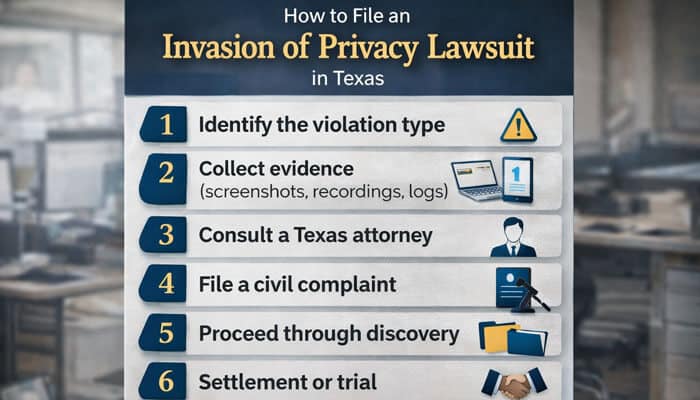
How to File an invasion of privacy laws in texas
Filing an invasion of privacy lawsuit in Texas involves more than simply saying your privacy was violated. You must identify the legal claim, collect supporting evidence, file in the correct court, and follow Texas civil procedure rules carefully.
- Identify the violation type
- Collect evidence (screenshots, recordings, logs)
- Consult a Texas attorney
- File a civil complaint
- Proceed through discovery
- Settlement or trial
Texas Data Privacy and Security Act
The Texas Data Privacy and Security Act is an important state law that gives Texas consumers more control over how businesses collect, use, and protect their personal data. It also requires covered businesses to follow privacy rules, provide notices, and maintain reasonable data security practices.
- Effective date
- Who it applies to
- Consumer rights
- Business duties
- Sensitive data protections
- Enforcement by the Texas Attorney General
Conclusion
Invasion of Privacy Laws in Texas provide strong legal protection against unauthorized access, misuse, and exposure of personal information. From traditional privacy violations to modern digital threats, these laws continue to evolve to address real-world challenges.
Understanding Invasion of Privacy Laws in Texas helps individuals protect their rights, take timely legal action, and avoid costly mistakes. Whether dealing with civil claims or criminal violations, awareness is the first step toward safeguarding your privacy
Invasion of Privacy Laws in Texas FAQs
1. What are the invasion of privacy laws in Texas?
Invasion of privacy laws in Texas protect people from unauthorized intrusion, disclosure of private facts, and misuse of their name or likeness. These laws come from both court decisions and specific Texas statutes.
2. Is invasion of privacy a crime in Texas?
Sometimes yes. In Texas, some privacy violations are civil claims, while others can lead to criminal charges, such as invasive visual recording or unlawful disclosure of intimate visual material.
3. What is the time limit to file an invasion of privacy lawsuit in Texas?
Texas generally applies a 2-year filing deadline to invasion of privacy claims. If you miss that deadline, the court may dismiss your case.
4. Does Texas recognize false light invasion of privacy?
No. Texas does not recognize false light as a valid invasion of privacy claim. This was made clear in Cain v. Hearst Corp.
5. Can I sue someone for posting my private information online in Texas?
Yes, you may be able to sue if someone publicly shares private facts or intimate material uses your identity without permission. The exact claim depends on the facts and the harm caused.
️ Disclaimer
This article is for informational purposes only and does not constitute legal advice. Laws may change, and individual cases vary. Always consult a qualified Texas attorney for advice specific to your situation.
