



If you are wondering how many people are required for a class action lawsuit, the short answer is this: there is no exact number written in the law. Courts do not set a fixed minimum like 50 or 100 people. Instead, judges look at whether the group is large enough that filing separate lawsuits would not make sense.
In most cases, that means:
• 20–40 people → Possibly enough
• 40+ people → More likely to qualify
• Hundreds or thousands → Very common in consumer cases
But the number alone does not decide the case. Courts care more about whether everyone was harmed in a similar way.
What Is a Class Action Lawsuit?
A class action lawsuit allows one or a few people (called lead plaintiffs) to file a lawsuit on behalf of a larger group who suffered the same harm.
Instead of 500 separate lawsuits, the court allows one combined case to improve efficiency and fairness.
Common examples include:
• Defective products
• Data breaches
• Wage violations
• Securities fraud
One well-known example is the Capital One data breach settlement, where millions of customers were affected and claims were handled together in one legal process.
Is There a Class Action Minimum Number?
There is no official class action minimum number in federal law. Courts apply a rule called “numerosity.” This means the group must be large enough that individual lawsuits would be impractical.
While there is no strict rule, courts often consider:
• Fewer than 20 people → Usually too small
• 20–40 people → Depends on circumstances
• 40+ people → Often meets the numerosity requirement
• Hundreds or more → Strong support for certification
However, even 100 people may not qualify if their claims are too different from each other.
Class Action Lawsuit Requirements
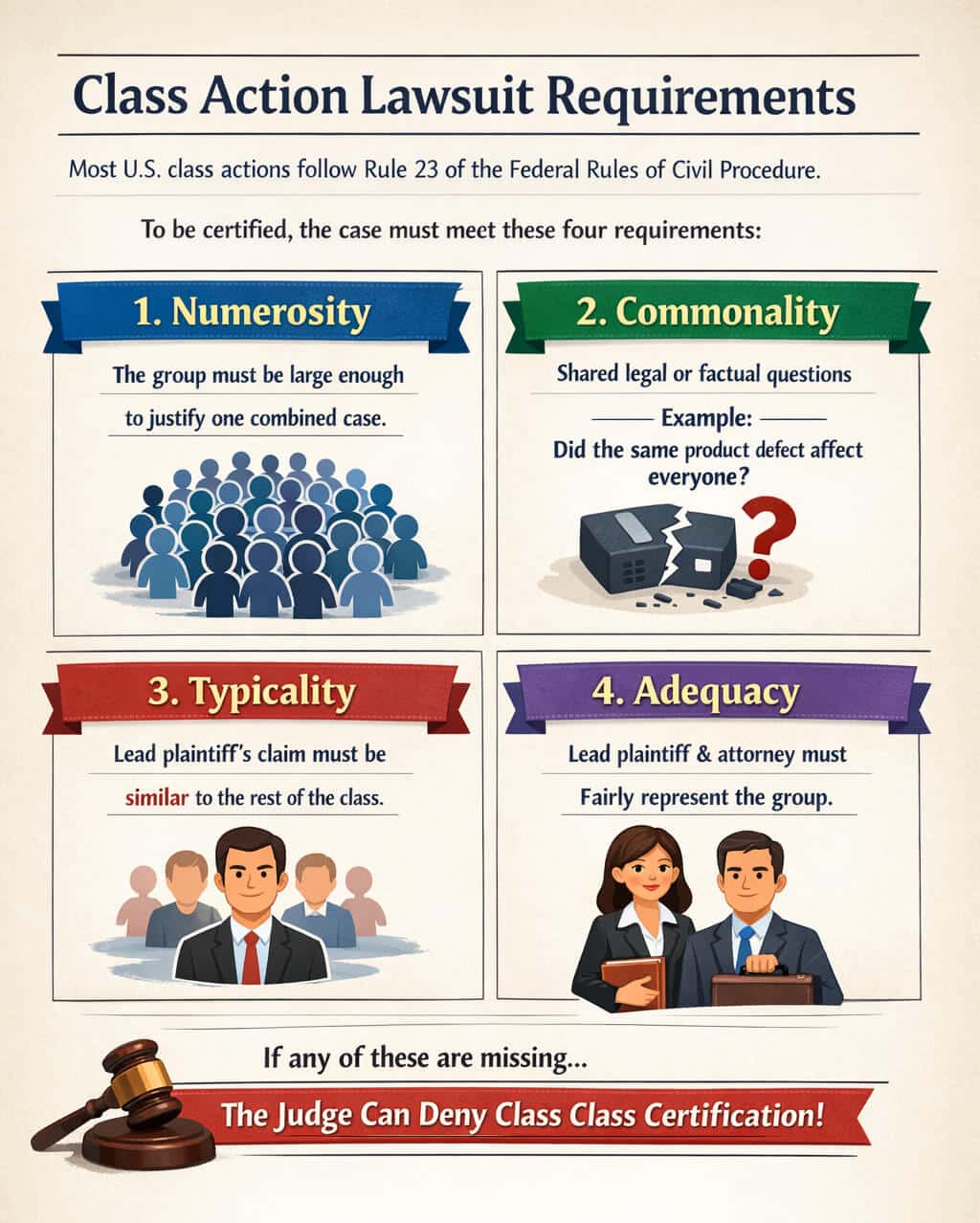
Most U.S. class actions follow Rule 23 of the Federal Rules of Civil Procedure. Before the case moves forward, the court must approve it as a class action. This is called class certification.
Four main requirements must be met:
1. Numerosity
The group must be large enough to justify one combined case.
2. Commonality
There must be shared legal or factual questions.
Example:
Did the same product defect affect everyone?
3. Typicality
The lead plaintiff’s claim must be similar to the rest of the class.
4. Adequacy
The lead plaintiff and attorney must fairly represent the group.
If any of these are missing, the judge can deny class certification.
Class Action vs Mass Tort: Quick Comparison
Many people confuse class actions with mass tort lawsuits. They are not the same.
| Feature | Class Action | Mass Tort |
| Lawsuits Filed | One lawsuit for everyone | Individual lawsuits grouped together |
| Harm | Very similar harm | Similar but more individualized injuries |
| Settlement | Shared settlement fund | Individual compensation amounts |
| Example | Data breach cases | Large product liability cases |
In a class action, everyone is treated as one group.
In a mass tort, each person’s damages are evaluated separately.
How Many People Are Needed for a Class Action Lawsuit in State Courts?
State courts often follow similar standards, but procedures vary.
Important things to know:
- Some states are stricter about certification.
- Multi-state cases often move to federal court.
- The number required depends on practicality, not a fixed rule.
If your case involves people in different states, federal court is common.
What Is Needed for a Class Action Lawsuit (Beyond Numbers)?
When asking what is needed for a class action lawsuit, remember that numbers are only one factor.
Courts also look for:
- The same defendant
- The same core legal issue
- Similar type of harm
- A more efficient resolution in one case
If each person must prove different facts, certification becomes harder.
Shareholder Class Action Lawsuit
A shareholder class action lawsuit happens when investors claim a company misled them, usually about financial performance.
These cases often involve:
- Hundreds or thousands of investors
- Publicly traded companies
- Claims of misleading statements
Here, the main challenge is proving securities fraud — not proving there are enough people.
How to Start a Class Action Lawsuit
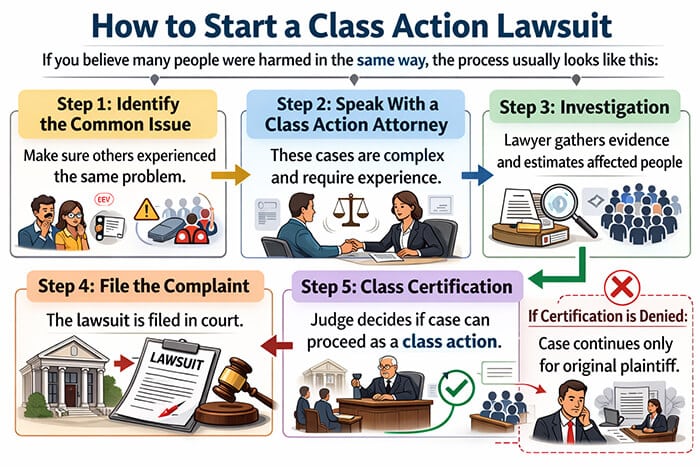 If you believe many people were harmed in the same way, the process usually looks like this:
Step 1: Identify the Common Issue
Make sure others experienced the same problem.
Step 2: Speak With a Class Action Attorney
These cases are complex and require experience.
Step 3: Investigation
The lawyer gathers evidence and estimates the number of affected people.
Step 4: File the Complaint
The lawsuit is filed in court.
Step 5: Class Certification
The judge decides whether the case can proceed as a class action.
If certification is denied, the case may continue only for the original plaintiff.
How Class Action Lawsuit Settlements Work
Most class action lawsuit settlements happen before trial.
Typical process:
- Defendant agrees to pay a settlement amount.
- The court reviews and approves it.
- Attorneys’ fees are deducted.
- Class members are notified.
- Payments are distributed.
Important reality:
Individual payments are often modest because the total settlement is divided among many people.
Common Misunderstandings
Myth: You need 100 people to file.
Reality: No fixed number exists.
Myth: Bigger class means automatic approval.
Reality: Similarity of claims matters more than size.
Myth: Everyone gets large payouts.
Reality: Most payments are small unless damages are significant.
Do You Need a Lawyer?
Technically, you can file a lawsuit on your own. But class actions involve:
- Strict procedural rules
- Certification hearings
- Complex legal standards
In practice, these cases almost always require experienced legal counsel.
If your damages are large and unique, an individual lawsuit may be stronger.
If damages are small but affect many people, a class action may be more practical.
Conclusion: How Many People Are Required for a Class Action Lawsuit?
There is no fixed number required for a class action lawsuit.
Courts focus on whether:
- The group is large enough to make separate lawsuits impractical
- Everyone shares common legal issues
- One case can fairly resolve the dispute
In many situations, 40 or more people increases the chance of certification. But the real test is whether the claims are similar and manageable together.
If you believe many people were harmed in the same way, gather documentation and consult a qualified attorney to evaluate your options.
Disclaimer: This article provides general legal information for educational purposes only. It is not legal advice. Laws and court procedures vary by state and by case. Always consult a qualified attorney in your jurisdiction about your specific legal situation.