

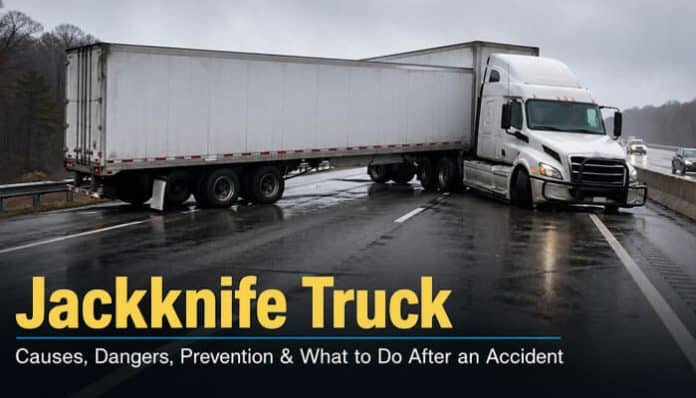

A jackknife truck is one of the most dangerous types of commercial truck accidents. It happens when the trailer of a semi-truck, tractor-trailer, or 18-wheeler swings out to the side and forms a sharp angle with the cab. The shape looks similar to a folding pocketknife, which is why the crash is called a jackknife accident.
A jackknife truck can block several lanes, strike nearby vehicles, cause underride crashes, spill cargo, and trigger multi-vehicle collisions. These crashes are especially dangerous on highways, bridges, curves, downhill roads, and wet or icy surfaces.
Large truck crashes are a serious road safety issue. NHTSA reported that 5,472 people were killed in crashes involving large trucks in 2023, and 70% of those killed were occupants of other vehicles. That means people in passenger cars often face the greatest risk when a large truck loses control.
This guide explains what a jackknife truck is, why it happens, how dangerous it can be, who may be responsible, how drivers can prevent it, and what accident victims should do after a crash.
What Is a Jackknife Truck?
A jackknife truck is a type of truck accident in which the trailer swings outward from the cab, forming a sharp “V” or “L” shape. This usually occurs when the truck loses traction, brakes suddenly, or skids, causing the trailer to move faster than the cab can control, often leading to serious multi-vehicle collisions.
How Does a Jackknife Truck Accident Happen?
A semi-truck jackknife occurs when the truck’s cab and trailer stop moving together. The cab may slow down or turn, while the trailer continues moving forward due to momentum. If the trailer wheels lose traction, it can swing sideways and form a sharp angle with the cab, creating a dangerous jackknife truck situation.
The most common process looks like this:
- The truck driver brakes suddenly.
- The cab slows down faster than the trailer.
- The trailer wheels lose traction.
- The trailer swings sideways.
- The truck forms a sharp angle.
- The trailer may block lanes or hit nearby vehicles.
Jackknife truck accidents are more likely during emergency braking, bad weather, downhill driving, or sudden lane changes, where control and traction are reduced.
Common Jackknife Truck Accident Causes
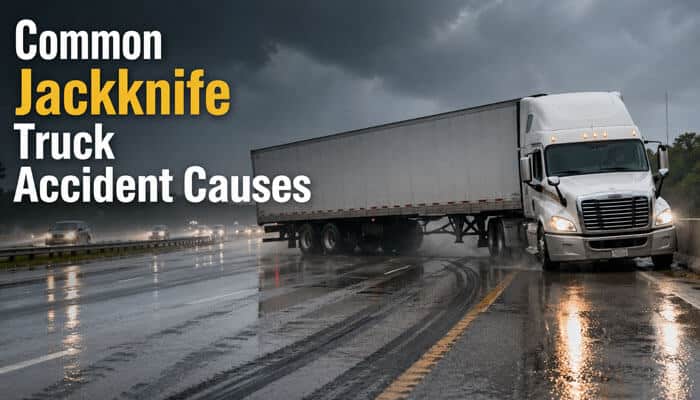
A jackknife crash usually occurs when the trailer loses traction or pushes against the cab, causing it to swing sideways. This loss of control can happen within seconds, especially when a truck is moving fast, carrying heavy cargo, braking suddenly, or driving on slippery roads.
1. Sudden or Improper Braking
Hard braking is one of the most common causes of a jackknife truck accident. When a driver brakes too forcefully, the wheels may lock or lose grip. If the cab slows down faster than the trailer, the trailer can swing outward and form a dangerous angle.
Example:
- A driver notices stopped traffic too late.
- The driver brakes suddenly.
- The trailer loses traction.
- The truck begins to skid sideways.
2. Speeding
Speeding increases the risk of losing control because large trucks need much more distance to stop than smaller vehicles. According to the Federal Motor Carrier Safety Administration, large trucks may need up to two football fields to come to a complete stop.
Example:
- A semi-truck enters a curve too quickly.
- The driver brakes while turning.
- The trailer shifts outward due to momentum.
3. Wet, Icy, or Slippery Roads
Low-traction surfaces make jackknife truck crashes more likely. Rain, snow, ice, oil, loose gravel, and road debris can reduce tire grip and make braking harder to control.
| Road Condition | Risk Factor |
| Rain | Reduced traction and longer stopping distance |
| Ice | Suddenly, unpredictable sliding |
| Snow | Higher skidding risk during braking |
| Downhill roads | Extra forward pressure from trailer weight |
| Sharp curves | Reduced stability while turning |
| Oil or debris | Unexpected tire grip loss |
4. Poor Brake Maintenance
Faulty or uneven brakes can create an imbalance between the cab and trailer. If one part of the truck slows faster than the other, the trailer may push forward or swing outward.
Example:
- Trailer brakes are worn.
- The cab slows faster than the trailer.
- The trailer pushes forward and shifts sideways.
5. Improper Cargo Loading
Uneven, overloaded, or unsecured cargo can make the trailer unstable. When cargo shifts during braking or turning, it can change the truck’s weight balance and increase the risk of a jackknife accident.
Example:
- Cargo is unevenly distributed.
- The truck brakes while going downhill.
- The load shifts forward.
- The trailer becomes unstable.
6. Driver Fatigue
Driver fatigue is a common cause of a semi-truck accident because it slows reaction time and affects decision-making. A fatigued driver may respond too late to traffic changes, leading to sudden braking and loss of control.
Example:
- The driver fails to notice slowing traffic.
- The driver reacts at the last moment.
- Sudden braking causes the trailer to skid.
7. Following Too Closely
Large trucks need extra space to stop safely. When a truck follows another vehicle too closely, the driver may not have enough time to slow down gradually.
Example:
- A vehicle ahead stops suddenly.
- The truck driver brakes aggressively.
- The trailer swings sideways from the braking force.
8. Sharp Turns and Curves
Taking curves too fast or braking while turning can destabilize the trailer. This is especially dangerous on highway ramps, steep curves, and wet roads.
Example:
- A truck enters a ramp at high speed.
- The driver brakes mid-turn.
- The trailer loses alignment.
9. Downhill Driving
Gravity increases forward pressure on the trailer when a truck travels downhill. If the driver brakes too sharply instead of controlling speed early, the trailer may push against the cab.
Example:
- A loaded truck descends a steep hill.
- The driver brakes too forcefully.
- The trailer pushes forward and slides.
10. Driver Distraction
Driver distraction is a common cause of a jackknife truck accident because it delays reaction time and reduces awareness. Even a brief lapse in attention can result in sudden braking and loss of control.
Example:
- The driver looks away from the road.
- Traffic slows unexpectedly.
- The driver brakes too late.
- The truck begins to skid.
How Brake Lockup Leads to Jackknifing
Brake lockup happens when the wheels stop rotating, but the truck continues sliding. If the tractor wheels lock, the cab may skid. If the trailer wheels lock, the trailer can lose direction and swing sideways.
Here is the simple physics:
| Step | What Happens |
| Driver brakes suddenly | Wheels slow too quickly |
| Tires lose traction | The truck starts to skid |
| Trailer keeps moving | Trailer pushes forward |
| Cab and trailer angle changes | Jackknife shape begins |
| Driver loses control | The trailer may block lanes or hit vehicles |
Modern braking systems can reduce risk, but no system can fully prevent a jackknife crash if the driver is speeding, braking too hard, or driving too fast for road conditions.
Why Jackknife Truck Accidents Are So Dangerous
A truck jackknife crash is dangerous because the trailer can swing across lanes like a moving barrier. Nearby drivers often have only seconds to react.
Common dangers include:
| Danger | Why It Matters |
| Multi-vehicle crashes | A jackknife truck can block several lanes |
| Underride accidents | Smaller vehicles may slide under the trailer |
| Rollovers | The truck or trailer may overturn |
| Cargo spills | Heavy or hazardous cargo may fall onto the road |
| Fires | Fuel leaks or hazardous cargo can increase danger |
| Road closures | Highways may be blocked for hours |
| Severe injuries | Passenger vehicles absorb much greater impact |
Common Injuries After a Truck Jackknife Crash
Victims of a jackknife crash may suffer serious or life-changing injuries because large commercial trucks are much heavier than passenger vehicles. When a trailer swings across lanes or blocks traffic, smaller vehicles can crash into the truck with extreme force.
Common injuries from a jackknife truck include:
- Traumatic brain injuries
- Neck injuries
- Back injuries
- Spinal cord damage
- Broken bones
- Internal bleeding
- Burns
- Crush injuries
- Soft tissue injuries
- Amputation injuries
- Emotional trauma
- Wrongful death
Because commercial trucks are significantly larger and heavier than passenger vehicles, the impact force in these crashes is often devastating, increasing the risk of long-term or permanent injuries.
Jackknife Truck vs Regular Truck Accident
Truck accidents can take many forms, but not all carry the same level of risk or complexity. Here’s how a jackknife crash compares to other common truck accident types:
| Feature | Jackknife Truck Accident | Regular Truck Accident |
| Main movement | Trailer swings sideways | Direct impact or collision |
| Road impact | Can block multiple lanes | Usually affects fewer lanes |
| Common cause | Skidding, braking, trailer swing | Speeding, distraction, lane change |
| Risk level | Very high | Varies by crash type |
| Multi-car risk | Very high | Moderate to high |
A jackknife truck accident is often more complex because it may involve braking systems, cargo loading, road conditions, trailer movement, and multiple vehicles.
Who Is Liable in a Truck Jackknife Accident?
Determining liability in a jackknife collision is considerably more complex than in a standard car crash. Multiple parties may share legal responsibility simultaneously, and identifying all of them is critical for victims seeking full and fair compensation
| Responsible Party | Possible Reason |
| Truck driver | Speeding, fatigue, distraction, unsafe braking |
| Trucking company | Poor training, unsafe schedules, and negligent hiring |
| Maintenance company | Failed brake or tire repairs |
| Cargo loading company | Improperly loaded or unsecured cargo |
| Truck manufacturer | Defective brakes, tires, or parts |
| Other drivers | Cutting off the truck or forcing sudden braking |
| Government agency | Poor road design or unsafe road maintenance |
A full investigation is often needed to determine who caused the crash.
Evidence Used in a Truck Jackknife Accident Case
A truck accident case involving jackknifing requires strong and well-documented evidence because these crashes often involve multiple factors, including driver behavior, vehicle condition, cargo loading, and road conditions. Establishing what caused the semi-truck jackknife is critical for determining liability and securing fair compensation.
Important evidence may include:
- Police accident report
- Truck black box data
- Driver logbooks
- Brake inspection records
- Tire maintenance records
- Cargo loading documents
- Dashcam footage
- Surveillance footage
- Witness statements
- Road condition photos
- Skid mark evidence
- Weather reports
- Trucking company safety records
- Driver training records
This evidence helps explain how the accident happened. It can show whether the truck was speeding, braking too hard, poorly maintained, overloaded, or affected by road and weather conditions.
It can also help identify who may be responsible, such as the truck driver, trucking company, maintenance provider, cargo loader, or another driver. Strong evidence is important for insurance claims and legal cases.
What to Do After a Jackknife Truck Accident
If you are involved in a semi-truck accident involving jackknifing, your first priority should be safety and medical care. These crashes can be serious because the truck trailer may block several lanes, cause chain-reaction collisions, or leave vehicles in dangerous traffic areas.
Follow these steps after the jackknife truck accident:
- Call 911 immediately.
- Move to a safe area if possible.
- Get medical attention, even if injuries seem minor.
- Take photos of vehicles, road conditions, skid marks, cargo, and injuries.
- Collect witness names and contact details.
- Do not admit fault at the scene.
- Avoid giving recorded insurance statements without legal advice.
- Keep medical bills, repair bills, and accident documents.
- Write down what happened while your memory is fresh.
- Speak with a qualified truck accident attorney if injuries or major damages occurred.
After a jackknife truck blocks two highway lanes, another car crashes into the trailer. The injured driver calls 911, gets medical care, photographs the truck position and skid marks, collects witness contacts, and keeps all medical records. These steps can help support an insurance claim or legal case later.
How Truck Drivers Can Prevent Jackknifing
Truck drivers can reduce the risk of a jackknife crash by using safe speed, smooth braking, proper spacing, and regular vehicle checks.
Important prevention steps include:
- Driving slower in rain, snow, fog, and ice
- Keeping a safe following distance
- Avoiding sudden braking
- Braking before curves, not during turns
- Checking mirrors often
- Inspecting tires and brakes before trips
- Securing cargo properly
- Avoiding distractions
- Taking required rest breaks
- Using gradual steering movements
- Reducing speed on downhill roads
- Avoiding overcorrection during skids
These steps help the driver keep better control of the cab and trailer. A jackknife crash often starts when the trailer loses traction, so smooth driving and enough stopping distance are very important.
Regular inspections also matter because worn brakes, bad tires, or loose cargo can make the trailer unstable. Safe driving habits and proper maintenance can greatly reduce the chance of a jackknife truck accident.
How Trucking Companies Can Prevent Truck Jackknife Crashes
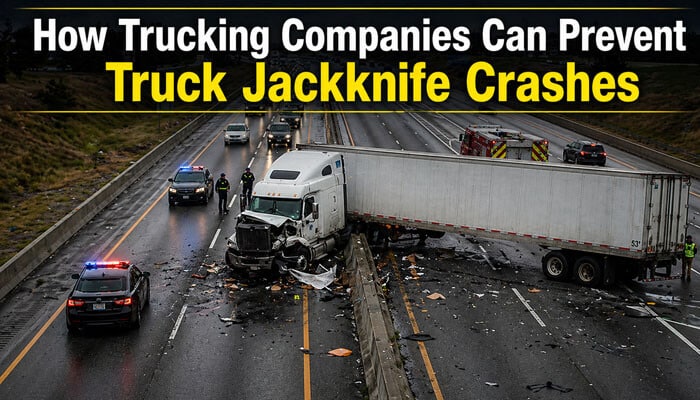
Trucking companies also have safety responsibilities. They can reduce jackknife truck accident risk by:
| Safety Step | Why It Helps |
| Train drivers for bad weather | Reduces unsafe braking and skidding |
| Maintain brakes and tires | Prevents mechanical failure |
| Monitor driver hours | Reduces fatigue-related crashes |
| Inspect cargo securement | Prevents shifting loads |
| Avoid unrealistic delivery schedules | Reduces speeding and pressure |
| Use safety technology | Helps monitor speed and braking |
| Review crash history | Identifies risky driving patterns |
A trucking company that ignores maintenance, training, or safety rules may increase the risk of a serious crash.
How Passenger Drivers Can Stay Safe Around Large Trucks
Passenger drivers cannot control every truck accident risk, but they can significantly reduce danger by driving cautiously around large commercial vehicles. Because trucks are heavier and require longer stopping distances, even small mistakes can lead to serious crashes.
Helpful safety tips:
- Do not cut closely in front of trucks
- Avoid truck blind spots
- Give trucks extra space in bad weather
- Do not tailgate trailers
- Be careful near curves and ramps
- Watch for trailer sway
- Avoid sudden braking near trucks
- Give trucks room to turn
- Slow down if a truck looks unstable
The FMCSA also advises drivers to leave extra space when merging in front of large trucks, as they need much longer distances to stop safely.
Where Jackknife Crashes Commonly Happen
A jackknife truck accident can happen anywhere, but some locations are higher risk.
| Location | Why Risk Is Higher |
| Highways | High speeds and sudden traffic stops |
| Curves | Trailer swing risk increases |
| Downhill roads | Trailer weight pushes forward |
| Bridges | Wind, ice, and limited escape space |
| Construction zones | Sudden lane shifts and braking |
| Intersections | Sudden stops and tight turns |
| Wet roads | Reduced traction |
Imagine a tractor-trailer traveling on a wet highway. Traffic ahead suddenly slows. The truck driver brakes hard, but the trailer wheels lose traction. The cab slows while the trailer keeps sliding forward. Within seconds, the trailer swings across two lanes and blocks traffic.
Conclusion
A jackknife truck accident remains one of the most dangerous road incidents due to the size and force of commercial vehicles. When a trailer swings out of control, it can block multiple lanes, trigger chain-reaction crashes, and cause severe injuries or fatalities.
Understanding how a jackknife truck accident occurs—from sudden braking and slippery roads to poor maintenance and driver fatigue—helps both truck drivers and passenger vehicle drivers stay alert and better prepared. Simple steps like maintaining safe speeds, keeping proper distance, and ensuring regular vehicle inspections can significantly reduce the risk.
While not every incident can be prevented, awareness and responsible driving play a crucial role in improving road safety. Staying informed and cautious is the most effective way to protect yourself and others from the serious consequences of a jackknife truck accident.
If you or someone you know has been involved in a truck jackknife crash, taking the right steps early can make a significant difference. Document the scene, seek medical care, and consider speaking with a qualified attorney to understand your legal options.
Early action can protect both your health and your rights.
Jackknife Truck FAQs
1. What is a jackknife truck accident?
A jackknife truck accident occurs when a semi-truck’s trailer swings sideways and forms a sharp angle with the cab. This usually happens due to sudden braking, loss of traction, or slippery road conditions, often leading to multi-vehicle collisions.
2. What causes a jackknife truck accident?
The most common causes of a jackknife truck accident include sudden or improper braking, speeding, wet or icy roads, poor brake maintenance, improper cargo loading, driver fatigue, and following too closely.
3. Why are jackknife truck accidents so dangerous?
A truck jackknife incident is dangerous because the trailer can block multiple lanes, cause chain-reaction crashes, and lead to severe injuries or fatalities, especially for passengers in smaller vehicles.
4. Who is liable in a jackknife truck accident?
Liability in a jackknife truck accident may involve the truck driver, trucking company, maintenance provider, cargo loading company, or even a vehicle manufacturer, depending on the cause of the crash.
5. How can jackknife truck accidents be prevented?
A jackknife truck accident can be prevented by maintaining safe speeds, avoiding sudden braking, keeping a proper distance, securing cargo correctly, and ensuring regular vehicle maintenance and driver rest.
Disclaimer:
This article is for informational purposes only and does not constitute legal advice. Truck accident laws vary by state, and outcomes depend on the facts of each case. For guidance about your specific situation, consult a qualified truck accident attorney.
Editorial Note:
This article is based on publicly available safety data, transportation regulations, and commonly observed patterns in commercial truck accident investigations. It is designed to provide clear, structured, and research-backed insights into how these accidents occur and how they are handled from both safety and legal perspectives.
Key information is supported by recognized authorities such as the National Highway Traffic Safety Administration and Federal Motor Carrier Safety Administration, along with industry safety practices and legal analysis.
The insights presented reflect common factors identified in real-world accident reports and claim investigations, although each case may involve unique circumstances.
This content is intended for informational purposes only and does not constitute legal advice. Outcomes may vary depending on specific facts, evidence, and jurisdiction.