

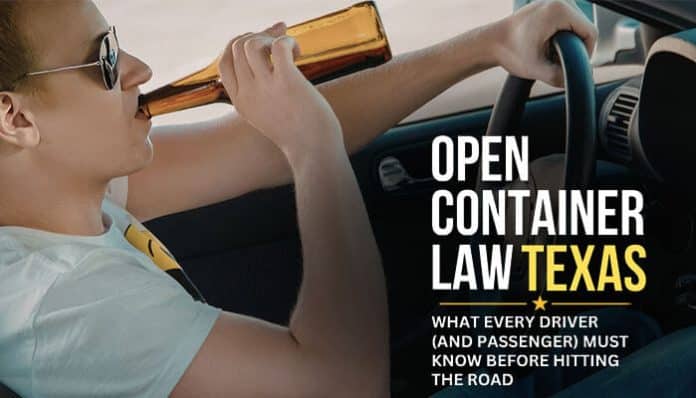

Picture this, you’re on a road trip through Texas with friends. Someone pops open a cold beer in the back seat. Sounds harmless, right? Wrong. What just happened could land everyone in that car in serious legal trouble. The Open Container Law Texas enforces strict regulations about open alcoholic beverages in vehicles, and most people don’t realize the full extent until they’re talking to a police officer by the side of the road.
The open container law Texas enforces is not just about the driver. It covers passengers, too, and that surprises a lot of people. Whether you’re cruising through Dallas, heading to a music festival in Austin, or driving back from a beach day in Galveston, the law applies everywhere on public roads in the state.
What Exactly Is an Open Container Under Texas Law?
Before we get into penalties and exceptions, you need to know what Texas actually means when it says open container.
Under Texas Alcoholic Beverage Code, Section 49.031, an open container is defined as any bottle, can, or other receptacle that:
- Contains any amount of alcoholic beverage, AND
- Is open, has a broken seal, or has been partially removed
So it doesn’t matter if the bottle is half-full or has just one sip missing. If the seal is broken and there’s alcohol inside, that’s an open container by Texas law.
Surprising Things That Count as Open Containers in Texas
Most people think of a cracked-open beer can. But the definition is much wider:
- Re-corked wine bottle: Even if your restaurant recorked it for you, it’s still open
- Flask with a lid: If it has alcohol inside and the original seal is broken, it counts
- Yeti cup or tumbler: A travel mug with a lid full of margarita? That’s an open container
- To-go cocktail cup from a restaurant: Open container if the seal has been broken
- An empty can that’s still cold to the touch: Texas case law says this still qualifies
- Growlers from a craft brewery: If the seal is broken, they’re open containers
Critical Case Law Fact: A container that is technically empty but still cool and has condensation on the outside has been treated as an open container under Texas case law. This is NOT written in the statute, but courts have upheld it. Don’t keep even empty cans in the passenger area.
Who Does the Open Container Law Texas Apply To?
This is where most people get confused. Many assume only the driver is at risk. That’s not true.
1. The Driver
A driver with an open container within reach faces the harshest consequences. If a driver is found with an open alcoholic beverage in the passenger area of the vehicle, it’s a Class C misdemeanor even if they haven’t had a single drink.
2. The Passengers
Passengers can also be ticketed for having an open container. Under Texas law, any person in the passenger area of a motor vehicle who possesses an open container on a public highway can face a fine even if the car is parked.
3. Rideshare and Hired Vehicles
There IS an exception here, and it’s a common one people try to use incorrectly:
- Passengers in for-hire vehicles (like taxis or party buses) may drink in some circumstances
- Passengers in self-driven rideshares like Uber or Lyft generally do NOT qualify for this exception
- The exception applies when the living/passenger area is separate from the driver’s area (like a limousine)
Where Does This Law Apply?
The open container law Texas enforces applies on public highways and roads. This includes:
- Freeways and interstates
- City streets
- County roads
- Highway rest stops and pull-offs
- Public parking lots connected to roads
Where it does NOT apply:
- Private property (like your own driveway)
- Certain permitted outdoor areas (like designated entertainment districts)
- Some cities with specific entertainment district permits (more on that below)
The Passenger Area Explained: Know Exactly What’s Off-Limits
The law specifically covers the passenger area of a vehicle, the area designed for the driver and passengers to sit. Here’s the breakdown in plain English:
| Location | Open Container Allowed? |
|---|---|
| Driver’s seat / front seat | No |
| Back seat / floor | No |
| Center console | No |
| Door pockets | No |
| Cup holders | No |
| Under the seats | No |
| Locked glove compartment | Yes |
| Trunk of a car | Yes |
| Behind the last upright seat (SUV/van) | Yes, if not accessible |
| Bed of a pickup truck (on public road) | No |
The within reach test is the one police use in practice. If a seated driver or passenger can reach it without getting out of the car, it’s in the wrong spot.
Open Container Law Texas: Penalties at a Glance
Here’s a quick-reference table so you can see the consequences clearly:
| Violation | Who It Applies To | Penalty |
|---|---|---|
| Passenger with open container | Any passenger | Fine up to $500 (Class C Misdemeanor) |
| Driver with open container (sober) | Driver only | Fine up to $500 (Class C Misdemeanor) |
| Driver with open container + DWI | Driver | Up to $2,000 fine + jail time (Class B Misdemeanor minimum) |
| Driver with open container + DWI (prior record) | Driver | Enhanced penalties, possible felony charges |
| Minor with open container | Anyone under 21 | Separate charges under MIP laws (Minor in Possession) |
Note: A DWI charge combined with an open container automatically raises the minimum jail time to 6 days, even on a first offense. This is a key detail most people don’t know.
The Hidden Penalty Nobody Talks About: Your Permanent Criminal Record
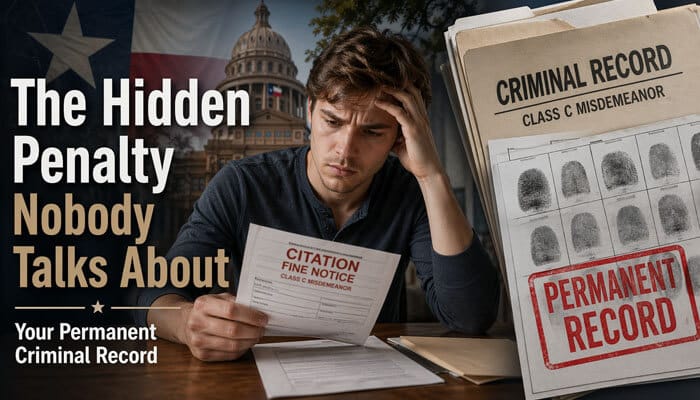
Here’s the part that shocks most people, especially young Texans. A Class C misdemeanor sounds harmless. No jail. Just a fine. Pay it and move on, right?
Wrong.
When you pay that $500 fine in Texas without fighting it, you may be admitting guilt and that creates a permanent criminal conviction on your record. It doesn’t go away on its own. And that record follows you:
- Job applications: Many applications ask if you’ve been convicted of a crime. You must disclose it. Employers in healthcare, education, law enforcement, finance, and government will see it.
- Professional licenses: Real estate agents, nurses, teachers, and many other licensed professionals in Texas can have licenses denied, suspended, or revoked based on criminal convictions.
- Security clearances: Any alcohol-related conviction can flag you during a federal background check.
- College financial aid: A conviction can affect your eligibility for certain scholarships and federal financial aid programs.
- College admissions: Many schools ask about criminal history in their applications.
- Auto insurance rates: Insurance companies view any alcohol-related conviction as a risk signal. Expect your premiums to go up.
Key Takeaway: An open container ticket is NOT like a speeding ticket. It’s a criminal charge. Treat it like one.
The Passenger Area Rule
The law specifically covers the passenger area of a vehicle. This is defined as the area designed for the driver and passengers to sit basically the cab of your car.
Here’s what this means in practice:
- Alcohol stored in a locked glove compartment is okay
- Alcohol in the trunk of a car is okay
- Alcohol behind the last upright seat in a vehicle with no trunk (like an SUV or pickup) is okay if it’s not accessible
- Alcohol on the back seat, the floor, or in a cup holder is NOT okay, even if sealed, but already opened
- Alcohol in a center console is typically NOT okay (considered within reach)
5 Practical Tips to Stay Out of Trouble
You don’t need to be a lawyer to protect yourself. You just need to be smart.
- Tip 1: Just Put It in the Trunk: The safest place for any opened or unopened alcohol in your car is the trunk. If your vehicle doesn’t have a trunk (SUV, van, truck), put it as far back as possible behind the last row of seats.
- Tip 2: Never Trust the I Was Just Holding It Defense: Texas law doesn’t care who owns the drink. If it’s in your hand in the passenger seat, you’re liable. Period.
- Tip 3: Reseal Doesn’t Mean Okay: Just twisting the cap back on a partially drunk bottle doesn’t remove the open container label. Once it’s open, it’s open under Texas law.
- Tip 4: Know Your Rideshare Rights: If you’re in an Uber or Lyft, do not assume you can drink. The partition exception doesn’t apply to most rideshare cars. When in doubt, wait until you’re at your destination.
- Tip 5: Parties on Wheels Still Follow the Law: Renting a van with friends for a road trip? Unless it’s a properly licensed party bus with a professional driver and a physical separation between driver and passengers, everyone needs to keep it sealed.
The Full List of Exceptions to the Open Container Law Texas
The Open Container Law Texas can be confusing for many, and while some articles briefly mention a few exceptions, we’re here to give you the full picture. Here are the key exceptions to the Open Container Law Texas:
Exception 1: Paid Transportation Vehicles
Passengers in for-hire transportation may have open containers.
This includes:
- Taxis
- Limousines
- Party buses (when properly licensed)
- Public buses
Important: The exception applies because the driver’s area is physically separated from the passenger area. Uber and Lyft do NOT qualify their cars are standard vehicles without a partition.
Exception 2: RV and Motorhome Living Quarters
The residential living area of a motorized home is not legally considered the passenger area of a vehicle. This means:
- Passengers in the living section (beds, kitchen area, couch) of a motorhome, self-contained camper, or RV may have open containers
- The driver’s cab is completely separate and still subject to the normal open container rules
- Warning: If someone hands a beer forward from the back of an RV into the cab area, that’s a violation of the Open Container Law Texas.
Exception 3: Locked Glove Compartment or Trunk
As discussed, storing opened alcohol in a locked glove compartment or trunk is perfectly legal. The key word is locked for the glove compartment.
Exception 4: Tailgating at Designated Areas
College campuses and sports arenas sometimes have designated tailgating zones where consumption of alcohol is legally permitted even on public or semi-public property. However:
- These exemptions are venue-specific and event-specific
- They do NOT apply to streets or roads near the venue
- Once you’re back inside a vehicle on a public road, the Open Container Law Texas goes back into effect.
Exception 5: Boats on Texas Waterways
Open containers are legal on boats in Texas. You can have a beer on Lake Travis, Lake Conroe, Galveston Bay, or any other Texas waterway. However:
- Boating While Intoxicated (BWI) is illegal and carries the same serious penalties as DWI
- The open container law is a motor vehicle law; boats are a different legal category
The School Zone Rule: A Law Most People Have Never Heard Of
Under Texas Alcoholic Beverage Code Section 101.75, it is a separate Class C misdemeanor to possess or consume an open container on a public street, alley, or sidewalk within 1,000 feet of a school (including elementary, middle, and high schools, public or private).
This is a separate offense from the motor vehicle open container law. So if you’re cited near a school with an open container in your car, you could potentially face two separate charges.
This applies to:
- Public schools
- Private schools
- Parochial (religious) schools
- Pre-K through 12th grade facilities
The To-Go Cocktail Problem: What Texas Restaurant Diners Need to Know
Texas law now allows many restaurants to offer to-go alcoholic beverages, cocktails, wine, and beer to dine-in customers. This is a newer development that has created a lot of confusion.
Here’s what you need to know before you grab that to-go margarita and hop in your car:
- Taking a to-go cocktail from the restaurant is legal if properly sealed by the establishment
- A re-corked wine bottle from dinner is legal to transport if stored correctly
- A to-go cup sitting in your cup holder is a violation even if it has a lid
- A re-corked bottle on the passenger seat is a violation
- Both items are fine in your trunk or locked glove compartment
What Happens If You Get Pulled Over With an Open Container?
Here’s the realistic sequence of events so you’re not caught off guard:
- Officer spots or smells alcohol in the vehicle
- Officer asks driver (and sometimes passengers) if there’s an open container
- Lying to the officer makes things worse. Cooperate calmly
- If found, driver may face a field sobriety test even if they claim not to have been drinking
- If sober, the ticket is written up as a Class C misdemeanor, a fine, no arrest typically
- If ANY sign of impairment, DWI investigation begins, and the open container becomes an aggravating factor
What NOT to Do This Is Critical
- Do not hide the container or throw it outside the window. This is tampering with evidence, a higher-level criminal offense
- Do not reach under the seat or towards the container. Officers may see this as a threat
- Do not lie about what’s in the car; it makes everything worse
- Do not try to flee. Evading in a vehicle is a felony in Texas, far more serious than an open container ticket
- Do remain calm, provide your license and insurance, and keep your answers minimal
- Do politely decline to answer additional questions until you speak with an attorney
Legal Defense Strategies That Actually Work
An open container citation is not automatically a conviction. A skilled Texas defense attorney can challenge the charge in several legitimate ways:
Defense 1: No Reasonable Suspicion for the Traffic Stop
Police cannot pull you over without a specific, articulable reason. If the stop itself was unlawful, the evidence gathered from it (including the open container) may be inadmissible.
Defense 2: Unlawful Search
If the container was not visible from outside the vehicle, the officer needed a legal reason to search. If that search was conducted without a valid warrant or probable cause, the evidence could be thrown out.
Defense 3: You Didn’t Know It Was There
Texas law requires knowing possession. If a passenger brought an open container into your car without your knowledge, and they are willing to state that it’s a valid defense. The law doesn’t make you automatically responsible for everything in your car.
Defense 4: It Wasn’t in the Passenger Area
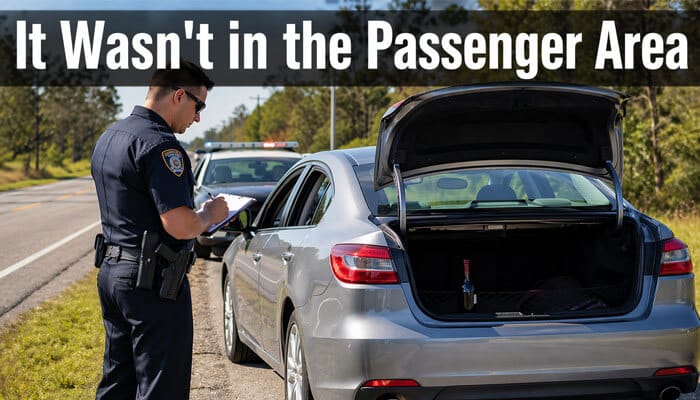
If the container was in the trunk, behind the last seat, or in a locked glove compartment, there’s no offense. The officer’s report must accurately reflect where it was found.
Defense 5: The Item Didn’t Meet the Legal Definition
Was it actually an open container? Was the seal truly broken? Was there alcohol in it? These definitions are specific under Texas law, and an attorney can challenge whether the item actually met the legal standard.
The Open Container + DWI Combination: Why It’s So Much Worse
If you are stopped for DWI and also have an open container, things escalate significantly. Here’s what changes with an open container DWI enhancement:
| Factor | DWI Only (First Offense) | DWI + Open Container (First Offense) |
|---|---|---|
| Charge Level | Class B Misdemeanor | Class B Misdemeanor |
| Minimum Jail Time | 72 hours | 6 days (mandatory judge cannot waive) |
| Maximum Jail Time | 180 days | 180 days |
| Maximum Fine | $2,000 | $2,000 (often pushed to maximum) |
| License Suspension | Up to 1 year | Up to 1 year (more likely to be applied) |
| Insurance Impact | Significant | More significant |
Those extra three days in jail might not sound like much, but for most working Texans, six mandatory days behind bars can mean losing a job, missing rent, or missing time with family. And the judge has no ability to reduce it.
Implied Consent: The Law That Connects Open Container to DWI Investigations
When you get a Texas driver’s license, you automatically agree to implied consent, meaning you agree to submit to a chemical test (breath or blood) if lawfully arrested for DWI.
Here’s why this matters in an open container stop:
- An open container gives an officer probable cause to begin a DWI investigation
- That investigation can lead to a breath or blood test
- Refusing the test results in an automatic license suspension 180 days for a first refusal, two years for a second
So what starts as a simple open container encounter can quickly become a situation where your driving privileges are on the line, even if you haven’t been drinking.
Special Texas Entertainment Districts
Some cities in Texas have created special entertainment districts where different rules apply. For example:
- Sixth Street in Austin has areas where open containers are allowed on foot
- The Stockyards in Fort Worth has similar designated zones
- Sundance Square in Fort Worth and parts of Deep Ellum in Dallas may have designated areas
These exceptions apply to pedestrians walking on public streets within those zones, NOT to people inside vehicles. The moment you get into a car on a public road, the open container law Texas enforces kicks back in no exceptions.
Open Container Law Texas vs. Other States – How Does Texas Compare?
| State | Passengers Allowed to Drink? | Open Container Fine |
|---|---|---|
| Texas | No | Up to $500 |
| Mississippi | Yes (certain roads) | N/A in some areas |
| Missouri | Yes (passengers only) | Varies |
| California | No | Up to $1,000+ |
| Florida | No | Up to $90 (first offense) |
| Nevada | Yes (passengers in some areas) | Varies |
Texas is stricter than many people expect, especially compared to neighboring states people might be used to.
Open Container Law Texas for Minors: Extra Consequences
If you’re under 21 in Texas, an open container situation gets significantly more serious.
- Minors face Minor in Possession (MIP) charges under Texas Alcoholic Beverage Code Section 106.05, on top of the open container charge
- MIP charges can include fines, community service, alcohol awareness classes, and license suspension
- A conviction as a minor can affect college admissions, scholarships, and job opportunities for years
- However, under TABC Section 106.04(b), a minor may legally possess and consume alcohol in the visible presence of a parent or legal guardian or spouse of legal drinking age a narrow but real exception
The Bottom Line
The open container law Texas enforces isn’t trying to ruin your fun. It’s designed to keep Texas roads safer for everyone, including you. And the good news is, staying compliant is genuinely simple: keep your alcohol sealed, or put it where the law says it belongs, your trunk, your locked glove box, or behind the last seat.
Whether you’re a college student heading to a weekend event, a family on a road trip, or someone who just grabbed a six-pack from the store, knowing this law protects you. Ignorance isn’t a defense in Texas courts, and police officers have seen every excuse in the book.
Take Action Before Your Next Road Trip
Before you hit the road in Texas do this:
- Move all opened or partially consumed alcohol to your trunk
- Tell your passengers about this law (you’re responsible for what’s in your car)
- If you’re in a rideshare, keep drinks sealed until you reach your destination
- If you’ve been charged with an open container violation, consult a Texas traffic attorney. Some charges can be reduced or dismissed with proper legal help
Open Container Law Texas FAQs
1. Can I drink in the back of a pickup truck in Texas?
No. The bed of a pickup truck on a public road is still covered under Texas open container law. You may not possess or consume alcohol back there while the vehicle is on a public highway.
2. What if the car is parked and turned off?
The law still applies on public roads and public parking areas. If you’re parked on a public street with an open container, you can still be cited.
3. Does a sealed wine bottle I’m transporting count?
A: If it has never been opened and the seal is intact, no, it’s not an open container. The issue arises only when the seal has been broken.
4. Can a passenger drink a beer if the driver isn’t drinking?
No. Both the driver AND the passenger can be individually cited under Texas open container law.
5. What’s the difference between open container and DWI in Texas?
Open container is about possession of an open alcoholic beverage in a vehicle. DWI is about operating a vehicle while impaired. You can get an open container charge without a DWI, but having both makes everything significantly worse for you legally.
Disclaimer:
This article is for informational purposes only and does not constitute legal advice. If you are facing charges related to the open container law in Texas, please consult a licensed Texas attorney.