



If you or a family member lived at Marine Corps Base Camp Lejeune between 1953 and 1987 and later developed a serious illness, you may be eligible to file a claim under the Camp Lejeune Justice Act as part of the Camp Lejeune Mass Tort.
But confusion remains.
- Is this a class action?
- Do you need a lawyer?
- How long does it take?
- What compensation is realistic?
This article provides clear, legally grounded answers — without exaggerated promises or marketing hype.
Camp Lejeune Mass Tort: Eligibility, Process, Deadlines & Realistic Expectations (U.S.)
What Is the Camp Lejeune Mass Tort?
Between 1953 and 1987, drinking water at Camp Lejeune was contaminated with industrial solvents, including:
- Trichloroethylene (TCE)
- Perchloroethylene (PCE)
- Benzene
- Vinyl chloride
Decades later, many former Marines, family members, and civilian workers developed serious illnesses.
In 2022, Congress passed a law allowing affected individuals to sue the federal government. These cases are filed in the United States District Court for the Eastern District of North Carolina.
Important: This Is Not a Class Action
The camp lejeune mass tort is not a single group lawsuit where everyone gets the same payout.
Instead:
- Each person files individually
- Each case is evaluated separately
- Compensation depends on personal medical history and proof
Who Qualifies to File a Camp Lejeune Mass Tort Claim?
You may qualify if:
- You lived or worked at Camp Lejeune
- For at least 30 cumulative days
- Between August 1, 1953 and December 31, 1987
- And later developed a related illness
Both veterans and civilians may qualify.
What Illnesses Are Commonly Claimed?
Some of the most frequently cited conditions include:
- Kidney cancer
- Liver cancer
- Bladder cancer
- Leukemia
- Parkinson’s disease
- Non-Hodgkin’s lymphoma
Not every illness qualifies automatically. Medical documentation is critical.
How the Camp Lejeune Mass Tort Process Works
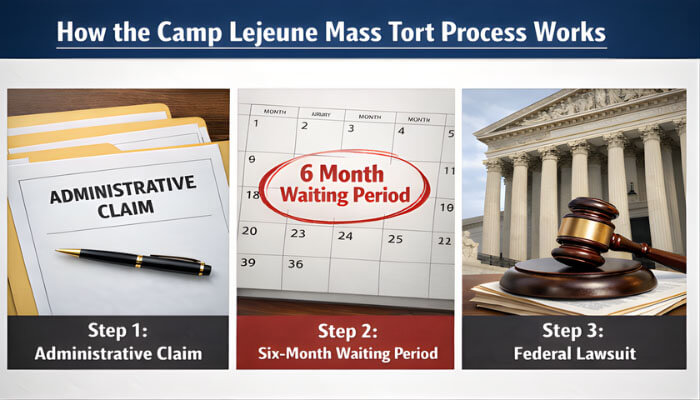
Here is the simplified legal pathway:
Step 1: Administrative Claim
Before filing a lawsuit, you must submit a claim to the U.S. Navy.
Step 2: Six-Month Waiting Period
The government has six months to:
- Accept the claim
- Deny it
- Or take no action
Step 3: Federal Lawsuit
If unresolved, you may file in federal court in North Carolina.
What This Means in Practice
These cases can take time. There is no guaranteed fast settlement.
Filing Deadlines: Do Not Ignore This
The Camp Lejeune Justice Act created a limited window to file claims.
Missing deadlines may permanently bar recovery.
If you believe you qualify, do not delay gathering records and seeking guidance.
Do You Need a Lawyer for a Camp Lejeune Mass Tort?
Many people ask this directly.
When a Lawyer Is Usually Needed
- You have a serious illness like cancer
- Medical history is complex
- You are filing a wrongful death claim
- Your administrative claim is denied
Mass tort litigation against the federal government is procedurally complex.
When Some People Try Without One
- Clear documentation
- Straightforward exposure history
- Strong medical records
However, errors in filing can cause delays or dismissal.
How Attorneys Typically Charge
Most firms work on contingency:
- No upfront payment
- Fee is a percentage of recovery
- Often between 30%–40%
Costs and fee structures vary by firm.
Practical takeaway: For serious illnesses, legal representation is usually advisable.
How Compensation Is Calculated
There is no fixed payout chart.
Compensation depends on:
- Type and severity of illness
- Length of exposure
- Age
- Lost income
- Medical expenses
- Pain and suffering
Large settlements are possible, but they are not automatic.
Online claims of guaranteed million-dollar payouts are often misleading.
Real-World Example
Example:
A Marine stationed at Camp Lejeune from 1978–1980 who later developed kidney cancer and has documented medical treatment may have a stronger claim than someone who:
- Stayed only briefly
- Lacks medical documentation
- Has an unrelated condition
Each case turns on proof.
Common Myths About the Camp Lejeune Mass Tort
Myth 1: Everyone gets paid the same.
Fact: False. Each case is individualized.
Myth 2: Living there automatically guarantees compensation.
Fact: Exposure + illness + proof are required.
Myth 3: This will resolve quickly.
Fact: Federal mass tort litigation is often slow.
Camp Lejeune Mass Tort Marketing Campaign & Lead Generation (For Law Firms)
For legal professionals, there is also significant interest in:
- camp lejeune mass tort marketing campaign
- camp lejeune mass tort case leads
- camp lejeune mass tort lead generation
Because these claims are centralized and time-limited, advertising competition increased significantly after passage of the Camp Lejeune Justice Act.
Camp Lejeune Mass Tort Marketing Campaign Strategy
Effective campaigns typically focus on:
- Clear eligibility education
- Geographic targeting (nationwide veterans)
- Ethical advertising compliance
- Realistic messaging
Avoid:
- “Guaranteed compensation” language
- False urgency
- Misleading statistics
Ethics rules from state bar associations apply.
Camp Lejeune Mass Tort Case Leads: Quality Matters
High-quality leads generally include:
- Confirmed residence dates
- Documented diagnosis
- Military or employment records
Low-quality leads may:
- Lack proof
- Be duplicated from lead vendors
- Include non-qualifying illnesses
Firms should track cost per lead (CPL) and intake screening rates carefully.
Camp Lejeune Mass Tort Lead Generation Risks
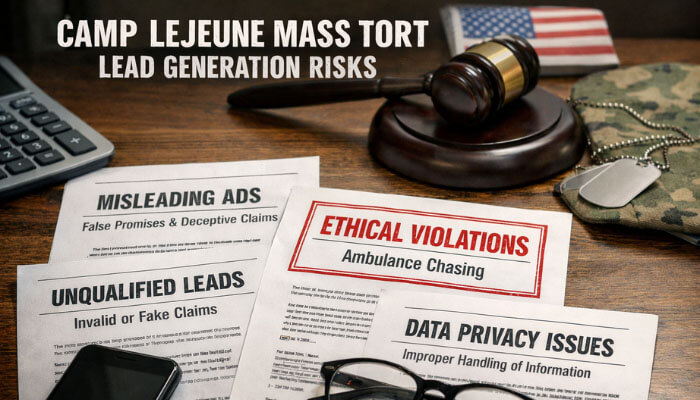
Third-party lead generation can:
- Increase acquisition costs
- Produce duplicate leads
- Create compliance risks
Long-term strategy often favors:
- Organic SEO
- Educational content
- Intake screening systems
Practical Next Steps
If You Lived at Camp Lejeune
- Gather service or residency records
- Collect medical documentation
- Confirm dates of exposure
- Consult a qualified attorney to review your case
If You Are a Law Firm
- Focus on education-based content
- Prioritize ethical compliance
- Screen leads carefully
- Track intake quality over volume
Final Summary
The camp lejeune mass tort allows individuals harmed by water contamination at Marine Corps Base Camp Lejeune in North Carolina to seek compensation under federal law.
It is:
- Not a class action
- Not automatic compensation
- Not a guaranteed fast payout
Understanding eligibility, deadlines, and documentation requirements is essential before filing.
Legal Disclaimer
This article provides general information about the camp lejeune mass tort and the Camp Lejeune Justice Act. It is not legal advice and does not create an attorney-client relationship. Laws and procedures can change, and outcomes depend on individual facts. If you believe you may qualify for a claim, consider speaking with a licensed attorney about your specific situation.
FAQs
1. How much is the Camp Lejeune lawsuit payout per person?
There is no fixed payout. Compensation under the Camp Lejeune Justice Act depends on illness severity, exposure length, medical costs, and proof. Each case is evaluated individually.
2. What evidence is needed for a mass tort claim?
You need proof of residence or service at Marine Corps Base Camp Lejeune for at least 30 days (1953–1987), plus medical records showing a qualifying illness.
3. How do I check the status of my Camp Lejeune claim?
Contact your attorney or the Navy’s Tort Claims Unit. If a lawsuit was filed, updates may appear in the United States District Court for the Eastern District of North Carolina docket.
4. What is the Camp Lejeune lawsuit?
It is a mass tort allowing people exposed to contaminated water at Marine Corps Base Camp Lejeune to seek compensation under the Camp Lejeune Justice Act. It is not a class action.
5. Is Camp Lejeune a class action lawsuit?
No. The Camp Lejeune litigation is a mass tort, not a class action.
Each claimant files individually, and compensation depends on personal medical evidence and proof of exposure.
6. Can family members file a Camp Lejeune lawsuit?
Yes. Spouses, children, and civilian workers who lived or worked at Marine Corps Base Camp Lejeune for at least 30 cumulative days during the exposure period may qualify if they later developed a related illness.
Wrongful death claims may also be possible.