



If you are searching for the ford transmission lawsuit, you are likely dealing with shifting problems, hesitation, jerking, or even safety concerns in your vehicle. Many complaints involve Ford’s 10-speed automatic transmission, especially the 10R80 model used in popular trucks and SUVs.
This guide explains:
- What the lawsuits claim
- Which vehicles are involved
- What legal options drivers have (class action vs lemon law)
- Whether you need a lawyer
- What to do next
This article focuses primarily on U.S. law, and lemon law rights vary by state.
What Is the Ford Transmission Lawsuit About?
The ford transmission lawsuit centers on allegations that certain 10-speed automatic transmissions — particularly the 10R80 — have design or manufacturing defects.
Drivers report:
- Hard or delayed shifting
- Sudden jerking or lunging
- Slipping between gears
- Hesitation when accelerating
- Harsh downshifting
- Transmission failure at low mileage
Some lawsuits argue that Ford knew about these issues but continued selling vehicles without properly fixing the root cause.
The main legal theories include:
- Breach of warranty
- Consumer protection violations
- Failure to disclose known defects
What Is the Ford 10R80 Transmission?
The 10R80 is a 10-speed automatic transmission co-developed by Ford Motor Company and General Motors.
It was marketed as:
- Improving fuel economy
- Providing smoother shifting
- Enhancing towing performance
However, many drivers report ford 10 speed transmission problems, especially in:
- Ford F-150
- Ford Expedition
- Ford Mustang
- Ford Ranger
- Ford Explorer
(Model years vary by claim and lawsuit.)
Common Ford Transmission Problems Reported
Here is a simplified breakdown:
| Problem | What It Feels Like | Why It Matters |
| Hard shifting | Sudden jerk between gears | Can feel unsafe |
| Delayed engagement | Press gas, car hesitates | Dangerous in traffic |
| Gear slipping | RPMs rise but car doesn’t move normally | Loss of control risk |
| Sudden downshift | Car slows abruptly | Rear-end collision risk |
| Transmission failure | Vehicle won’t move | Expensive repair |
Some drivers say software updates helped temporarily. Others say the issue returned.
What Is the Ford Transmission Class Action Lawsuit?
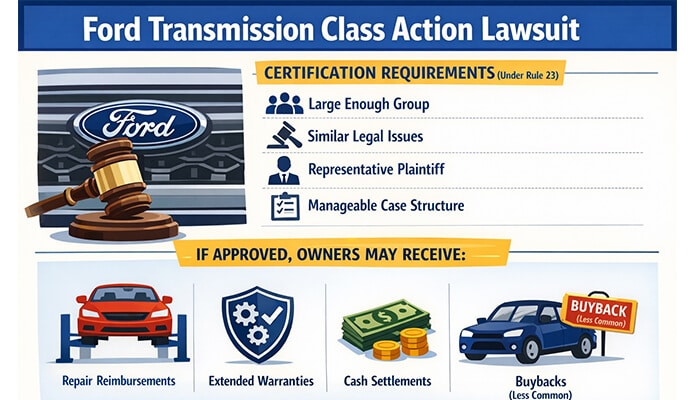
A ford transmission class action lawsuit is when one or more vehicle owners sue on behalf of many drivers with similar issues. Instead of everyone filing separately, the court treats the group as one case.
To move forward, the lawsuit must be certified under Federal Rule of Civil Procedure 23, which requires:
- A large enough group
- Similar legal issues
- A representative plaintiff
- A manageable case structure
If approved, affected owners may receive:
- Repair reimbursements
- Extended warranties
- Cash settlements
- Buybacks (less common in class actions)
Ford Class Action Lawsuit Transmission vs Lemon Law: What’s the Difference?
This is where many online articles stop — but this distinction is critical.
| Feature | Class Action | State Lemon Law Claim |
| Who files? | Group of owners | Individual owner |
| Speed | Often slow | Usually faster |
| Compensation | Shared settlement | Buyback or replacement possible |
| Control | Lawyers control case | You control your case |
| Best for | Large defect affecting many | Vehicle that repeatedly fails |
If your vehicle has repeated repair attempts and is still under warranty, a lemon law claim in your state may be more powerful than waiting for a class action.
State Lemon Law: Why Your Location Matters
Lemon laws vary by state.
Most states require:
- The vehicle is under warranty
- Multiple repair attempts (usually 2–4)
- The problem substantially affects use, value, or safety
Example:
- In California, 2 repair attempts for a serious safety issue may qualify.
- In Texas, the standards are stricter and may require more documented repair attempts.
This is why state-specific advice matters more than general internet advice.
Do You Need a Lawyer for Ford Transmission Problems?
Not always.
You may NOT need a lawyer if:
- The vehicle is still under warranty
- The dealership fixes the issue permanently
- You are simply requesting repairs
You likely SHOULD consult a lawyer if:
- The problem keeps returning
- The transmission failed completely
- The dealership says “no problem found” repeatedly
- Your vehicle is unsafe to drive
- You are considering a lemon law claim
Many lemon law attorneys charge no upfront fees because fee-shifting laws may require the manufacturer to pay attorney fees if you win.
How Much Could a Ford Transmission Lawsuit Pay?
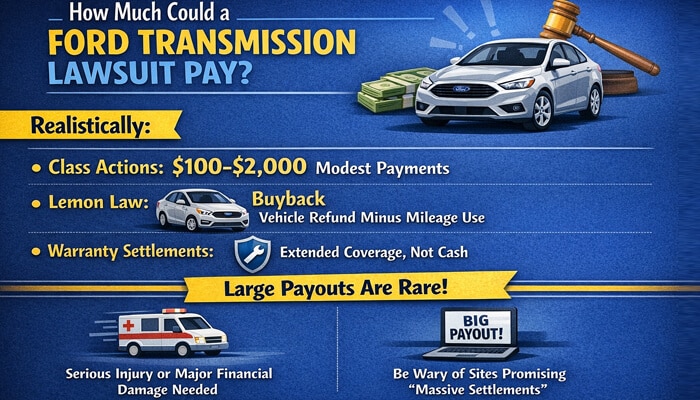
Realistically:
- Class actions: Often modest payments ($100–$2,000 depending on damage)
- Lemon law: Could result in buyback (vehicle refund minus mileage use)
- Warranty extension settlements: Extended coverage instead of cash
Large payouts are rare unless there is serious injury or major financial damage. Be cautious of websites promising “massive settlements.” That is not how most automotive defect cases work.
What Ford Owners Often Overlook
Many online articles focus only on lawsuits. Here are practical steps owners should not ignore:
1. Document Everything
Keep:
- Repair orders
- Service dates
- Technician notes
- Video evidence of symptoms
2. Check for Technical Service Bulletins (TSBs)
Manufacturers sometimes issue software updates or repair procedures.
3. Do Not Wait Too Long
Lemon law rights often expire after:
- A set mileage threshold
- A specific time from purchase
4. Understand Diminished Value
Even if repaired, vehicles with known transmission issues may lose resale value.
What About Warranty Extensions?
In some cases, manufacturers extend warranties after widespread complaints. This may:
- Cover transmission repairs longer
- Avoid a recall
- Reduce immediate repair costs
But warranty extension does NOT automatically mean:
- Buyback
- Refund
- Compensation for inconvenience
Are These Cases Still Ongoing in 2026?
Some claims remain active, while others may have been dismissed or settled. Lawsuits evolve.
If you are considering joining a ford transmission lawsuit, confirm:
- Is the case certified as a class action?
- Is there a settlement?
- What deadlines apply?
Court records and official filings are more reliable than social media posts.
Common Myths About the Ford Transmission Class Action Lawsuit
Myth 1: If there is a class action, I will automatically get paid.
Not true. You may need to submit a claim.
Myth 2: Every hard shift means I qualify for a lawsuit.
Not necessarily. Severity and repair history matter.
Myth 3: Software updates fix everything permanently.
Some owners report recurring problems.
Myth 4: Lemon law and class action are the same.
They are completely different legal processes.
Practical Next Steps If You Have Ford Transmission Problems
- Review your repair history.
- Confirm your vehicle is still under warranty.
- Research your state’s lemon law.
- Consider a consultation if the defect continues.
- Monitor active class action developments.
If your vehicle is unsafe to drive, prioritize safety before legal action.
Final Thoughts on the Ford Transmission Lawsuit
The ford transmission lawsuit centers on serious concerns involving shifting defects in Ford’s 10-speed automatic transmission.
For some owners, waiting for a ford transmission class action lawsuit may make sense.
For others — especially those with repeated repairs — state lemon law may offer a faster and stronger solution.
The key is understanding your options early, documenting your issues carefully, and making a decision based on your state’s laws — not internet headlines.
FAQs
1. How do I submit a claim to a Ford transmission settlement?
If a settlement is approved, you must visit the official court settlement website, confirm your vehicle qualifies, complete the claim form, and submit proof of repairs or ownership before the deadline. If the case is still pending, there may be no claim process yet.
2. Which Ford transmission is being recalled?
Most complaints involve Ford’s 10R80 10-speed automatic transmission. However, a lawsuit does not automatically mean there is a recall. Check your VIN on Ford’s official recall website to see if your vehicle has an active recall.
3. How to join class action lawsuit Ford 10 speed transmission?
If a class action is certified, eligible owners are usually included automatically. You only need to submit a claim if a settlement is approved. Until then, there is nothing to “join.”
4. What years did Ford have bad transmissions?
Many complaints involve model years starting around 2017 and later, especially in vehicles using the 10R80 transmission. Qualification depends on repair history and warranty status — not just the model year.
Disclaimer
This article provides general legal information about the ford transmission class action lawsuit and related consumer rights in the United States. Laws vary by state, and this is not legal advice. If you are facing a specific vehicle defect issue, consider speaking with a qualified attorney in your jurisdiction.