


The Perdon Migratorio I-601, also known as the Application for Waiver of Grounds of Inadmissibility. This is a process that allows individuals to ask the U.S. government to forgive or waive certain reasons that make them inadmissible (not eligible) to enter, stay, or receive certain immigration benefits in the U.S.
This article provides a detailed yet simple explanation of the Perdon Migratorio I-601 waiver in a way that’s easy to understand, even for 8th-grade readers.
What is the Perdon Migratorio I-601?
The Perdon Migratorio I-601 is a form that individuals file with U.S. Citizenship and Immigration Services (USCIS) to request that a specific ground of inadmissibility be forgiven or waived. This waiver can be requested when someone is considered inadmissible for reasons like illegal entry, prior deportation, or criminal history.
In simple terms, if an immigration officer tells you that you cannot enter or stay in the U.S. due to something in your past, the Perdon Migratorio I-601 allows you to request a pardon for that reason under certain conditions.
Why Would Someone Need the Perdon Migratorio I-601?
There are various reasons why a person may be considered inadmissible to the U.S., such as:
- Being in the U.S. without permission or overstaying a visa
- Committing immigration fraud or using false documents
- Having a criminal record
- Being previously deported
- Entering the U.S. without passing through a border official
These situations could prevent someone from obtaining a visa or adjusting their immigration status. The Perdon Migratorio I-601 is used to request forgiveness for the inadmissibility.
Who Can File for the “Perdon Migratorio I-601”?
Generally, individuals who can file for the Perdon Migratorio I-601 must:
- Be involved in an active immigration process (such as an approved family petition)
- Have a close family member in the U.S. who is a citizen or permanent resident (like a spouse, parent, or child)
- Show that the inadmissibility would cause extreme hardship to their qualifying relative if the waiver is not granted
In cases of unlawful presence (being in the U.S. without permission), only certain family members (spouse or parents) can be considered to demonstrate the extreme hardship.
What Does Extreme Hardship Mean?
Extreme hardship is a legal term that means more than just a minor inconvenience or financial difficulty. You need to show that your qualifying family member would be severely impacted if you are not allowed to be with them.
Examples of extreme hardships may include:
- Severe medical conditions that cannot be treated in the home country
- Complete financial dependence on the qualifying relative
- Risk of violence or persecution in the home country
- Significant emotional distress on the qualifying relative
The hardship must be well-documented with proof such as medical records, personal letters, or affidavits.
Documents Required for the Perdon Migratorio I-601
When filing for the Perdon Migratorio I-601, you will need to include:
- Completed I-601 form
- Payment of the filing fee (currently $1,050, but subject to change)
- Copy of your passport or another government-issued ID
- Evidence of your relationship with the qualifying family member
- Proof of extreme hardship
- Any documents related to your inadmissibility (court records, immigration history, etc.)
Ensure that documents not in English are translated.
How to File for the Perdon Migratorio I-601?
Here are the general steps to file for the Perdon Migratorio I-601:
- Identify the reason for inadmissibility
- Gather all necessary supporting documents
- Complete and sign the I-601 form
- Pay the filing fee
- Submit the application to USCIS or the U.S. consulate
- Wait for USCIS’s decision
The process can take anywhere from several months to over a year, depending on the complexity of your case. Processing delays and backlogs can affect the timeline.
What Happens After the I-601 Waiver is Approved?
If your Perdon Migratorio I-601 is approved:
- The grounds for inadmissibility are waived
- You can proceed with your immigration process (such as a consular interview or adjusting your status in the U.S.)
- If you were outside the U.S., you may attempt to receive your visa
If it is denied:
- You can appeal the decision
- You may submit a new application with additional evidence
Tips for denial cases: Always review the reason for the denial and consult with an immigration lawyer to address any gaps in your documentation.
I-601 vs I-601A (Provisional Waiver) Comparison Table
| Feature | I-601 (Immigration Waiver) | I-601A (Provisional Waiver) |
| Where to file? | Inside or outside the U.S. | Only inside the U.S. |
| What does it cover? | Waives general grounds of inadmissibility | Waives only unlawful presence before leaving |
| Requirements | Must have specific inadmissibility grounds | Must be in the U.S. with qualifying family member |
| Processing time | ~12-15 months | ~32+ months (approx.) |
The I-601A waiver is often faster but is available only for those currently inside the U.S. with a qualifying family member.
Important Tips
- Provide clear, convincing evidence of extreme hardship – this is a critical factor in the success of your application.
- Be honest — do not hide any negative facts or past mistakes. Transparency is key to a successful waiver.
- Consult with an experienced immigration lawyer for assistance, especially if your case is complicated.
- Double-check the official instructions for the I-601 form before submitting your application to ensure all documents are correct.
Common Mistakes to Avoid
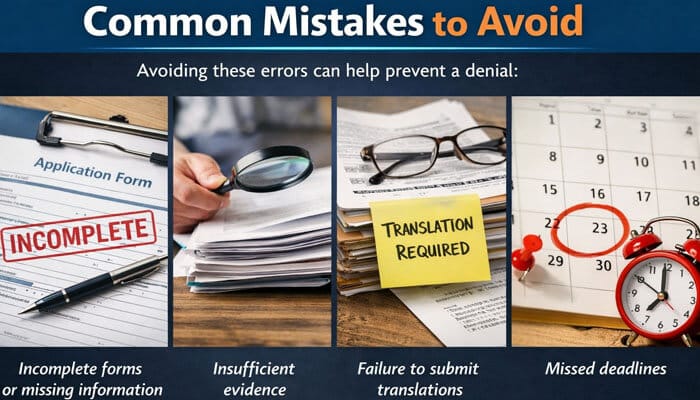
Even with the best intentions, mistakes can happen. Here are some common errors that could result in a denial:
- Incomplete forms or missing information: Make sure every section is filled out completely and accurately.
- Insufficient evidence: Submitting vague or generic hardship evidence can weaken your case. Provide specific, detailed documentation.
- Failure to submit translations: Any non-English documents should be translated and certified.
- Missed deadlines: Ensure your application is submitted before the expiration of any deadlines.
Avoiding these mistakes can increase your chances of approval.
Conclusion
The Perdon Migratorio I-601 is an essential tool for individuals who face inadmissibility, allowing them to request forgiveness and continue their immigration journey. With the right evidence and attention to detail, this waiver can make it possible to receive a visa or adjust immigration status despite previous issues.
This article is your one-stop resource to fully understand the Perdon Migratorio I-601, from the process to the necessary steps for a successful outcome.
Perdon Migratorio I-601 FAQs
1. Can I file Form I-601 without a lawyer?
A: Yes, but many applicants hire a lawyer because waiver cases often require detailed legal arguments and strong evidence.
2. Does filing I-601 give me legal status?
A: No. Filing Form I-601 does not by itself give you lawful status, a visa, or a green card.
Q: Can I work while my I-601 is pending?
A: Not based on Form I-601 alone. You need separate work authorization or another valid immigration status.
Q: Can I travel while my I-601 is pending?
A: Form I-601 does not provide travel permission. Travel depends on your separate status or authorization.
Q: Can USCIS send an RFE for I-601?
A: Yes. USCIS may ask for more evidence if the initial filing is incomplete or needs clarification.
Q: Can I expedite my I-601 case?
A: Sometimes. USCIS may expedite certain cases, but approval is discretionary and requires strong reasons.
Disclaimer: This content is provided for informational purposes only and should not be treated as legal advice. Immigration rules, waiver eligibility, filing procedures, and processing times may change. Always review the latest USCIS guidance and speak with a qualified immigration lawyer about your specific case.
