


Insurance companies play a crucial role in providing financial security to individuals and businesses alike. However, they are not immune to legal disputes. Over time, several lawsuits against insurance companies have made headlines, especially class action lawsuits that have challenged these companies for unfair practices, including bad faith and denial of claims.
This guide provides a comprehensive legal overview, including types of claims, notable cases, litigation strategies, regulatory protections, and practical steps if you’re considering legal action.
Why Do Policyholders Sue Insurance Companies?
Insurance lawsuits generally arise from:
- Wrongful claim denials
- Unreasonable payment delays
- Underpayment of valid claims
- Misrepresentation of policy coverage
- Failure to properly investigate
- Systemic unfair claim practices
At the core of most lawsuits is a legal concept called the duty of good faith and fair dealing — a doctrine requiring insurers to treat policyholders fairly and honestly.
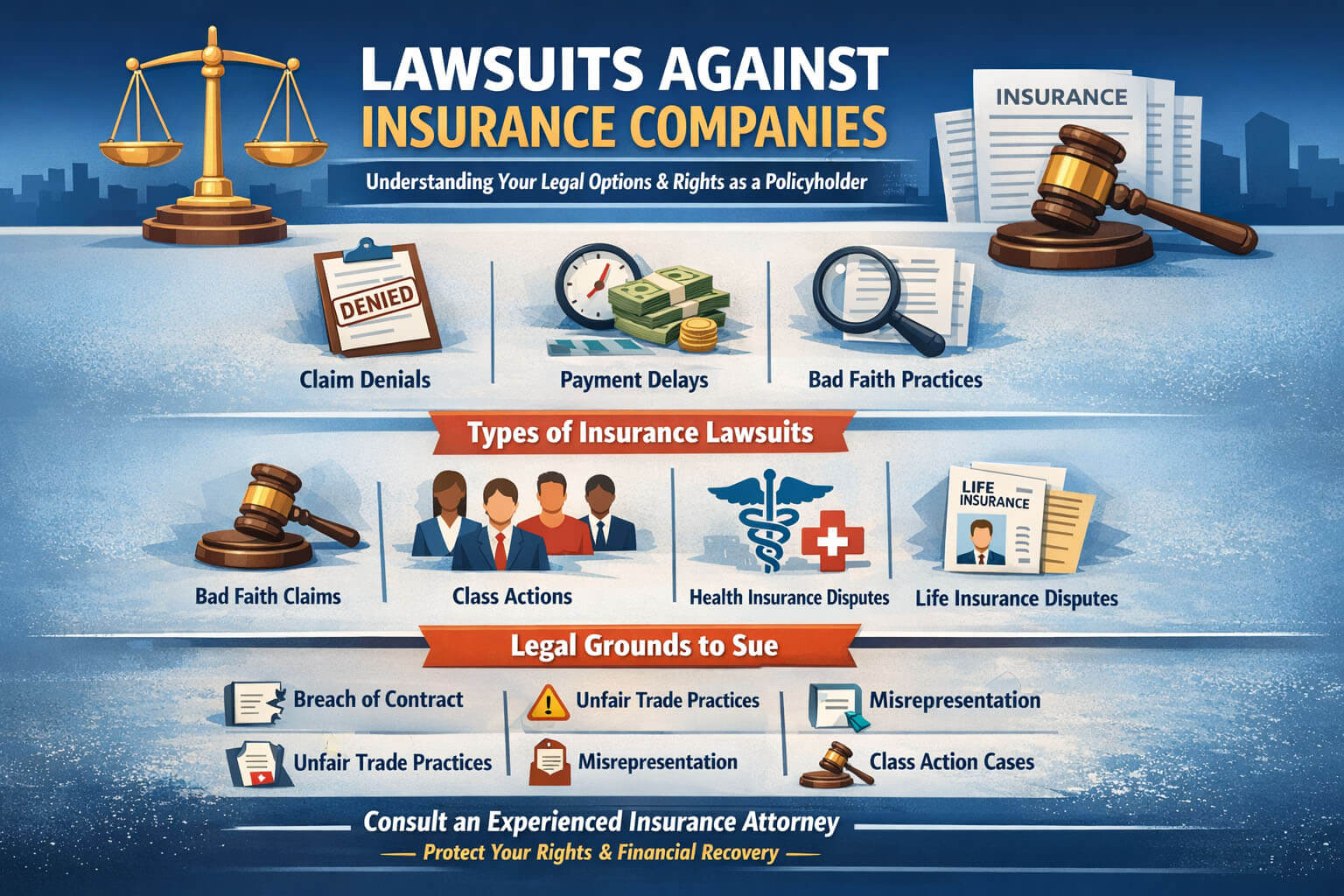
Types of Lawsuits Against Insurance Companies
1. Bad Faith Insurance Lawsuits
A bad faith claim occurs when an insurer unreasonably denies, delays, or underpays a legitimate claim.
Common Examples of Bad Faith:
- Ignoring evidence supporting coverage
- Failing to respond to claim communications
- Delaying investigations without justification
- Offering settlements far below documented losses
- Misinterpreting policy language to avoid payout
Real-World Example: Allstate Bad Faith Litigation
Courts across the U.S. have ruled against Allstate in multiple bad faith disputes involving undervalued property and auto claims. In some instances, juries awarded punitive damages where insurers were found to prioritize internal cost-control policies over fair claims handling.
Legal Impact:
Bad faith cases can allow recovery beyond the policy limits, including emotional distress damages and, in some states, punitive damages.
Key Insight:
Class actions can pressure insurers to change widespread practices but may result in smaller individual payouts compared to separate bad faith lawsuits.
2. Health Insurance Lawsuits
Health insurers face lawsuits when they deny coverage for medically necessary treatments.
Regulatory Framework: Affordable Care Act
The ACA requires insurers to:
- Provide essential health benefits
- Avoid lifetime coverage limits
- Offer internal and external appeals processes
Common Disputes:
- Denial of experimental treatment
- Out-of-network emergency coverage refusal
- Pre-existing condition disputes
- Medically necessary procedure denials
In high-profile cases, courts have ordered insurers to pay for life-saving treatments where denial violated policy language or regulatory protections.
3. Life Insurance Lawsuits
Life insurance disputes often arise during the contestability period (usually first two years after policy issuance).
Typical Reasons for Denial:
- Alleged misrepresentation on application
- Suicide exclusion clauses
- Policy lapse for non-payment
- Ambiguous beneficiary designations
Courts often interpret unclear language against the insurer under the doctrine of contra proferentem — meaning ambiguities are resolved in favor of the insured.
4. Class Action Lawsuits Against Insurance Companies
Class actions arise when a large group of policyholders suffers similar harm due to the same insurer practice.
Common Class Action Allegations:
- Improper depreciation calculations
- Systemic denial of disaster-related claims
- Unlawful premium hikes
- Misleading policy language
Example: Hurricane Claims Litigation – State Farm
Following major hurricanes, thousands of homeowners alleged that State Farm improperly denied or underpaid property damage claims. These lawsuits resulted in significant settlements and changes to claims-handling procedures.
Legal Grounds for Suing an Insurance Company
| Legal Claim | What It Involves | Potential Compensation | Complexity |
| Breach of Contract | Failure to honor policy terms | Policy benefits + interest | Moderate |
| Bad Faith | Unreasonable denial or delay | Benefits + punitive damages | High |
| Misrepresentation | False coverage statements | Rescission or damages | Moderate |
| Unfair Trade Practices | Regulatory violations | Civil penalties + damages | High |
| Class Action | Widespread policyholder harm | Structured settlements | Complex |

How Insurance Companies Protect Against Lawsuits
Large insurers like UnitedHealth Group and Liberty Mutual employ sophisticated defense strategies:
1. Strict Policy Interpretation
Insurers rely heavily on exclusions and definitions to justify denials.
2. Arbitration Clauses
Some policies require binding arbitration instead of court litigation.
3. Compliance Documentation
Insurers maintain extensive internal documentation to demonstrate regulatory compliance.
4. Litigation Strategy
Large insurers have in-house legal teams and national law firms defending claims.
When Should You File a Lawsuit against insurance companies
Consider legal action if:
- Your valid claim was denied without clear reasoning
- The insurer failed to respond after repeated follow-ups
- Settlement offers are unreasonably low
- Appeals were exhausted
- You suspect intentional misconduct
Step-by-Step: What to Do Before Filing a Lawsuit
1. Request written denial explanation
2. Review your policy carefully
3. File a formal internal appeal
4. Submit complaint to your State Department of Insurance
5. Consult an experienced insurance attorney
6. Check statute of limitations deadlines
Statute of Limitations Overview (General U.S. Averages)
| Claim Type | Typical Deadline Range |
| Breach of Contract | 2–6 years |
| Bad Faith | 1–4 years |
| Fraud / Misrepresentation | 2–5 years |
Deadlines vary significantly by state.
Financial Risks & Rewards of Litigation
Potential Benefits:
- Full claim recovery
- Interest on unpaid amounts
- Attorney’s fees (in some states)
- Punitive damages in bad faith cases
Potential Risks:
- Lengthy litigation (1–3+ years)
- Legal costs if unsuccessful
- Emotional stress
Final Legal Insight on Lawsuits Against Insurance Companies
Lawsuits against insurance companies are not uncommon, especially where there is alleged bad faith, systemic denial practices, or misleading policy language. Courts consistently emphasize that insurers must act fairly and uphold contractual obligations.
If you believe your insurer has acted improperly, understanding your legal options early can protect both your financial recovery and your legal rights.
Frequently Asked Questions (FAQs)
1. Can I sue my insurance company for emotional distress?
Possibly. Emotional distress damages are often available in bad faith cases, depending on state law.
2. What qualifies as insurance bad faith?
Unreasonable delay, failure to investigate, misrepresentation, or denying a claim without proper basis.
3. Do most insurance lawsuits settle?
Yes. Many cases settle before trial, especially when strong documentation supports the policyholder.
4. How much does an insurance lawyer cost?
Many insurance attorneys work on contingency fees (typically 25–40% of recovery).
5. Can I sue after accepting a settlement?
Generally no. Most settlements include release agreements preventing further claims.
6. What if my insurer says the damage isn’t covered?
The dispute often centers on policy interpretation. Courts typically interpret ambiguous language in favor of the insured.
7. Can insurance companies be fined by regulators?
Yes. State Departments of Insurance can impose fines, sanctions, or license suspensions.