


If you are asking is eminent domain reserved only for the federal government, the short answer is no.
In the United States, both the federal government and state governments have the power of eminent domain. Cities, counties, and certain agencies may also exercise it under state law.
Understanding how this works requires looking at the Constitution, state authority, and how the process actually plays out in real life.
Eminent Domain Definition
An accurate eminent domain definition is:
The government’s legal power to take private property for public use, as long as it pays “just compensation.”
This power is recognized in the Fifth Amendment to the United States Constitution, which includes what is known as the Takings Clause.
In plain terms:
- The government can take land for a legitimate public project.
- It must pay fair market value.
- The taking must serve a public purpose.
Common examples:
- Highways and road expansions
- Public schools
- Military installations
- Utility pipelines
- Flood control systems
Is Eminent Domain Reserved Only for the Federal Government?
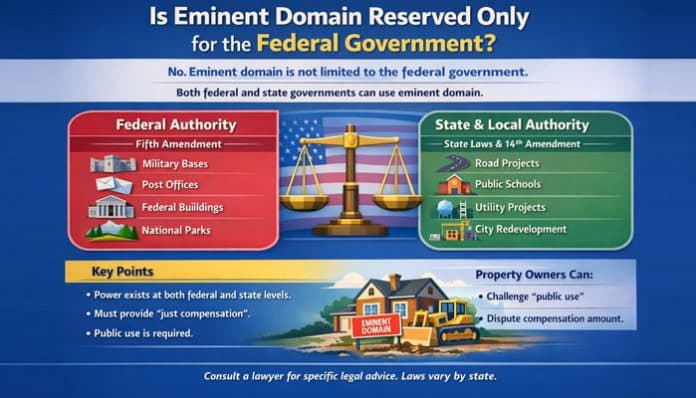
No. Eminent domain is not limited to the federal government.
The United States operates under a system of shared sovereignty (federalism). Both federal and state governments possess inherent sovereign powers — including eminent domain.
Federal Eminent Domain Authority
The federal government has used eminent domain since the early days of the country to:
- Build forts and military bases
- Create post offices
- Develop federal buildings
- Acquire land for infrastructure projects
The U.S. Department of Justice, through its Land Acquisition Section, handles federal condemnations when agencies need property for federal use.
State and Local Authority
States also have sovereign power. Through their own constitutions and statutes, they authorize:
- State transportation departments
- Counties and municipalities
- Public utility commissions
- Certain private utilities (with limitations)
For example, a state department of transportation may condemn land to widen a highway. A city may take land for a public water facility.
Key point:
Eminent domain exists at both the federal and state level because sovereignty is shared in the American system.
Is Eminent Domain in the Constitution?
Yes — but in a specific way.
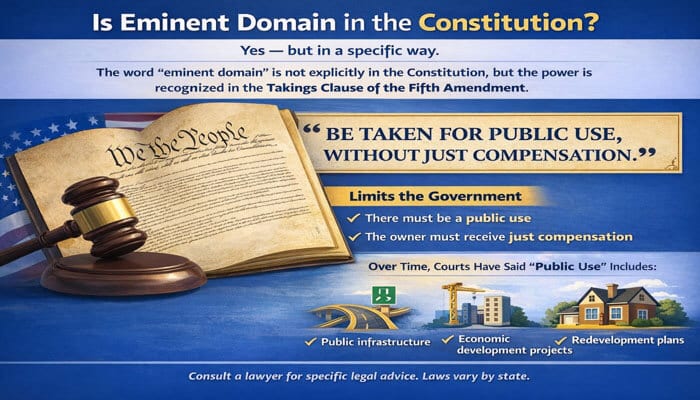
If you are wondering, “is eminent domain in the Constitution?” the word “eminent domain” does not appear explicitly. Instead, the power is recognized in the Takings Clause of the Fifth Amendment to the United States Constitution.
It states that private property shall not:
“be taken for public use, without just compensation.”
This clause limits the government. It does not create unlimited power — it sets conditions:
- There must be a public use
- The owner must receive just compensation
Over time, courts have interpreted what “public use” means. It can include public infrastructure, economic development projects, and redevelopment plans under certain circumstances.
What Amendment Is Eminent Domain?
If you’re searching “what amendment is eminent domain”, the answer is:
The Fifth Amendment.
However, the Fifth Amendment originally applied only to the federal government. Through the Fourteenth Amendment’s incorporation doctrine, courts have held that states must also follow the same “just compensation” rule.
This means:
- Federal takings → Fifth Amendment applies
- State takings → Fifth Amendment protections apply through the Fourteenth Amendment
So while eminent domain is constitutional, it is not unlimited.
How Courts Interpret “Public Use”
One of the most debated issues in eminent domain law is what qualifies as “public use.”
The U.S. Supreme Court has addressed this question in several landmark cases.
1. Berman v. Parker
The Court allowed property to be taken as part of urban redevelopment efforts, even if the property was later transferred to private parties, as long as the broader plan served a public purpose.
2. Kelo v. City of New London
The Court held that economic development can qualify as public use under certain circumstances, even when property is transferred to another private entity.
This decision sparked widespread debate and led many states to pass laws narrowing eminent domain authority.
Courts generally defer to legislative judgment regarding public purpose unless the taking is clearly improper.
Federal vs. State Eminent Domain Powers
| Feature | Federal Government | State & Local Governments |
| Constitutional Basis | Fifth Amendment | Fifth Amendment (via Fourteenth Amendment) + State Constitution |
| Who Uses It | Federal agencies (e.g., military, federal buildings, national parks) | State DOTs, cities, counties, utility authorities |
| Typical Projects | Military bases, post offices, federal courthouses | Roads, schools, utilities, redevelopment projects |
| Court System | Federal court | State court (usually) |
| Governing Law | Federal statutes and regulations | State statutes and procedures |
| Can Owner Challenge? | Yes (public use & compensation) | Yes (public use & compensation) |
Key Takeaway
Eminent domain is a shared governmental power. It is not reserved only for the federal government, but exercised at multiple levels depending on the project.
Can You Refuse Eminent Domain?
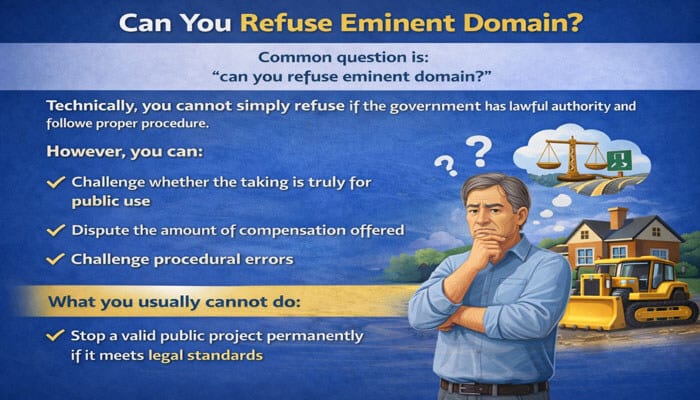
A common question is: “can you refuse eminent domain?”
Technically, you cannot simply refuse if the government has lawful authority and follows proper procedure.
However, you can:
- Challenge whether the taking is truly for public use
- Dispute the amount of compensation offered
- Challenge procedural errors
What you usually cannot do:
- Stop a valid public project permanently if it meets legal standards
What Property Owners Often Contest
Most eminent domain disputes focus on:
- Fair market value
- Business losses
- Access impairment
- Relocation damages
Courts generally defer to the government’s stated public purpose unless it is clearly improper.
Common Misunderstandings About Eminent Domain
Myth 1: Only the federal government can take property.
Fact: States and municipalities regularly exercise this power.
Myth 2: The government can take land without paying.
Fact: Compensation is constitutionally required.
Myth 3: You have no rights once the process starts.
Fact: You have procedural and valuation rights.
Myth 4: “Public use” only means roads and schools.
Fact: Courts have interpreted public use broadly in some cases.
When Do You Need a Lawyer in an Eminent Domain Case?
You do not always need a lawyer — but many property owners consult one because:
- Valuation disputes can be complex
- Appraisal methodology matters
- Commercial property cases are high-value
- Partial takings affect remaining property value
If:
- The offer seems low
- Your business is impacted
- Only part of your land is taken
…professional review may be worth considering.
In smaller residential cases with straightforward valuation, some owners negotiate directly.
Practical Summary
- Eminent domain is not reserved only for the federal government.
- It exists at both federal and state levels.
- It is grounded in the Fifth Amendment.
- Governments must provide just compensation.
- You generally cannot refuse a lawful taking, but you can challenge compensation and procedure.
Final Thoughts
Eminent domain is a constitutional power with limits. It balances public infrastructure needs against private property rights.
If you are facing a condemnation notice:
- Identify whether the authority is federal, state, or local
- Review the stated public purpose
- Evaluate the compensation offer carefully
- Consider whether a valuation review is necessary