


People often say “a deal’s a deal” after shaking hands. But the big question is: Is a handshake legally binding? Can a simple handshake or a spoken agreement really hold up in court?
In this article, we explore the legality of handshake agreements, verbal contracts, and when such informal agreements are legally enforceable. You’ll learn:
- What a handshake agreement is
- How handshake deals are treated under the law
- When a handshake agreement is legally binding
- Are verbal agreements legally binding?
- How courts handle handshake deals
- Tips to ensure your agreement is enforceable
This guide will help clarify when your handshake actually counts as a valid contract and how you can protect yourself in informal agreements.
What Is a Handshake Deal?
A handshake deal is an agreement made between two parties, often without any written documentation. It is typically sealed with a handshake, a nod, or even verbal words. This type of deal relies heavily on mutual trust.
Examples of a Handshake Agreement
- Agreeing to mow a neighbor’s lawn for payment
- Promising to sell a bike for ₹2,000 without writing it down
- Two friends deciding to split the profits from a small project
While a handshake feels like a promise, trust alone doesn’t always make it legally binding. In fact, for a handshake to hold legal weight, it must meet certain criteria under contract law.
Are Verbal Agreements Legally Binding?
A question that often arises is: Are verbal agreements legally binding? Yes, in many cases, verbal agreements can be legally binding. However, several factors determine their enforceability:
When a Verbal Agreement Is Legally Binding
A verbal agreement may be legally binding if:
✔ Both sides clearly agree on the terms
✔ There is an exchange of value (like payment for a service)
✔ No law requires the agreement to be in writing
✔ Both parties have a clear understanding of the terms
When a Verbal Agreement Is NOT Binding
A verbal agreement may not be legally binding if:
✘ The terms are vague or unclear
✘ One party didn’t fully agree to the terms
✘ The law requires the agreement to be written down (more on that later)
✘ There is no physical proof to support the agreement
In essence, verbal agreements can be enforceable, but their success in court often hinges on clear terms and available evidence.
Is a Handshake Legally Binding?
Now, let’s address the big question: Is a handshake legally binding?
It depends. A handshake can be legally binding if the agreement meets the necessary legal criteria. But in many cases, a handshake alone is not sufficient.
Five Elements of a Legally Binding Contract
For any agreement to be legally enforceable — whether verbal, written, or a handshake — it must have these essential elements:
| Contract Element | What It Means |
| Offer | One party proposes terms of the agreement |
| Acceptance | The other party agrees to those terms |
| Consideration | Something of value (money, service, goods) is exchanged |
| Legal Intent | Both parties intend to be legally bound by the agreement |
| Capacity | Both parties are legally able to enter into the contract (not minors or mentally impaired) |
If these elements are clearly met, then the handshake deal may be enforceable under the law. However, a handshake deal by itself is often harder to enforce without clear documentation.
Does a Handshake Hold Up in Court?
The key concern is whether a handshake deal will stand up in court. Does a handshake really hold up in a legal dispute?
What Courts Look For
To enforce a handshake agreement, the court will typically check:
✔ Clear intention by both parties to be legally bound
✔ Clearly defined terms of the agreement (what was promised)
✔ Proof of performance or payment, or partial performance
✔ Any available witnesses or supporting documentation
Challenges of Proof
While handshake agreements can be enforceable, proving the terms in court can be difficult. Without written documentation, you rely on:
- Emails or text messages
- Third-party testimony
- Bank records or receipts
- Notes or records made at the time of the agreement
Without solid proof, a handshake can be your word against theirs, making enforcement challenging.
When Does the Law Require a Written Contract?
Certain agreements, including handshake deals, are not valid unless written down. This is dictated by laws like the Statute of Frauds, which require certain types of contracts to be written to be enforceable.
Examples of Contracts That Must Be Written
- Real estate transactions
- Long-term leases
- Contracts lasting over a year
- Certain high-value loans and agreements
In these cases, a handshake cannot replace a formal, written contract. Understanding the legal requirements in your jurisdiction is essential.
Are There Risks With Handshake Agreements?
Yes. Handshake agreements come with significant risks:
- They are harder to prove than written contracts
- Terms may be misunderstood or forgotten over time
- One party may fail to perform or dispute the terms
- Courts may not enforce them without sufficient proof
How to Make Your Agreements More Secure
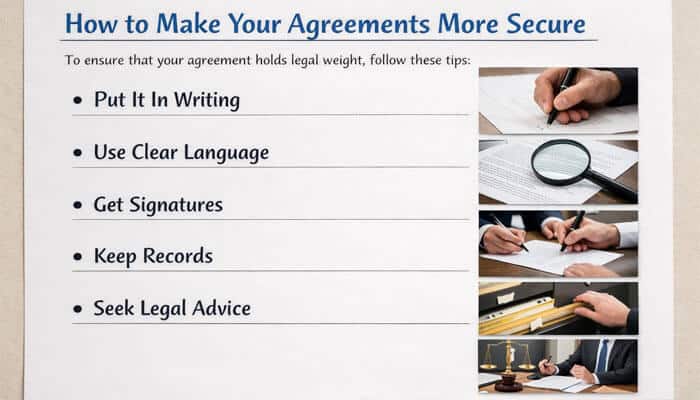
To ensure that your agreement holds legal weight, follow these tips:
1. Put It In Writing
A written contract removes ambiguity and provides solid evidence should the deal go to court. Even if you prefer the informality of a handshake, it’s safer to document the terms.
2. Use Clear Language
Define the terms and deadlines clearly. Vague terms can lead to confusion or disputes.
3. Get Signatures
Signing the agreement ensures that both parties understand and consent to the terms.
4. Keep Records
Save any communications related to the agreement, such as emails, text messages, and receipts.
5. Seek Legal Advice
For complex or high-value deals, consult a lawyer to ensure that the agreement is legally sound.
Quick Summary: Is a Handshake Legally Binding?
- A handshake can be legally binding only if it meets legal contract requirements.
- Verbal agreements can be binding, but they are harder to prove in court.
- Many contracts must be written under the law (e.g., real estate, long-term leases).
- A handshake rarely holds up in court without proof of the terms.
- Always document agreements to protect yourself.
Final Thoughts
Handshakes are a symbol of trust, but they are not a guarantee of enforceability under the law. A handshake can be legally binding, but only when it meets the requirements of a contract, such as clear terms, mutual intent, and proof. When in doubt, it’s safer to put the agreement in writing to protect both parties involved.
Is a Handshake Legally Binding FAQs
1. Is a Handshake Legally Binding?
Yes, a handshake can be legally binding if it meets the basic contract requirements, but proof is often needed for enforcement.
2. Can someone sue you over a handshake or verbal agreement?
Yes, you can sue for breach of a handshake or verbal agreement if it meets contract requirements. Proof of the agreement’s terms and intent is essential for enforcement.
3. Are text messages or emails considered part of a verbal agreement?
Yes, text messages and emails can serve as evidence of a handshake agreement’s terms. They help validate the agreement and may be used in court as proof.
4. Can a handshake agreement be changed later?
Yes, a handshake agreement can be modified if both parties agree. Any changes should be documented to avoid confusion or disputes.
5. What happens if the terms of a handshake deal are unclear?
If the terms are unclear, a court may refuse to enforce the handshake agreement. Clear, specific terms are necessary for legal enforceability.
Disclaimer:
The information in this article is for general informational purposes only and is not intended as legal advice. Laws and regulations vary by jurisdiction and can change over time. For specific legal advice regarding handshake agreements or any other legal matters, please consult a qualified attorney.
