



If you are asking can a temporary employee sue for wrongful termination, the short answer is: yes, in certain situations.
Temporary workers are not “rightless” employees. In most U.S. states, they are protected by the same anti-discrimination and retaliation laws that apply to permanent employees. However, because most employment is at-will, not every firing is illegal.
This guide explains:
- When a temp worker can sue
- Whether a temp agency can fire you for no reason
- What happens if you get fired from a temp job
- How staffing agency termination works in practice
This is general legal information, not legal advice.
Are Temporary Employees Protected by Law?
Yes. Temporary workers are generally covered under:
- Title VII of the Civil Rights Act of 1964
- Americans with Disabilities Act (ADA)
- Age Discrimination in Employment Act (ADEA)
- State anti-discrimination laws
- Wage and hour laws (federal and state)
In many situations, both the staffing agency and the company where you are assigned (called the “host employer”) can be considered joint employers. That means both may share responsibility if your rights are violated.
Common misconception
Many people assume temporary workers can be terminated for any reason simply because they are “temporary.” That is not accurate. Temporary status does not eliminate legal protections.
Temporary vs Permanent Employee Rights
| Issue | Temporary Employee | Permanent Employee |
| Protected from discrimination | Yes (federal & state law) | Yes |
| Protected from retaliation | Yes | Yes |
| Covered by wage laws | Yes | Yes |
| Guaranteed job duration | Usually no | Sometimes (contract-based) |
| At-will employment | Usually yes | Usually yes |
| Can sue for wrongful termination | Yes, if illegal reason | Yes, if illegal reason |
| Joint employer issues | Often | Rare |
When Can a Temporary Employee Sue for Wrongful Termination?
A temporary employee may have a valid wrongful termination claim if the firing involved:
1. Discrimination
You cannot legally be fired because of:
- Race
- Religion
- National origin
- Gender or pregnancy
- Disability
- Age (40+)
- Other protected characteristics under state law
If a host employer ends your assignment for discriminatory reasons, both the company and the staffing agency may be liable.
2. Retaliation
You may have a claim if you were fired after:
- Reporting harassment
- Filing a discrimination complaint
- Requesting disability accommodation
- Reporting wage violations
- Reporting unsafe working conditions
Retaliation claims are common in temporary employment disputes.
3. Contract Violations
If you had a written agreement guaranteeing a certain assignment length or termination conditions, and it was violated, you may have a breach of contract claim.
However, most temp arrangements are at-will and do not guarantee continued work.
4. Public Policy Violations
You generally cannot be fired for:
- Serving on a jury
- Taking protected medical leave (where applicable)
- Refusing to participate in illegal activity
These cases are fact-specific and vary by state.
Can a Temp Agency Fire You for No Reason?
In most states, employment is at-will. That means a staffing agency can end your employment:
- Without advance notice
- Without giving a reason
- Even for unfair or arbitrary reasons
But they cannot fire you for an illegal reason.
There is a difference between:
- Unfair termination (legal in many cases)
- Illegal termination (actionable in court)
If the termination involves discrimination, retaliation, or contract violations, it may be unlawful.
Staffing Agency Termination: Who Is Responsible?
Temporary work creates a layered employment structure.
There are usually two entities involved:
- The staffing agency (your official employer)
- The host company (where you perform the work)
Liability can depend on:
- Who made the termination decision
- Who supervised you daily
- Who controlled your pay and discipline
- Whether both entities participated in the decision
In discrimination cases, courts often treat staffing agencies and host employers as joint employers.
This is why wrongful termination claims involving temp workers can be more complex than standard employment cases.
What Happens If You Get Fired from a Temp Job?
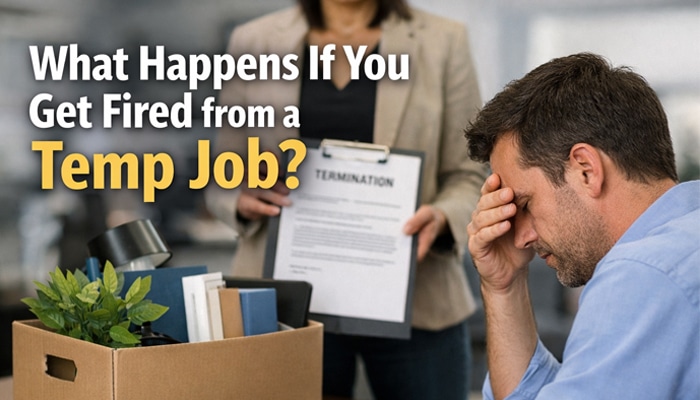
If you are terminated from a temporary assignment, several things may occur:
1. End of Assignment Only
Sometimes the assignment ends, but you remain registered with the staffing agency for future placements.
2. Full Termination by the Agency
The staffing agency may remove you from their system entirely.
3. Unemployment Benefits
You may qualify for unemployment benefits, depending on:
- State law
- Whether the assignment truly ended
- Whether you were offered another placement
- Whether misconduct was alleged
Each state has its own eligibility standards.
How Courts Evaluate Wrongful Termination Claims for Temp Workers
Courts generally look at:
- Whether the worker was an employee (not an independent contractor)
- Whether a protected activity occurred
- Whether there is evidence linking the termination to discrimination or retaliation
- Whether legitimate business reasons were documented
Employers often defend these cases by arguing:
- Poor performance
- Assignment completion
- Budget cuts
- Business restructuring
The burden shifts depending on the type of claim.
When Should a Temporary Employee Speak to a Lawyer?
You may consider consulting an employment attorney if:
- You were fired shortly after filing a complaint
- You experienced harassment and then lost your assignment
- You were denied reasonable accommodations
- You believe discrimination was involved
- The staffing agency and host employer are blaming each other
Many employment attorneys offer free consultations and work on contingency in discrimination cases.
Situations Where You May Not Have a Case
You may not have a strong wrongful termination claim if:
- The assignment simply ended as scheduled
- There is documented performance misconduct
- The company eliminated your role for legitimate business reasons
- No protected characteristic or protected activity was involved
Not every termination feels fair — but not every unfair firing is illegal.
State Law Matters
Wrongful termination law varies significantly by state. Some states provide broader protections, including:
- Expanded discrimination categories
- Stronger retaliation standards
- Public policy exceptions
- Implied contract doctrines
If you are researching this issue, it is important to look at your specific state’s employment laws.
Summary: Can a Temporary Employee Sue for Wrongful Termination?
Yes — a temporary employee can sue for wrongful termination if the firing involved:
- Discrimination
- Retaliation
- Contract violations
- Violations of public policy
However, because most temp jobs are at-will, employers can legally end assignments for many non-illegal reasons.
The key question is not whether the firing was unfair — but whether it was unlawful.
Practical Next Steps
If you believe your termination may have been illegal:
- Write down a timeline of events.
- Save emails, texts, and written communications.
- Identify who made the termination decision.
- Check your state’s filing deadlines (often 180–300 days for discrimination claims).
- Consider speaking with an employment attorney.
Understanding the difference between legal termination and wrongful termination is critical before filing a claim.
Legal Disclaimer
This article provides general information about wrongful termination and temporary employment under U.S. law. Employment laws vary by state, and the outcome of any claim depends on specific facts and local statutes. This content is for informational purposes only and does not create an attorney-client relationship or constitute legal advice.
Frequently Asked Questions: Can a Temporary Employee Sue for Wrongful Termination?
1. Can a temp worker file an EEOC claim?
Yes. Temporary workers can file discrimination claims with the EEOC under laws such as Title VII of the Civil Rights Act of 1964, Americans with Disabilities Act, and Age Discrimination in Employment Act.
2. Who is the employer in a temp job?
In many cases, both the staffing agency and the host company are considered “joint employers,” meaning both may share liability for wrongful termination.
3. Can a temp employee be fired without notice?
Yes. In most states, temp work is at-will. Employers can terminate without notice unless the reason is illegal.
4. Do temporary employees qualify for FMLA?
Sometimes. Eligibility under the Family and Medical Leave Act of 1993 depends on:
- Length of employment
- Hours worked
- Size of the employer
5. Is ending an assignment the same as being fired?
Not always. Sometimes the assignment ends but the staffing agency continues the employment relationship.