



Dense fog can create some of the most challenging and dangerous driving conditions one can encounter. It can sharply reduce visibility, make depth perception difficult, and turn even familiar roads into hazards. When road visibility drops to just a few feet, even a minor driving error can trigger an accident. Slight steering overcorrections, delayed braking, and misjudged speed can lead to loss of vehicle control or collisions. Here’s everything drivers should know about what makes driving through dense fog so dangerous.
The Effect of Dense Fog on Visibility
Encountering dense fog while driving can reduce visibility to just a few feet in a matter of seconds. When it does, drivers have little time to react and adjust. They may suddenly be unable to see slowing vehicles ahead, approaching curves, or debris on the roadway. Even if they do react and slow down, drivers behind them may not react in time to avoid a collision.
Fog also creates problems for vehicles driving with their headlights on. Water droplets suspended in the air can scatter light, reflecting it toward its source. For drivers, the effect is like being blinded by headlights from vehicles driving in the opposite direction. Almost instantly, it can make road markings and signs impossible to see and distort depth perception. That often leads to drivers drifting out of lanes or misjudging their speed, setting the stage for an accident.
The Psychological Effect of Driving in Dense Fog
Encountering dense fog while driving doesn’t just affect what drivers can see. It also changes how they think and react to their surroundings. The sudden loss of visibility can trigger anxiety that leads to rushed decisions and inconsistent speed control. Paradoxically, it can also make drivers overly cautious, leading to sudden braking or slowing unpredictably. Some drivers react to fog with overconfidence, which prevents them from exercising due caution.
Fog can also induce a condition known as tunnel vision. As drivers adjust to reduced visibility, they often focus intently on the space directly in front of their vehicle. That may cause them to stop checking their side and rear-view mirrors. It can also make it harder to judge distance to other vehicles, road dividers, and road hazards in the driver’s peripheral vision.
Common Accidents in Dense Fog
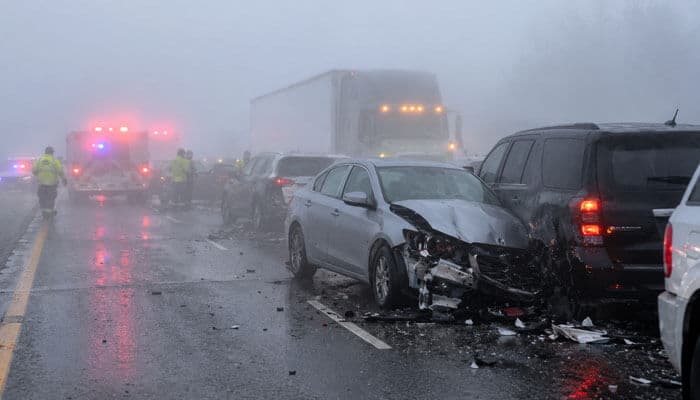
The effects that dense fog has on drivers are well understood. They help explain the causes of some common accident types in foggy conditions. The most common highway accident in dense fog is a multi-car pileup. It typically involves a rear-end collision that affects the first two vehicles that encounter the fog. Because the initial accident often occurs well inside the fog, approaching vehicles have little chance to stop in time and avoid another collision. This can create a chain reaction of accidents that can stretch for miles, often stopping only when the last cars in the pileup end up outside the fog.
Drivers on local roads are just as likely to get into a rear-end collision in dense fog. The good news is that lower speed limits typically prevent these crashes from becoming multi-car pileups. Drivers may also strike parked vehicles on local roads because lane drift in dense fog can push them into them. In more rural areas, where roads often have sharper curves, fog frequently causes drivers to leave the roadway and collide with structures and other obstacles.
How To Stay Safe While Driving in Dense Fog
There are some driving techniques that can help drivers avoid accidents in dense fog. The key is knowing them ahead of time so you can adjust accordingly. First, slow down gradually and avoid sudden braking. That way, you’ll have time to see what’s ahead and avoid surprising drivers behind you. It’s also a good idea to increase your following distance so you have plenty of space to react to changing conditions ahead. You can also turn on your vehicle’s hazard lights to help other drivers see you.
Drivers should also avoid turning on their high-beam headlights. They’ll only make visibility worse. If your vehicle has fog lamps, use those instead. They’re placed far lower and won’t reflect into your eyes. It’s also a good idea to pull off the road in designated areas when visibility becomes too low to continue safely. It’s better to arrive at your destination later than you’d planned instead of not at all.
Accident Liability in Dense Fog
When an accident occurs in dense fog, assigning fault becomes challenging. Investigators must assess the behavior of all drivers involved. To do that, they have to figure out how each driver reacted to the fog and whether they adjusted their speed, following distance, and headlight use appropriately. In a multi-car pileup, it isn’t always clear who’s responsible. When sudden braking and inappropriate following distances contribute, more than one driver could be at fault.
Whenever a driver becomes involved in a fog-related accident, it’s a good idea for them to consult a car accident lawyer right away. Fog often makes eyewitness accounts inconsistent at best and responsibility unclear. In that situation, having a capable lawyer like the attorneys at Pittman, Roberts & Welsh can help safeguard your rights. They’ll have the experience to interpret the circumstances and gather appropriate evidence. Their thorough documentation of road conditions, vehicle damage, and roadway visibility can play a decisive role in the assignment of responsibility.
The Takeaway
Dense fog makes driving difficult for both inexperienced and experienced drivers. It also dramatically increases the odds of multi-car accidents. For that reason, all drivers should learn to drive safely in fog before they encounter it. And in the case of a fog-related accident, they should consult a qualified car accident lawyer immediately. That can ensure they have an advocate to stand up for their rights and hold responsible drivers accountable.