



WASHINGTON — U.S. Senator Josh Hawley (R-Mo.) announced Wednesday he will introduce the Stop Flock Abuse Act, legislation aimed at establishing federal safeguards for AI-powered surveillance cameras amid mounting bipartisan concerns over privacy violations and documented abuses by law enforcement.
The bill, named after leading automated license plate reader (ALPR) vendor Flock Safety, would impose stricter limits on how vehicle data is collected, stored, and shared, following a Senate investigation and hearing that exposed systemic misuse of the technology
What Is the Stop Flock Abuse Act?
The Stop Flock Abuse Act is proposed federal legislation intended to establish nationwide standards for AI-powered automated license plate reader systems.
These cameras capture license plates and vehicle characteristics, including make, model, and color. The information can help police identify vehicles associated with investigations, but interconnected systems can also reveal patterns of vehicle movement.
Flock Safety operates approximately 120,000 cameras across 49 states, according to Reuters reporting published on October 9, 2026.
Privacy advocates argue that large surveillance networks can create detailed records of ordinary Americans’ movements, even when those individuals are not suspected of committing crimes.
Supporters of the technology emphasize its potential to help law enforcement investigate crimes and locate vehicles.
What Restrictions Would the Stop Flock Abuse Act Introduce?
Hawley’s proposal identifies seven major safeguards intended to improve accountability and protect personal information.
- Restrictions on data sharing: Local governments would be prohibited from selling or sharing collected vehicle location data with nongovernmental third parties.
- Written search authorization: Agencies would need documented approval procedures for accessing surveillance records.
- Mandatory audit logs: Agencies would record who searched the system, why the search occurred, who approved it, and what information was accessed.
- Data security: Collected information would require encryption and would be prohibited from leaving the United States.
- Ten-day retention limit: Driver information would generally have to be permanently deleted after ten days, with narrow exceptions for active criminal investigations.
- Foreign technology restrictions: ALPR hardware and software sourced from foreign adversaries would be prohibited.
- Facial recognition prohibition: ALPR networks would not be allowed to incorporate facial recognition technology.
These provisions are proposed requirements and are not currently enforceable under the Stop Flock Abuse Act.
Why Is Congress Investigating Flock Safety?
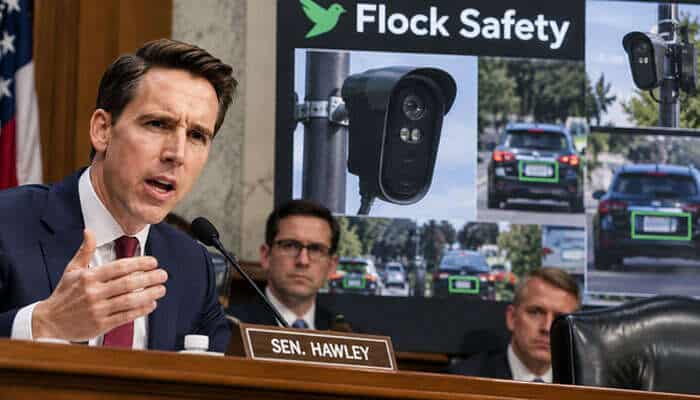
The legislation follows a congressional investigation into the collection, storage, and sharing of data generated by surveillance cameras.
On September 23, 2026, the Senate Judiciary Subcommittee on Crime and Counterterrorism held a hearing titled Always Watching: Flock’s Nationwide AI Surveillance Network.
The hearing examined concerns involving unauthorized searches, cybersecurity vulnerabilities, inaccurate vehicle identification, and access to surveillance databases.
Witnesses included cybersecurity engineer Benn Jordan, American Civil Liberties Union representative Chad Marlow, and Lindsey Isaacs, a Florida woman who described being wrongfully accused following the use of automated license plate reader information.
The testimony highlighted concerns about how surveillance errors and inappropriate database access could affect individuals.
How Has Flock Safety Responded?
Flock Safety CEO Garrett Langley declined an invitation to testify before the September congressional hearing. However, the company provided written responses to Hawley’s investigation and acknowledged the need for a federal regulatory framework governing surveillance technology.
According to Hawley’s office, Flock also described safeguards introduced following public scrutiny. The company maintains that its systems support law enforcement investigations and public safety.
The debate continues over how to preserve legitimate investigative uses while preventing unauthorized monitoring and misuse of collected information.
What Would the Proposed Law Mean for Americans?
If enacted, the Stop Flock Abuse Act could establish additional protections for drivers whose vehicle information is captured by automated surveillance networks. Government agencies using covered systems could face stricter requirements for authorizing searches, documenting access, and deleting collected records.
The proposed ten-day retention rule could also reduce the amount of historical vehicle location information routinely maintained by agencies. However, the legislation would not completely ban automated license plate readers or require a judicial warrant for every database search.
Existing federal constitutional protections and state privacy laws would remain relevant to determining whether particular surveillance practices are lawful.
What Happens Next for the Stop Flock Abuse Act?
The proposal would need to complete the federal legislative process before becoming law. Congress must consider the legislation, and both the Senate and House of Representatives would need to approve the required legislative text before it could be presented to the president.
As of October 12, 2026, the Stop Flock Abuse Act has not been enacted into federal law. Its ultimate provisions, legislative progress, and implementation requirements remain subject to congressional action.
Conclusion
The Stop Flock Abuse Act highlights growing congressional scrutiny of AI surveillance cameras and the collection of Americans’ vehicle location data. Senator Josh Hawley’s proposal seeks to establish stronger safeguards for automated license plate reader networks, including restrictions on data retention, information sharing, and unauthorized searches.
While law enforcement agencies cite the investigative benefits of surveillance technology, privacy advocates continue to question the risks of widespread vehicle tracking. Whether Congress adopts the proposed restrictions remains uncertain, but the legislation adds to the national debate over balancing public safety, technological innovation, and constitutional privacy protections.