


Have you ever been pulled over by a police officer and heard them say, “I’m going to have to give you a citation for that”? Then you get home, tell your family about it, and everyone says you got a “ticket.” So which is it a citation vs ticket? Are they the same thing, or is there some hidden legal difference that could affect your driving record?
Here is the simple truth: a citation vs ticket is not really a debate at all. Both words describe the exact same piece of paper. When a police officer catches you breaking a traffic rule, they hand you a written document. That document is officially called a “citation” in legal and court language. In everyday life, people call it a “ticket.” Just like you might call a pay stub a “paycheck” same thing, two different names.
While the citation vs ticket question has a simple answer, what happens after you receive one is something every driver should understand. How it affects your car insurance, your driving record, whether you need to go to court, and how long it follows you these are the important details. This guide breaks it all down clearly.
Citation vs Ticket: The Simple Explanation
A citation vs ticket are two words for the same thing. When you violate a traffic law like speeding, running a red light, or parking illegally a police officer issues you a written notice. That written notice is what is called a citation vs ticket.
Quick Fact
“Citation” is the official legal term used by courts, police agencies, and the DMV. “Ticket” is the casual, everyday word most drivers use. Neither word changes what the document actually is or what it means for you legally.
Think of it this way: when you apply for a job, the company sends you a formal “offer of employment.” You probably call it a “job offer” to your friends. Same document different level of formality. The citation vs ticket distinction works exactly the same way.
Here is what both terms refer to the official written document will include:
- Your full name and personal details
- Your driver’s license number and vehicle registration info
- The specific traffic law you are accused of breaking
- The date, time, and exact location of the violation
- The police officer’s name and badge information
- Instructions on what to do next pay a fine, appear in court, or contest the charge
Citation vs Ticket: Side-by-Side Comparison
Here is a quick comparison to make the citation vs ticket distinction clear:
| Factor | Citation | Ticket |
| Formal or Informal? | Formal legal/court term | Informal everyday language |
| Who uses it? | Police officers, courts, DMV | Drivers, general public |
| Is it the same document? | Yes | Yes |
| Does it affect insurance? | Yes | Yes (same thing) |
| Goes on driving record? | Yes, if convicted | Yes, if convicted |
| Requires court appearance? | Depends on violation type | Depends on violation type |
| Penalty possible? | Yes | Yes |
| Warning version possible? | Yes warning citation | Yes warning ticket |
Why Do People Get Confused About Citation vs Ticket?
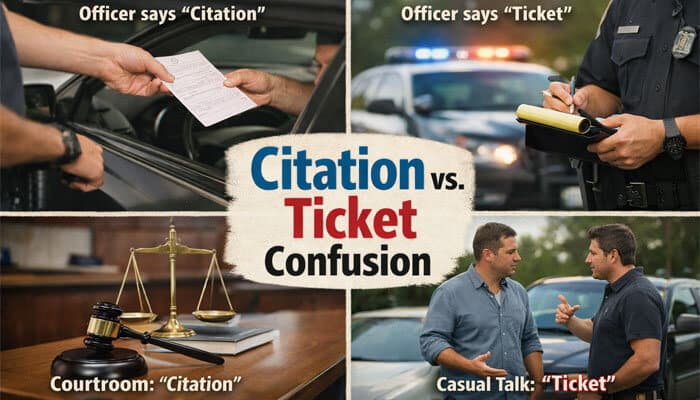
The confusion around the citation vs ticket topic usually comes from one of these situations:
- Different officers use different words: Some officers say “I’m issuing you a citation,” while others say “Here’s your ticket.” Both mean the same thing.
- State-specific language: In some states, official documents and court papers always use the word “citation.” In others, the word “ticket” appears on the actual paperwork.
- TV and movies: On cop shows and in news reports, both terms appear sometimes to describe different things which adds to the confusion.
- Formal vs. informal settings: In traffic court, the judge and lawyer will say “citation.” In everyday conversation, people say “ticket.”
Whether an officer hands you something and calls it a citation vs ticket, treat it seriously, respond on time, and understand your options. The citation vs ticket debate is purely about vocabulary not about what you owe or what could happen to your license.
Types of Citations and Tickets You Can Receive
Not all citations or tickets are equal. Some are minor. Others can follow you for years and cost thousands of dollars.
1. Moving Violations
A moving violation happens when your car is in motion and you break a traffic law. These are the most common types of citations and are generally the most serious. Examples include:
- Speeding (driving over the speed limit)
- Running a red light or stop sign
- Reckless driving
- Illegal lane changes or failing to yield
- Distracted driving / texting while driving
- Driving under the influence (DUI/DWI)
Moving violations typically add points to your driving record and can raise your car insurance rates.
2. Non-Moving Violations
A non-moving violation happens when your car is parked or stopped. These are generally less serious but still need to be addressed. Examples include:
- Parking in a no-parking zone or near a fire hydrant
- Expired vehicle registration
- Broken headlights or non-working brake lights (fix-it tickets)
- Expired inspection sticker
Most non-moving violations do not affect your insurance rates and do not add points to your driving record.
3. Criminal Traffic Citations
Some traffic violations are serious enough to become criminal matters, handled in criminal court rather than traffic court. Examples:
- DUI / DWI: Driving under the influence of alcohol or drugs
- Reckless driving: A pattern of extremely dangerous driving
- Vehicular manslaughter: Causing a death while driving
- Street racing on public roads
For criminal citations, you have the right to a lawyer. If you cannot afford one, the government provides a public defender.
4. Warning Citations (Warning Tickets)
Sometimes an officer issues a warning instead of a ticket. Here is what you need to know:
- A written warning does NOT require you to pay a fine
- It does NOT appear on your driving record
- It does NOT affect your car insurance
- It is a notice to correct your behavior
Common Traffic Violations: Types and Consequences
| Violation | Type | Consequence |
| Speeding | Moving | Fine, points, insurance increase |
| Running a Red Light | Moving | Fine, points, possible court |
| Reckless Driving | Moving (Criminal) | Heavy fine, license suspension, jail |
| DUI / DWI | Moving (Criminal) | Major fine, jail, long record impact |
| Illegal Parking | Non-Moving | Fine only, no points usually |
| Expired Registration | Non-Moving | Fine, correctable citation |
| Broken Headlights | Non-Moving | Fix-it ticket, dismissible |
| Failure to Signal | Moving | Fine, minor points |
| No Seatbelt | Varies by state | Fine, sometimes no points |
| Texting While Driving | Moving | Fine, points, insurance increase |
How a Citation vs Ticket Affects Your Car Insurance
Whether you call it a citation or a ticket, if it ends up on your driving record, your insurance company will find out and will likely raise your rates.
Here is how the process works:
- You receive a citation or ticket for a traffic violation.
- If you pay the fine without contesting it, you are legally admitting guilt this is a conviction.
- The conviction is recorded on your Motor Vehicle Record (MVR) by your state’s DMV.
- When your insurance renews, your provider checks your MVR and sees the violation.
- Your insurance premiums increase based on the type and severity of the violation.
Insurance Rate Increases by Violation Type (2026 Data)
| Violation Type | Avg. Insurance Increase | Duration on Record |
| Minor Speeding (1–10 mph over) | ~16–20% | 3 years |
| Major Speeding (20+ mph over) | ~30–40% | 3–5 years |
| Running a Red Light | ~20–25% | 3 years |
| Reckless Driving | ~70–80% | 5–7 years |
| DUI / DWI | ~80–100%+ | 5–10 years |
| Parking Ticket | 0% (no impact) | N/A |
| Expired Registration | Minimal or 0% | 1–3 years |
The type of citation vs ticket you receive has a significant impact on your insurance. A parking ticket will not increase your premiums. A DUI can double or even triple your rates.
How Long Does a Citation or Ticket Stay on Your Record?
The answer depends on your state and the type of violation.
General Rules (Most States)
- Minor violations (like speeding): Stay on your driving record for 3–5 years
- Serious violations (reckless driving): Can stay for 5–7 years
- DUI/DWI: Typically stays for 5–10 years, sometimes permanently
- Parking tickets: Usually not added to your driving record at all
- Warning citations: Never added to your record
The Three Records You Need to Know About
- DMV Driving Record: The official record maintained by your state’s Department of Motor Vehicles. This is what courts and law enforcement review.
- Insurance Record: Insurance companies review your last 3–5 years of violations when setting your rates. Even if the DMV clears a ticket, insurers may still count it.
- Criminal Record: Only criminal traffic violations (like DUI) appear on a criminal background check. Regular speeding citations do not appear on a criminal record.
What to Do When You Receive a Citation or Ticket
Step 1: Stay Calm During the Traffic Stop
- Pull over safely to the right side of the road
- Turn off your engine and put your hands on the steering wheel
- Wait for the officer to approach before reaching for anything
- Hand over your driver’s license, registration, and proof of insurance when asked
- Sign the citation if asked this does NOT mean you are admitting guilt; it only confirms you received the document
Step 2: Review the Citation Carefully
- Check that all details are correct – Your name, license number, vehicle info
- Note the violation listed and the date, time, and location
- Find the deadline to respond – Missing it can lead to a suspended license
- Note the court date if one is listed
Step 3: Choose How to Respond
When you receive a citation or ticket, you generally have three options:
- Option 1 Pay the Fine: This is the simplest option and is essentially pleading guilty. The violation goes on your record and may affect your insurance. Best for very minor violations.
- Option 2 Contest the Citation: Plead not guilty and request a court hearing. You can present evidence, bring witnesses, or negotiate with the prosecutor. If the officer does not appear, the case is often dismissed. Best if you believe the citation was issued in error.
- Option 3 Traffic School / Defensive Driving Course: Completing an approved driving course can keep points off your record or even dismiss the violation in many states. This is often the best option for a first-time offense.
Warning: Never ignore a citation or ticket. Failure to respond can result in additional fines, a suspended license, or a warrant for your arrest. Responding even if only to pay is always the right course of action.
Citation vs Ticket: State-by-State Context
- California: Courts and police officially use “citation.” The word appears on all official traffic documents.
- Texas: Texas uses presumed speed limits, meaning you can argue in court that you were driving safely even if you exceeded the posted limit.
- Florida: Florida distinguishes between civil citations (minor, non-criminal) and criminal citations (serious offenses), with major legal consequences for each.
- New York: Points from a citation in New York affect your driving privileges for 18 months from the date of the violation.
- Virginia: Known for strict traffic enforcement reckless driving can be a criminal misdemeanor even at moderate speeds.
Regardless of your state, the core citation vs ticket distinction remains the same: they are the same document, and the consequences depend on the type and severity of the violation not the word used to describe it.
How to Protect Your Driving Record
Before You Get a Ticket

- Always know the speed limit it can change frequently, especially in school and work zones
- Never use your phone while driving
- Keep your vehicle in good working condition (lights, brakes, registration)
- Take a defensive driving course voluntarily many insurers offer discounts for it
- Review your state’s traffic laws periodically, as they do change
After You Get a Ticket
- Consider contesting the citation especially for moving violations
- Look into traffic school eligibility in your state
- Compare car insurance quotes after a citation some companies are more forgiving than others
- Check your MVR (Motor Vehicle Record) annually for errors
- Consult a traffic attorney for serious offenses it is often worth the cost
Reducing Insurance Rate Increases
- Ask your insurer about accident forgiveness programs
- Complete a defensive driving course to earn a premium discount
- Consider usage-based insurance (UBI) if you are a consistently safe driver
- Raise your deductible to offset premium increases
- Bundle your auto insurance with home insurance for multi-policy discounts
Final Thoughts
The terms “citation vs ticket” may seem interchangeable, but understanding the difference is essential. A citation is the formal legal term, while a ticket is the casual term used in everyday conversation. Both documents are issued for moving violations like speeding or non-moving violations like parking. Ignoring them can lead to serious consequences, so it’s important to respond promptly.
When it comes to “citation vs ticket,” the impact on your driving record and insurance rates is the same, regardless of the terminology. You have options to manage the violation, such as paying the fine, contesting the citation, or attending traffic school. Acting quickly can help reduce the long-term effects. Stay informed, know your rights, and make a well-informed decision to protect your driving privileges.
Citation vs Ticket FAQs
1. What is the difference between Citation vs Ticket?
“Citation” is the formal legal term, while “ticket” is the informal term. Both refer to the same document issued for a traffic violation.
2. Can a Citation vs Ticket affect my driving record?
Yes, both a citation and a ticket can appear on your driving record if convicted, affecting your insurance rates and potentially leading to points on your license.
3. Do citations vs tickets require court appearances?
Whether a citation or a ticket requires a court appearance depends on the violation. Some minor violations can be settled without court, while serious offenses may require one.
4. Are there any differences in penalties between Citation vs Ticket?
No, the penalties are the same regardless of whether it’s called a citation or a ticket. The consequences depend on the type and severity of the violation.
5. Why do some people use Citation vs Ticket differently?
Some use “citation” in formal settings like courts or law enforcement, while “ticket” is more commonly used in everyday conversation, even though they refer to the same thing.
Disclaimer:
This article is for informational purposes only and does not constitute legal advice. For specific legal concerns, consult a qualified attorney. Laws may vary by state.