


If you live in Georgia and drive a car, you may wonder: is uninsured motorist coverage required in Georgia? The short answer is no, Georgia law does not require you to buy UM coverage. However, this doesn’t mean you should ignore it. Understanding how it works is important because it can significantly affect your financial protection if you’re ever in an accident with an uninsured driver.
What Are Georgia’s Car Insurance Requirements?
Before diving deeper into is uninsured motorist coverage required in Georgia, it is important to understand what the state actually mandates. Georgia is an at-fault state, which means the driver who caused the accident is responsible for paying for the damages. Because of this, the state requires all drivers to carry liability insurance but nothing more.
Georgia follows what is commonly called the 25/50/25 rule for minimum liability coverage:
| Coverage Type | Minimum Amount | Required by Law? |
| Bodily Injury Liability (per person) | $25,000 | YES |
| Bodily Injury Liability (per accident) | $50,000 | YES |
| Property Damage Liability | $25,000 | YES |
| Uninsured Motorist (UM) Coverage | $25,000 / $50,000 | NO (must be offered) |
| Underinsured Motorist (UIM) Coverage | Matches UM limits | NO (must be offered) |
| Collision Coverage | Varies | NO |
| Comprehensive Coverage | Varies | NO |
| Personal Injury Protection (PIP) | Varies | NO |
As you can see, Georgia only mandates liability coverage. Everything else including uninsured motorist coverage is optional. However, there is a very important catch.
Is Uninsured Motorist Coverage Required in Georgia?
So, is uninsured motorist coverage required in Georgia? Legally speaking, no. Georgia does not require you to purchase UM coverage. However, Georgia law takes a smart approach instead of making it required, it makes it the default.
Here is how the law actually works in plain English:
- Every insurance company selling auto policies in Georgia must include uninsured motorist coverage in their offer.
- If you do not actively reject UM coverage in writing, it is automatically included in your policy.
- The default UM limits are set equal to your liability coverage limits.
- You can choose lower UM limits, but you must do so in writing.
- You can reject UM coverage entirely, but again only with a written rejection.
This approach by Georgia lawmakers is intentional. Rather than forcing people to buy it, the state makes sure no one accidentally drives without it simply because they forgot to ask. The written rejection requirement protects consumers from losing valuable coverage without realizing it.
The bottom line: Is uninsured motorist coverage required in Georgia? Not technically. But because you must actively reject it in writing, most Georgia drivers who have any auto insurance also have UM coverage whether they know it or not.
What Does Uninsured Motorist Coverage Actually Cover?
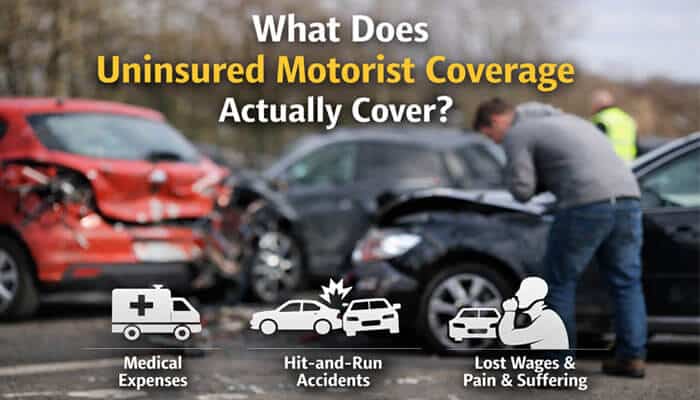
When asking is uninsured motorist coverage required in Georgia, let us talk about what it actually does for you. UM coverage is designed to step in and pay your losses when the at-fault driver either has no insurance at all or does not have enough insurance to cover what you lost.
Here is what UM coverage can pay for:
- Medical bills and hospital expenses
- Emergency room visits and surgeries
- Physical therapy and rehabilitation costs
- Lost wages if your injuries keep you out of work
- Pain and suffering damages
- Property damage to your vehicle
- Funeral expenses in wrongful death cases
UM coverage can also apply in situations beyond just car accidents. For example, if you are walking across a parking lot and an uninsured driver hits you as a pedestrian, your UM coverage can still apply. Similarly, if a hit-and-run driver injures you and cannot be found, UM coverage can protect you though Georgia law does require physical contact with the uninsured vehicle or an independent eyewitness to support a hit-and-run claim.
Types of Uninsured Motorist Coverage in Georgia
If you are asking ” is uninsured motorist coverage required in georgia? “, the answer is no but choosing the right type of coverage is still one of the most important financial decisions you can make as a driver. Even though it is not legally required, understanding your options can significantly impact how well you are protected after an accident.
When you purchase uninsured motorist (UM) coverage in Georgia, you must choose between two distinct types. Knowing the difference is critical, because one option provides far greater financial protection than the other.
1. Add-On (Stacking) UM Coverage The Better Option
With add-on coverage, your UM policy pays on top of whatever the at-fault driver’s liability insurance covers. Think of it as adding money to the pot, not replacing it.
Example: The at-fault driver has $25,000 in liability coverage. You have $100,000 in add-on UM coverage. Your total available compensation = $125,000.
This type gives you the maximum possible protection and is generally the recommended choice for most Georgia drivers.
2. Reduced-By (Offset) UM Coverage The More Common but Less Protective Option
With reduced-by coverage, your UM policy only covers the gap between what the at-fault driver pays and your UM limit. Your UM limits are not added on top they represent the ceiling of your total recovery.
Example: The at-fault driver has $50,000 in liability coverage. You have $100,000 in reduced-by UM coverage. Your total available compensation = $100,000, not $150,000. Your UM policy only pays the remaining $50,000.
While reduced-by coverage is less expensive, it provides significantly less protection especially in serious accident cases where your damages far exceed the other driver’s policy limits.
| Feature | Add-On UM | Reduced-By UM |
| How UM pays | On top of at-fault driver’s coverage | Only the gap up to your UM limit |
| Total recovery potential | Higher both policies combine | Lower capped at your UM limit |
| Premium cost | Slightly higher | Lower |
| Best for | Maximum protection | Budget-conscious drivers |
| Recommended by attorneys? | Yes, strongly | Generally not preferred |
Why Georgia Drivers Really Should Have UM Coverage
Even though uninsured motorist coverage is not required in Georgia, the reality of driving on Georgia roads makes it one of the smartest purchases you can make. Here is why:
Georgia Has a High Rate of Uninsured Drivers
Georgia consistently ranks among the states with the highest percentage of uninsured drivers. Studies estimate that around 18 percent of Georgia drivers nearly 1 in 5 are either uninsured or underinsured. Every time you get behind the wheel, you statistically share the road with multiple drivers who could not cover your damages if they caused a crash.
Minimum Liability Limits Are Often Not Enough
Even when the at-fault driver has insurance, Georgia’s minimum requirements may not cover a serious injury. A single emergency room visit, surgery, or extended hospital stay can easily cost more than $25,000. If the other driver only carries the minimum, you could be left with tens of thousands of dollars in unpaid bills. This is where UM coverage specifically underinsured motorist (UIM) coverage becomes critical.
Hit-and-Run Accidents Are a Real Risk
Hit-and-run accidents happen every day in Georgia. If a driver hits you and flees the scene, your ability to recover damages depends entirely on whether you have UM coverage. Without it, you may have no financial recourse at all.
UM Coverage Is Relatively Affordable
The cost of adding UM coverage to your policy is typically much lower than people expect. When you compare the small additional premium to the financial risk of being hit by an uninsured driver and facing thousands in uncovered medical bills and lost wages, the math becomes very clear.
Georgia’s Minimum UM Coverage Limits
When an insurer includes UM coverage in a Georgia policy, the minimum limits mirror the state’s liability requirements. Here is what those limits look like:
- $25,000 per person for bodily injury or death
- $50,000 per accident for bodily injury or death involving multiple people
- $25,000 per accident for property damage
However, you are not stuck with the minimums. Georgia law allows you to choose UM limits equal to your liability coverage limits, which is often the smarter choice. If you carry $100,000 in liability coverage, for example, you can also carry $100,000 in UM protection. You can also choose deductibles of $250, $500, or $1,000 for bodily injury coverage if you want to reduce your premium.
What Counts as an ‘Uninsured’ Vehicle in Georgia?
You might assume an uninsured vehicle simply means one without any insurance policy. But under Georgia law (O.C.G.A. § 33-7-11), a vehicle is considered uninsured in several situations:
- The owner or driver has no liability insurance at all.
- The owner or driver is unknown such as in a hit-and-run accident.
- The at-fault driver’s insurance company denies coverage or goes bankrupt.
- The driver’s policy exists, but the insurance company becomes insolvent and cannot pay.
- The driver’s policy limits are insufficient to cover the full extent of your damages (this is sometimes called an underinsured motorist situation).
This broad definition means that UM coverage can apply in more situations than most people realize. Even if the other driver technically has insurance, their policy may still leave you without enough compensation and your UM coverage can bridge that gap.
What Happens If an Uninsured Driver Hits You in Georgia?
If you are in an accident caused by an uninsured driver in Georgia, here is what typically happens and what you should do:
Step 1: Call 911 and Get a Police Report
Always report the accident to law enforcement immediately. A police report establishes an official record of the incident, who was involved, and what happened.
Step 2: Gather Evidence at the Scene
Take photos of both vehicles, the accident scene, any visible injuries, and the other driver’s information. If there are witnesses, get their contact information.
Step 3: Seek Medical Attention Right Away
Even if you feel fine, see a doctor as soon as possible. Some injuries especially whiplash and internal trauma do not show symptoms immediately. Delaying medical treatment can also hurt your insurance claim.
Step 4: Notify Your Insurance Company
Report the accident to your own insurer promptly. If you have UM coverage, your company will handle your claim under that policy. Be honest and thorough when describing what happened.
Step 5: Contact a Personal Injury Attorney
Navigating a UM claim in Georgia involves legal procedures that can be complicated. An experienced Georgia car accident attorney can identify all available sources of coverage including UM policies from household family members’ vehicles and help you maximize your recovery.
Understanding is uninsured motorist coverage required in Georgia becomes critical at this stage because without it, recovery options may be limited.
Bad Faith Claims: When Your Insurer Refuses to Pay
Georgia law includes protections for policyholders when their own insurer acts in bad faith. If your insurance company refuses to pay a valid UM claim within 60 days after a proper demand is made, and a court later finds the refusal was in bad faith, you may be entitled to:
- A penalty of up to 25% of your total recovery, or $25,000 whichever is greater
- Reasonable attorney’s fees
This is an important protection because it discourages insurance companies from delaying or wrongfully denying legitimate UM claims. If you believe your insurer is not treating your claim fairly, speaking with a Georgia personal injury attorney is a smart next step.
How Much Uninsured Motorist Coverage Should You Carry?
Since we have established that uninsured motorist coverage is not required in Georgia but is highly advisable, the next question is: how much should you get? The right answer depends on your personal situation, but here are some factors to consider:
- Your health insurance: If your health plan has high deductibles or limited coverage, you need more UM coverage for medical expenses.
- Your income: If you earn a good income, you have more to lose if injuries force you out of work. Higher UM limits protect your earning capacity.
- Your assets: If you own a home, savings, or investments, higher UM limits help protect your financial stability.
- Your vehicle’s value: More expensive vehicles benefit from higher property damage UM limits.
- Your risk tolerance: If you drive frequently, on busy highways, or in high-traffic areas of Georgia, you face a higher chance of encountering an uninsured driver.
As a general rule, most Georgia personal injury attorneys recommend carrying UM limits that match your liability coverage and choosing add-on (stacking) coverage rather than reduced-by. The extra premium cost is small compared to the added financial protection.
Penalties for Driving Without Insurance in Georgia
While the focus here is on UM coverage, it is worth understanding what happens to uninsured drivers in Georgia because their behavior directly creates the need for UM coverage in the first place.
Georgia uses an electronic insurance compliance system that allows law enforcement and the Department of Driver Services to check a vehicle’s insurance status instantly. If you are caught driving without required liability insurance, the consequences can be serious:
- Fines ranging from $200 to $1,000
- Up to 12 months in jail for a first offense (classified as a misdemeanor)
- Suspension of your driver’s license and vehicle registration
- Requirement to pay a reinstatement fee
- Possible SR-22 insurance filing requirement
Despite these penalties, many Georgia drivers still take the risk and drive uninsured. That is precisely why uninsured motorist coverage even though it is not required in Georgia is one of the most valuable protections you can carry.
Final Thoughts
So, is uninsured motorist coverage required in Georgia? No, but that does not mean you should go without it. With nearly 1 in 5 Georgia drivers uninsured or underinsured, and with Georgia’s busy highways posing risks every time you drive, UM coverage could be the single most important optional protection you can add to your auto policy.
The law already makes it easy if you do nothing, UM coverage is included in your policy automatically. The real decision is not just is uninsured motorist coverage required in Georgia, but whether you want to keep it, how much coverage you need, and which type add-on or reduced-by offers the best protection for your situation.
If you have been hurt in an accident with an uninsured or underinsured driver in Georgia, do not try to handle the insurance claim alone. Georgia’s UM laws are complex, and an experienced personal injury attorney can help you identify every available source of coverage, protect your rights, and fight for the full compensation you deserve.
Is Uninsured Motorist Coverage Required in Georgia FAQs
1. Is uninsured motorist coverage required in Georgia?
No. Georgia does not require drivers to carry uninsured motorist coverage. However, insurers must offer it with every policy, and it is included by default unless you reject it in writing.
2. Why is uninsured motorist coverage important if it is not required in Georgia?
It protects you if the at-fault driver has no or low insurance. This helps cover medical bills, lost wages, and vehicle damage.
3. What happens if I reject uninsured motorist coverage in Georgia?
If you reject it, you lose protection against uninsured or hit-and-run drivers. You may have to pay all damages out of pocket.
4. What is the difference between add-on and reduced-by UM coverage in Georgia?
Add-on coverage increases your total compensation by stacking on top. Reduced-by only fills the gap up to your policy limit.
5. How much uninsured motorist coverage should I carry in Georgia?
Experts suggest matching your UM limits with liability coverage. Higher limits provide better financial protection after serious accidents.