

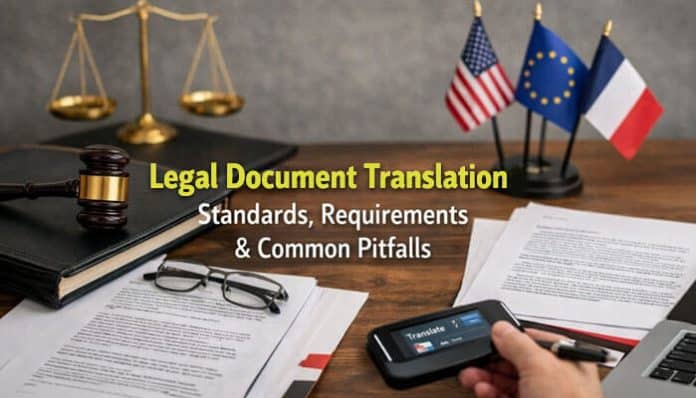

In legal proceedings, precision is not a preference — it is a requirement. A misplaced comma in a contract, an ambiguous term in a patent filing, or an inaccurate translation of a witness statement can alter the outcome of a case. When legal documents cross language barriers, the quality of legal document translation becomes a matter of legal consequence.
What Constitutes a Legal Translation?
Legal translation encompasses any document that will be used in a legal context, including contracts, court orders, witness statements, powers of attorney, wills, corporate formation documents, intellectual property filings, immigration-related legal documents, and regulatory compliance documentation.
Each of these document types carries specific terminological and formatting requirements. A power of attorney drafted under French civil law contains concepts and structures that have no direct equivalent in common law jurisdictions. The translator must not only convert language but navigate between legal systems.
Certification Requirements
For legal documents, most jurisdictions require certified translation at minimum. This means the translator or translation company provides a formal declaration that the translation is accurate and complete, along with their qualifications and contact information.
Some jurisdictions impose stricter requirements. Court proceedings in many US states require translations by ATA-certified translators. International arbitration bodies generally require certified translations but may also require notarisation. Cross-border transactions governed by the Hague Convention may require apostilled translations.
Terminological Precision in Legal Translation
Legal terminology is notoriously system-specific. The French “mise en demeure” is often translated as “formal notice” in English, but the legal implications differ significantly. The German “Grundbuch” has functional equivalents in English-speaking countries, but the registration systems operate differently. The Arabic “mahr” in family law has no precise English legal equivalent and requires contextual explanation.
Competent legal translators do not merely substitute words—they interpret concepts and signal where source-law and target-law concepts diverge.
Common Mistakes in Legal Document Translation
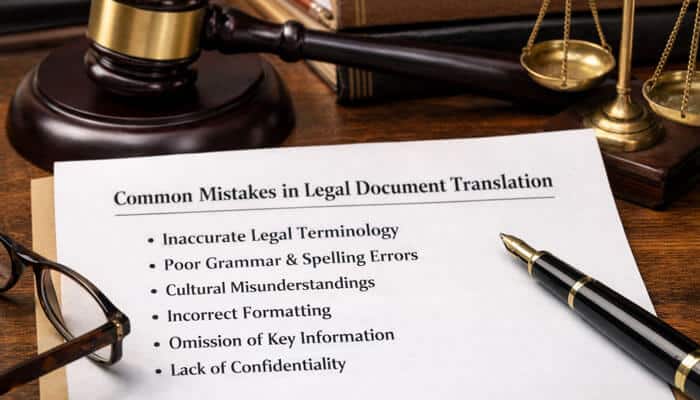
1. Using general-purpose translators for legal documents. Legal translation requires specialized knowledge that goes beyond linguistic fluency.
2. Inconsistent terminology across related documents. “Defendant” should not appear as “respondent” in one document and “accused” in another unless the original uses different terms.
3. Omitting translator credentials. Legal translations should include qualifications, professional memberships, and a certification statement.
4. Ignoring formatting and layout. Courts often require translations to mirror the layout of the original document.
5. Machine translation for legal content. Automated tools cannot navigate the conceptual differences between legal systems.
The intersection of law and language demands a level of care that goes beyond linguistic accuracy. For legal professionals, selecting qualified translators is not an administrative detail — it is a risk management decision.
Choosing the Right Legal Translation Provider
When selecting a translation provider for legal documents, consider these factors:
- Legal specialization: Does the provider have translators with legal training or experience in the relevant jurisdiction?
- Quality assurance process: Are translations reviewed by a second legal linguist before delivery?
- Confidentiality protocols: Legal documents often contain sensitive information. The provider should have robust data protection measures in place.
- Turnaround reliability: Legal deadlines are non-negotiable. The provider must be able to deliver consistently on time.
- Certification compliance: Can the provider meet the specific certification requirements of the court, agency, or institution that will receive the translation?
The cost of a poor legal translation is almost always higher than the cost of a good one. A contract dispute arising from an ambiguous translation can generate legal fees that dwarf the original translation cost by orders of magnitude. For legal professionals and their clients, professional legal translation is not an expense to minimize—it is a safeguard to invest in.