

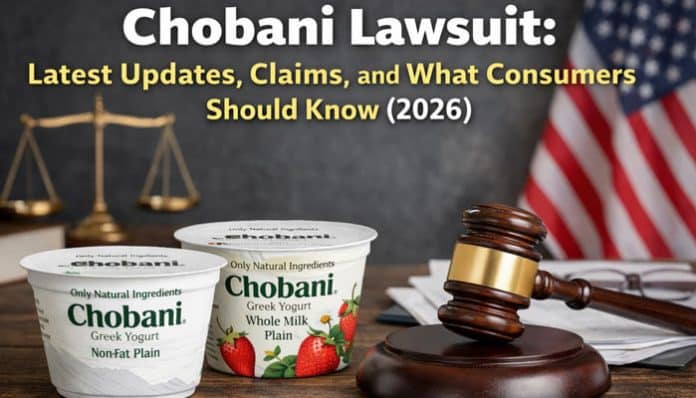

The Chobani lawsuit has become a widely searched topic as consumers look for clear answers about the allegations, the products involved, and the current legal status of the case. Much of the confusion comes from the fact that there are actually two separate Chobani lawsuits, including the active California case over “Only Natural Ingredients” labeling and the dismissed Illinois Zero Sugar case.
The active Chobani lawsuit focuses on claims that certain yogurt products were marketed in a way that may have misled consumers, particularly regarding natural-ingredient claims and alleged phthalate detection. Because the case is still ongoing and has not reached a final judgment, it is important to separate confirmed court developments from unresolved allegations.
In this article, you will learn what the Chobani lawsuit is about, which products are mentioned, what the court has decided so far, and why this case matters for consumers, labeling standards, and product transparency. This gives readers a more accurate and professional understanding of the case instead of relying on incomplete or misleading summaries.
Understanding the Chobani Lawsuit
The active Chobani lawsuit is Wysocki v. Chobani, LLC, a case in the U.S. District Court for the Southern District of California. The lawsuit alleges that certain Chobani yogurt products were marketed as having “Only Natural Ingredients” even though third-party testing allegedly detected phthalates. On April 6, 2026, the court allowed important parts of the case to continue while dismissing some other theories with leave to amend by May 2026.
This means the Chobani lawsuit is still active, but it has not been finally decided. There has not been a final judgment finding Chobani liable in the active California case. That distinction matters because some readers assume a lawsuit filing automatically means a company has already lost, which is not how litigation works.
Key points readers should know
- The active Chobani lawsuit involves “Only Natural Ingredients” labeling.
- The California case is still ongoing after the April 6, 2026, order.
- A different Zero Sugar lawsuit was dismissed in May 2025.
- The current court ruling is not a final liability decision.
What Is the Chobani Lawsuit About?
The current California lawsuit argues that Chobani misled consumers by using phrases such as “Only Natural Ingredients” and related no-artificial-ingredients messaging on certain yogurt products. According to the complaint and the court’s summary of it, the plaintiff says those claims led consumers to believe the products were wholly natural and free from harmful synthetic chemicals, while testing allegedly found phthalates in the products.
The products identified in the court order are Greek Yogurt Nonfat Plain and Greek Yogurt Whole Milk Plain. The plaintiff alleges she bought the yogurt relying on the label and suffered economic injury because she would not have purchased it, or would have paid less, had she known the alleged facts.
Chobani Lawsuit 2026 at a Glance
| Topic | Details |
| Active case | Wysocki v. Chobani, LLC |
| Main issue | “Only Natural Ingredients” labeling |
| Alleged concern | Third-party testing allegedly detected phthalates |
| Court | U.S. District Court, Southern District of California |
| Major update | Motion to dismiss granted in part and denied in part on April 6, 2026 |
| Current status | Case continues in part; some claims dismissed with leave to amend |
| Separate dismissed case | Chobani Zero Sugar lawsuit in Illinois |
The entries above reflect the current California docket order and reporting on the separate Zero Sugar case.
What is the Chobani Yogurt Lawsuit?
The Chobani Yogurt Lawsuit refers to legal actions taken against Chobani, a popular yogurt brand, over misleading product labeling. The lawsuit primarily concerns Chobani’s claim that its yogurt products contained “Only Natural Ingredients,” while third-party testing allegedly found phthalates, chemicals commonly found in plastics, in the yogurt. Phthalates are not directly added to food but may be present due to packaging and processing.
The lawsuit claims that these misleading labels deceived consumers into believing the yogurt was entirely natural and free of synthetic chemicals. The case, which is ongoing in California, focuses on whether Chobani violated consumer protection laws through false advertising and misrepresentation. While some parts of the case have been dismissed, significant aspects of the lawsuit remain unresolved, and the outcome could affect food labeling standards.
Products Mentioned in the Chobani Lawsuit
The court order identifies the products discussed in the complaint as Greek Yogurt Nonfat Plain and Greek Yogurt Whole Milk Plain. These products are the focus of much of the current reporting around the active Chobani lawsuit. When writing for SEO, it is more accurate to say the lawsuit concerns certain Chobani yogurt products rather than implying that every Chobani product is involved.
That wording improves professionalism and reduces legal overstatement. A careful article should avoid broad claims like “all Chobani yogurt is part of the lawsuit” unless a court filing or official notice clearly says that. Precision helps both readers and rankings because it makes the article sound more credible and better researched.
Products section takeaways
- The active Chobani lawsuit centers on specific plain Greek yogurt products.
- The complaint does not mean all Chobani products are affected.
- Accurate wording improves trust and SEO quality.
Legal Claims in the Chobani Lawsuit
The California Chobani lawsuit includes several legal theories. The complaint asserted claims under California’s Consumers Legal Remedies Act (CLRA), Unfair Competition Law (UCL), and False Advertising Law (FAL). It also included breach of express warranty and unjust enrichment/restitution theories.
Including these details makes your article look far more professional. Instead of sounding like a generic news summary, it shows the structure of the actual consumer case. This also helps you rank for long-tail searches such as “Chobani class action claims,” “Chobani false advertising lawsuit,” and “Chobani express warranty claim.” That is useful for SEO because it broadens topical relevance naturally.
Legal issues in the Chobani lawsuit
- CLRA claim
- UCL claim
- FAL claim
- Express warranty claim
- Unjust enrichment/restitution claim
April 2026 Court Update in the Chobani Lawsuit
The most important update in the active Chobani lawsuit came on April 6, 2026. Judge James E. Simmons, Jr. issued an order granting in part and denying in part Chobani’s motion to dismiss. The court did not throw out the case entirely. Instead, it allowed key misrepresentation-based parts of the complaint to continue while dismissing some other claims with leave to amend.
The April 2026 order was not a final win for the plaintiff, and it was not a full win for Chobani either. It was a procedural ruling that narrowed some issues and allowed the main case theory to move forward. Readers searching for the Chobani lawsuit usually want this exact status update.
What survived and what did not
- Core misrepresentation theory survived.
- Express warranty claim survived.
- Some DBP-based allegations were dismissed with leave to amend.
- Fraudulent omission, equitable relief, and unjust enrichment theories were dismissed with leave to amend.
Why Phthalates Matter in the Chobani Lawsuit
Phthalates matter in the Chobani lawsuit because they are associated with plastics and some food-contact uses, which makes them highly sensitive in labeling disputes built around “natural” claims. FDA says phthalates are not authorized to be directly added to food, though the agency still allows some phthalates in certain food-contact applications and continues reviewing safety and exposure data.
This context is important because readers may assume the case is only about the listed ingredients. In reality, the regulatory issue can involve packaging, processing, storage, or other food-contact pathways. That does not prove what happened in any specific Chobani product, but it explains why a Chobani lawsuit over “Only Natural Ingredients” can still involve alleged chemical exposure concerns.
- The Chobani lawsuit is tied to a broader “natural labeling” issue.
- Phthalates are not authorized to be directly added to food.
- Some phthalates remain authorized in certain food-contact uses.
What the Chobani Lawsuit Has Not Decided Yet
The April 2026 ruling did not establish that Chobani is liable. It did not award damages, approve a settlement, or certify a class. It simply held that important parts of the plaintiff’s complaint were plausible enough to continue at this stage.
This section is very important for SEO and credibility because accurate, balanced content performs better over time. Overstating a court filing as if it were a final verdict weakens trust. A more professional article makes clear that the active California Chobani lawsuit remains unresolved on the merits.
- No final judgment yet
- No damages award yet
- No class certification yet
- No final liability finding yet
The Other Chobani Lawsuit: Zero Sugar Case Explained
A separate Chobani lawsuit involved Chobani Zero Sugar yogurt. In that case, plaintiffs argued the label was misleading because the product contained allulose. On May 29, 2025, an Illinois federal judge dismissed that proposed class action, with reporting indicating the court found FDA labeling rules and guidance around allulose preempted the state-law claims.
This is why articles should clearly separate the two lawsuits:
| Case | Main issue | Status |
| California “Only Natural Ingredients” case | Alleged phthalates and natural-label claims | Active in part |
| Illinois Zero Sugar case | Allulose / Zero Sugar labeling | Dismissed in May 2025 |
That comparison helps prevent confusion for readers and improves topical completeness for search.
Case Timeline
- April 16, 2025: California lawsuit filed.
- May 29, 2025: Separate Zero Sugar lawsuit dismissed in Illinois.
- April 6, 2026: Motion to dismiss granted in part and denied in part in the California case.
- Early May 2026: Amended pleadings deadline reflected in the court record.
What to Watch Next
The next procedural milestone is the amended pleadings deadline in early May 2026. After that, the case could move into:
- An amended complaint
- Renewed motion practice
- Discovery
- Class-certification proceedings
- Settlement discussions
- Later-stage rulings
Because lawsuit coverage changes quickly, this article benefits from a visible last updated date and later revisions if there is a new amended complaint, class certification ruling, settlement, or appeal.
What Consumers Should Know About the Chobani Lawsuit
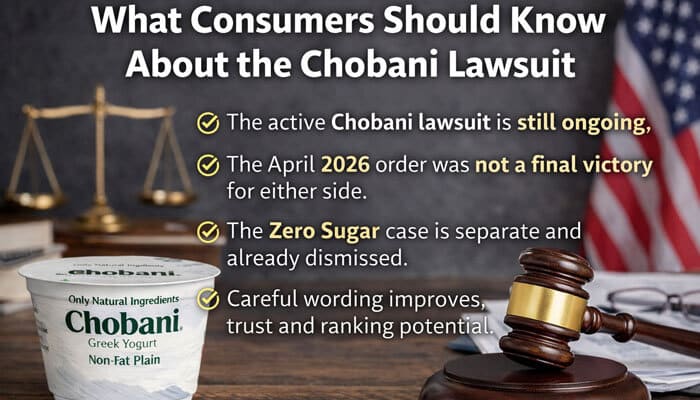
Consumers following the Chobani lawsuit should focus on three things. First, the active California case is still ongoing after the April 6, 2026 order. Second, the current order is not a final merits decision. Third, there is no basis to describe the active California case as finally resolved.
- The active Chobani lawsuit is still ongoing.
- The April 2026 order was not a final victory for either side.
- The Zero Sugar case is separate and already dismissed.
- Careful wording improves trust and ranking potential.
Final Takeaway
The Chobani lawsuit remains an important consumer-labeling case because it highlights the gap between marketing language and what shoppers believe they are buying. The active California case over “Only Natural Ingredients” is still ongoing, while the separate Zero Sugar lawsuit was dismissed, so it is important to distinguish between the two.
Overall, the Chobani lawsuit is not a final finding of liability, but it does show how seriously courts and consumers treat natural-label claims, alleged chemical exposure concerns, and product transparency. For readers, the key takeaway is simple: the case is still unresolved, the allegations are still being litigated, and future court developments will determine the final outcome.
Chobani lawsuit FAQs
1. What is the Chobani lawsuit about?
The Chobani lawsuit focuses on claims that certain yogurt products were marketed as having “Only Natural Ingredients” despite the alleged detection of phthalates. The case mainly centers on whether that labeling could mislead consumers.
2. Is the Chobani lawsuit still active in 2026?
Yes, the active Chobani lawsuit is still ongoing in California in 2026. The court allowed key parts of the case to move forward, but there is no final ruling yet.
3. Did Chobani lose the lawsuit?
No, Chobani has not lost the Chobani lawsuit at this stage. The case is still in progress, and the court has not issued a final judgment on liability or damages.
4. What products are involved in the Chobani lawsuit?
The Chobani lawsuit mainly mentions Greek Yogurt Nonfat Plain and Greek Yogurt Whole Milk Plain. The complaint focuses on specific products, not all Chobani items.
4. Why are phthalates important in the Chobani lawsuit?
Phthalates matter in the Chobani lawsuit because they are linked to plastics and food-contact materials, which may conflict with “natural” labeling claims. This issue is central to the consumer deception argument.
5. What is the difference between the two Chobani lawsuits?
The active Chobani lawsuit in California concerns “Only Natural Ingredients” and alleged phthalates. A separate Illinois case about Zero Sugar labeling was dismissed in 2025.