

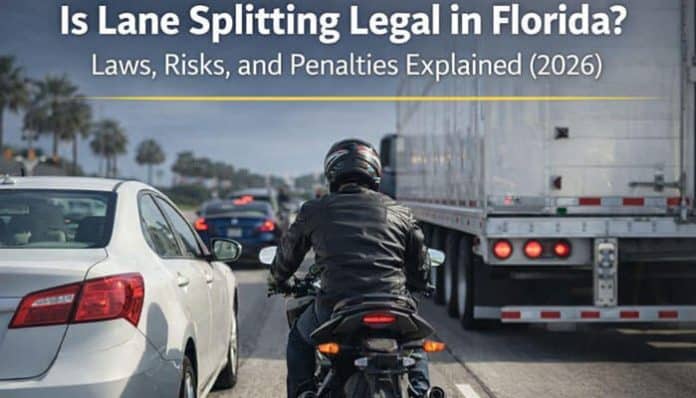

Is lane splitting legal in florida is a common question among motorcyclists, especially riders who deal with heavy traffic, stop-and-go roads, and crowded intersections. Many people hear different opinions about lane splitting, lane filtering, and lane sharing, which creates confusion about what is actually allowed under Florida law. Because motorcycle rules can vary from state to state, it is important for riders in Florida to understand the law clearly before making decisions on the road.
The simple answer to is lane splitting legal in florida is no. Florida law does not allow a motorcycle to operate between lanes of traffic or between adjacent lines or rows of vehicles. That means a rider cannot legally move between cars during traffic jams, at red lights, or in slow-moving highway traffic. Understanding this rule is important not only for avoiding tickets but also for reducing the risk of accidents and legal problems after a crash.
This article explains is lane splitting legal in florida in a clear and practical way. It covers what the law says, the difference between lane splitting and lane filtering, the possible penalties, the safety risks, and how lane splitting can affect accident claims. By the end, riders will have a better understanding of their legal responsibilities and the safer choices to make while riding in Florida.
What Is Lane Splitting?
Lane splitting is the practice of riding a motorcycle between lanes of traffic, often in slow-moving or stopped traffic. It allows motorcyclists to bypass congestion by navigating through the space between vehicles, typically at a higher speed than the surrounding cars.
People sometimes confuse lane splitting with related terms such as:
- Lane filtering: moving between stopped or very slow vehicles, usually near intersections
- Lane sharing: two motorcycles riding side by side in the same lane
- Shoulder riding: using the shoulder to move past traffic
These distinctions matter because some states treat them differently. In Florida, the key legal point is that a motorcycle may not operate between lanes of traffic or between adjacent rows of vehicles.
Is Lane Splitting Legal in Florida?
No, lane splitting is not legal in Florida. If you’re asking, Is lane splitting legal in Florida? The answer remains clear in 2026—it is prohibited. Florida’s current laws explicitly forbid operating a motorcycle between lanes of traffic or between adjacent rows of vehicles.
- Riders cannot pass between cars during traffic congestion
- Lane splitting is prohibited at stoplights and in slow traffic
- Even if there appears to be space, it is illegal to move between lanes
- Florida Statute 316.209 directly forbids this practice
In Florida, lane splitting is illegal, and violators can face fines and legal consequences for attempting it.
What Florida Law Actually Says
According to Florida Statute 316.209, lane splitting is not legal in Florida. This statute outlines specific rules that motorcyclists must follow to stay compliant and safe on the road.
- Motorcycles are entitled to the full use of a lane
- Overtaking and passing in the same lane as another vehicle is prohibited
- Motorcycles cannot operate between lanes of traffic or adjacent vehicle rows
- Motorcycles cannot ride more than two abreast in a single lane
The Florida Statute 316.209 explicitly answers the question Is Lane Splitting Legal in Florida—it is not, as motorcyclists cannot legally pass between lanes or vehicle rows.
Lane Splitting vs. Lane Filtering vs. Lane Sharing
| Term | What it means | Legal in Florida? |
| Lane splitting | Riding between moving or slow vehicles in adjacent lanes | No |
| Lane filtering | Moving between stopped vehicles, often near a light | No |
| Lane sharing | Two motorcycles are riding side by side in one lane | Yes, up to two abreast |
Florida law does not create a separate legal exception for filtering. It broadly prohibits operating a motorcycle between lanes of traffic or between adjacent lines or rows of vehicles, while still allowing motorcycles to ride two abreast in a single lane.
Is Lane Filtering Legal in Florida?
is lane splitting legal in florida? The same answer applies to lane filtering—it is not legal. Florida law is written broadly enough to prohibit riding between lanes, even in slow or stopped traffic
- Lane filtering is not separately allowed
- Florida law covers riding between vehicles
- Applies even in stopped traffic situations
- Moving to the front of the signals is still prohibited
- No legal distinction between splitting and filtering
In Florida, both lane splitting and lane filtering fall under the same restriction—so riders should avoid both to stay compliant and safe.
What Do I Do After a Lane Splitting Crash?
Even though lane splitting is illegal, drivers should still take the right steps after a crash to protect themselves legally, medically, and financially. The actions taken at the scene can make a big difference later when dealing with insurance claims or liability disputes.
Steps to Take at the Scene :
- Call the police: A police report can help document the accident and may note whether the motorcyclist was lane splitting.
- Take photos and videos: Capture vehicle positions, damage, skid marks, road conditions, and traffic flow.
- Get witness statements: If anyone saw the crash, their account may help confirm how the accident happened.
- Exchange insurance information: Even if the motorcyclist appears at fault, insurance details are still important.
- Seek medical attention: Some injuries are not obvious right away, so prompt medical care helps protect both your health and your records.
If the motorcyclist tries to leave the scene, try to note the license plate number, motorcycle details, and direction of travel, then give that information to the police as soon as possible.
Can Motorcycles Share a Lane in Florida?
Florida does allow a limited form of lane sharing: two motorcycles may ride two abreast in a single lane. But that does not mean a motorcycle can share a lane with a car or truck.
So the rule works like this:
- Allowed: two motorcycles riding side by side in one lane
- Not allowed: a motorcycle riding next to a passenger car in the same lane
- Not allowed: a motorcycle passing between rows of vehicles
Why Some Riders Support Lane Splitting
Many riders argue that lane splitting can help reduce rear-end collisions in heavy traffic, especially when motorcycles are stationary and vulnerable. However, if you’re still asking is lane splitting legal in florida, the answer remains no—it is strictly prohibited under Florida law regardless of safety arguments.
- Reduces the risk of rear-end crashes in traffic
- Helps riders avoid being stuck between vehicles
- Improves traffic flow in congested areas
- Common in places like California, not Florida
- Still illegal despite safety debates
- Can lead to fines and legal consequences
Penalties for Lane Splitting in Florida
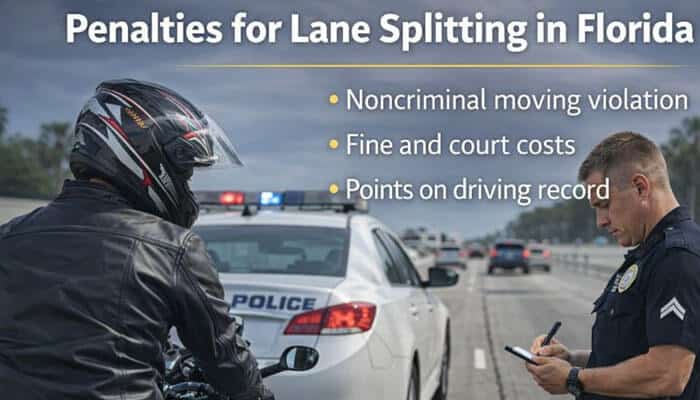
Lane splitting in Florida is treated as a non-criminal traffic violation, but it can still lead to serious legal and financial consequences. Even though it’s not a felony, riders can face fines, license points, and higher insurance costs.
In practical terms, that can mean:
- a traffic ticket
- fines and court costs
- possible points depending on how the citation is processed
- Higher insurance costs after a violation
If you’re asking is lane splitting legal in florida, not only is it illegal, but it can also lead to fines, license penalties, and serious legal consequences—especially if an accident occurs.
Why Lane Splitting Is Risky
Even beyond the legal question of is lane splitting legal in florida, the practice carries real safety risks. Drivers often do not expect motorcycles between lanes, which increases the chance of sudden collisions and severe injuries.
- Drivers don’t expect bikes between lanes
- Sudden lane changes increase crash risk
- Limited space leaves no room to react
- Blind spots make motorcycles harder to see
- Stop-and-go traffic creates unpredictable movement
- Higher risk of serious injuries in crashes
What Happens If a Crash Happens While Lane Splitting?
If a crash occurs while lane splitting, the legal question is lane splitting legal in florida becomes critical. Because it is illegal, the rider’s actions can be used against them in insurance claims or injury cases, making it harder to recover full compensation—even if the other driver was also at fault.
- The rider may receive a traffic citation
- Insurance may argue the rider contributed to the crash
- Compensation can be reduced under comparative fault
- Another driver can still be partially negligent
- Evidence like lane change or distraction matters
- The case becomes harder, but not impossible to win
Lane splitting does not automatically make the rider 100% at fault, but it weakens the claim position and increases legal complexity in Florida accident cases.
How Comparative Fault Can Affect a Florida Injury Claim
In Florida, the rule tied to is lane splitting legal in florida directly impacts injury claims through modified comparative fault. If a rider is found more than 50% responsible, they may recover nothing; if 50% or less, compensation is reduced based on their share of fault.
- Florida follows the modified comparative fault rule
- Over 50% fault means no compensation
- 50% or less reduces payout proportionally
- Lane splitting can increase the rider’s fault share
- Insurers may use illegality to reduce claims
- The other driver can still share responsibility
Even if another driver was negligent, violating lane-splitting laws can significantly reduce or completely block compensation, making it both a legal and financial risk.
What Riders Should Do Instead in Stop-and-Go Traffic
If riders cannot legally split lanes in Florida, the more useful question becomes what they should do instead.
Better options include:
- Stay centered or slightly offset within your lane for visibility
- Leave extra following distance
- Watch mirrors when stopping behind traffic
- avoid lingering in blind spots
- slowly, instead of making sudden gap moves
- Be ready for drivers to change lanes without seeing you
This kind of practical section improves the article because it gives readers a safer alternative instead of only repeating what is illegal.
Safety Tips for Florida Riders
If you ride in Florida, safer habits can protect both your health and your legal position:
- Stay fully within your lane in traffic
- avoid passing in the same lane occupied by another vehicle
- Leave extra following distance in stop-and-go conditions
- Watch carefully for sudden lane changes
- Use proper protective gear
- Make sure your motorcycle endorsement and insurance are current
Common Myths About Lane Splitting in Florida
Myth 1: Lane splitting is legal if traffic is stopped
False. Florida law does not create a stopped-traffic exception. Riding between rows of vehicles is still prohibited.
Myth 2: Lane filtering is different, so it must be allowed
False. Florida’s wording is broad enough to cover both lane splitting and lane filtering.
Myth 3: A motorcycle can share a lane with any vehicle
False. Florida allows up to two motorcycles abreast in one lane, but it does not allow a motorcycle to share the lane with a passenger car.
Myth 4: It is only a small ticket, so it does not matter
False. A citation may be only the beginning. Insurance costs, points, and fault arguments after a crash can be much more expensive than the original ticket.
Conclusion
To sum up, is lane splitting legal in Florida is an important question for every rider who wants to stay safe and follow the law. The answer is clear: Florida does not allow motorcycles to ride between lanes of traffic or between adjacent rows of vehicles. That means riders should avoid lane splitting and lane filtering, even in slow or stopped traffic.
Understanding is lane splitting legal in Florida can help motorcyclists avoid tickets, reduce crash risks, and protect themselves if an accident happens. The safest approach is to stay fully within your lane, ride defensively, and follow Florida motorcycle laws at all times.
Is Lane Splitting Legal in Florida? FAQs
1. Is lane splitting legal in Florida?
No, lane splitting is not legal in Florida. Motorcyclists are not allowed to ride between lanes of traffic or between adjacent rows of vehicles.
2. Is lane filtering legal in Florida?
No, lane filtering is also not legal in Florida. Even in slow or stopped traffic, motorcycles cannot move between cars.
3. Can you lane split at a red light in Florida?
No, Florida law does not allow lane splitting at red lights. It remains illegal even when traffic is stopped.
4. What happens if you get caught lane splitting in Florida?
A rider may receive a traffic citation, fines, and possible insurance complications. It may also hurt the rider’s position in an accident claim.
5. Can lane splitting affect a motorcycle accident claim in Florida?
Yes, it can. If a rider was lane splitting during a crash, it may be used as evidence that the rider contributed to the accident.
Disclaimer: This article is for general informational purposes only and is not legal advice. Laws can change, and legal outcomes depend on the facts of each case. For advice about your specific situation, consult a qualified Florida attorney or official state sources.