

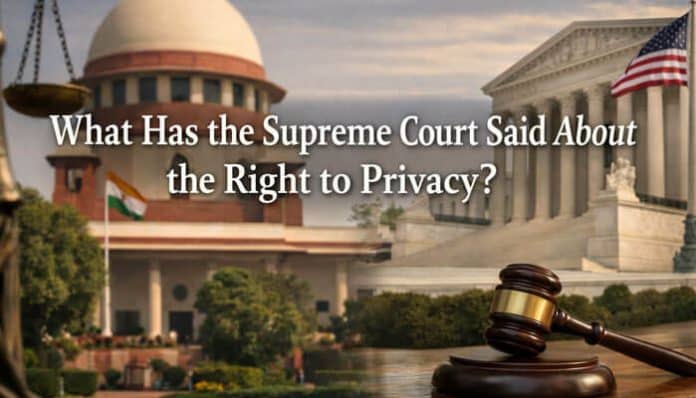

When readers ask, what has the Supreme Court said about the right to privacy?, the first issue is identifying which Supreme Court they mean. In most cases, the search intent points to either the Supreme Court of India or the Supreme Court of the United States, and these two courts do not frame privacy in exactly the same way. India’s Supreme Court has clearly recognized privacy as a fundamental constitutional right, while the U.S. Supreme Court has developed privacy protections through several constitutional doctrines rather than one single express privacy clause.
This distinction matters because privacy is no longer a narrow legal topic. It now affects bodily autonomy, family life, sexuality, medical confidentiality, digital surveillance, location tracking, and control over personal data. In India, privacy is closely tied to dignity, liberty, and autonomy. In the United States, privacy law developed through cases involving marital privacy, intimate relationships, the Fourth Amendment, and modern digital records.
The guide explains what has the Supreme Court said about the right to privacy? requires more than a short summary. It requires a structured review of landmark cases, legal tests, and the way both courts understand privacy in the modern world.
What has the Supreme Court said about the right to privacy?
The Supreme Court of India has said that privacy is a fundamental right protected by the Constitution, especially under Article 21, and closely linked to dignity, personal liberty, autonomy, and identity. That principle was authoritatively confirmed in Justice K.S. Puttaswamy (Retd.) v. Union of India.
The U.S. Supreme Court has said that privacy interests exist in several important constitutional areas, including marital decisions, intimate relationships, and protections against certain forms of search and surveillance. However, it has not adopted one all-purpose constitutional privacy clause, and in Dobbs v. Jackson Women’s Health Organization, it rejected abortion as a constitutional privacy right.
In simple terms
- India clearly says privacy is a fundamental right
- The U.S. protects privacy through different legal doctrines
- India’s approach is more direct
- The U.S. approach is more limited and case-specific
Why the Right to Privacy Matters
The right to privacy matters because it protects the space in which people make deeply personal decisions. It is not only about secrecy or hiding information. It is also about bodily integrity, family life, personal identity, sexual autonomy, dignity, and the freedom to make intimate choices without unjustified state interference.
In practical terms, privacy disputes now arise in issues that affect daily life. Courts increasingly face cases involving biometric identification systems, digital identity, phone searches, historical location data, personal records, and state access to sensitive information. Privacy law is now one of the main ways constitutional systems deal with modern technology.
Why this topic matters today
- What has the Supreme Court said about the right to privacy? affects bodily autonomy
- It shapes rules on surveillance and digital tracking
- It influences law on marriage, sexuality, and family life
- It helps define the limits of government power
- It matters even more in a digital, data-driven world
What the Supreme Court of India Has Said About the Right to Privacy
Privacy Is a Fundamental Right in India
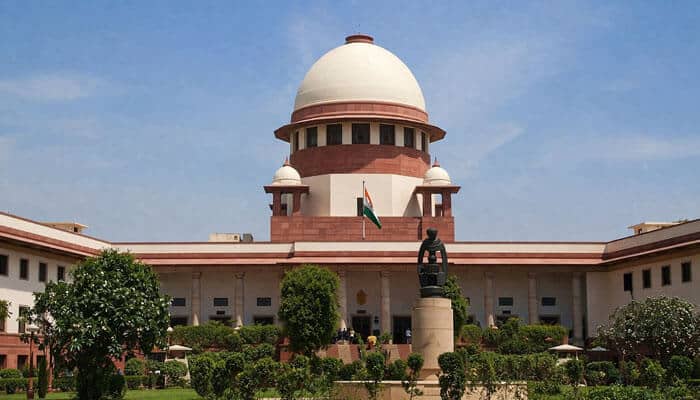
The modern Indian position begins with Justice K.S. Puttaswamy (Retd.) v. Union of India, where a nine-judge bench held that privacy is a constitutionally protected fundamental right. The Court rooted privacy primarily in Article 21, which protects life and personal liberty, and also connected it to the broader guarantees of freedom and dignity in Part III of the Constitution.
This judgment is one of the most important constitutional decisions in modern India because it moved privacy from uncertainty to clear recognition. The Court rejected the idea that privacy is a weak or incidental claim. Instead, it treated privacy as part of the constitutional protection of the human person, including identity, dignity, and decisional autonomy.
What this means in practice
- Privacy is a fundamental right
- Privacy is tied to life and personal liberty
- Privacy protects dignity and autonomy
- Privacy is part of the broader structure of constitutional freedom
Puttaswamy Did Not Appear Out of Nowhere
For deep research, it is important to understand that Puttaswamy did not emerge in isolation. The judgment reviewed earlier constitutional doctrine and addressed prior uncertainty about whether privacy had full constitutional status. By resolving that uncertainty, the Court did more than discuss privacy. It settled the debate and established privacy as a core constitutional principle.
That historical background gives the case much of its authority. When readers ask what has the Supreme Court said about the right to privacy?, Puttaswamy matters not only because of its conclusion, but because it became the turning point that unified Indian privacy jurisprudence under a clear constitutional framework.
Why Puttaswamy matters
| Point | Importance |
| Clarified earlier uncertainty | Made privacy doctrine more stable |
| Recognized privacy as a right | Elevated privacy to constitutional importance |
| Linked privacy to dignity | Expanded privacy beyond secrecy |
| Guided later cases | Influenced future privacy rulings |
Privacy in India Is Broad, Not Narrow
The Supreme Court of India did not define privacy narrowly. It treated privacy as a broad constitutional idea that covers multiple dimensions of life, including physical, decisional, and informational privacy. This broad interpretation makes privacy relevant to both traditional civil liberties and modern digital rights.
Privacy in India is not just about keeping matters hidden from others. It is also about protecting an individual’s ability to make choices about body, identity, family, and information without arbitrary interference. That is why privacy has become one of the strongest constitutional protections in India.
What has the Supreme Court said about the right to privacy? in broad terms?
- It includes bodily integrity
- It includes decisional autonomy
- It includes family life and marriage
- It includes sexual orientation and identity
- It includes informational control over personal data
Privacy, Dignity, Sexuality, and Personal Choice
The Court’s privacy jurisprudence did not stop with Puttaswamy. In later cases, privacy continued to influence constitutional reasoning about dignity, sexuality, and individual choice. This shows that privacy in Indian constitutional law is not limited to state surveillance or personal secrecy.
Instead, privacy also supports the right to live with dignity, build intimate relationships, and make personal choices free from degrading legal control. This makes privacy one of the strongest constitutional foundations for personal liberty in modern India.
Key implications
- Privacy protects intimate life
- Privacy supports dignity and personhood
- Privacy influences cases involving sexuality and identity
- Privacy helps define limits on state power
Privacy Is Not Absolute in India
Even though privacy is fundamental, the Supreme Court of India has made clear that it is not absolute. A state action that restricts privacy must be supported by law and must satisfy constitutional standards. This ensures that privacy remains strong, but not unlimited.
The most practical takeaway is the proportionality framework. In simple terms, a privacy restriction must satisfy legality, legitimate aim, necessity, and proportionality. This makes privacy a serious constitutional doctrine rather than a vague moral idea.
Privacy test in India
| Requirement | Meaning |
| Legality | There must be a valid law |
| Legitimate aim | The state must have a proper objective |
| Necessity | The measure must be needed |
| Proportionality | The intrusion must not go too far |
Aadhaar and the Privacy Framework
The Indian privacy debate is also closely associated with Aadhaar and the constitutional questions raised by large-scale identity systems and state data collection. Aadhaar-related litigation showed that the real legal issue is often not whether privacy exists, but whether a privacy intrusion can be justified.
This makes Aadhaar highly important in any article about what has the Supreme Court said about the right to privacy? It shows how privacy doctrine works in real disputes involving data collection, governance, and digital identity.
Why Aadhaar matters
- It connects privacy law to digital identity systems
- It shows how proportionality works in practice
- It links privacy to modern governance
- It makes constitutional privacy relevant to everyday life
What the U.S. Supreme Court Has Said About the Right to Privacy
There Is No Single Explicit Privacy Clause in the U.S. Constitution
The U.S. Supreme Court has never said that the Constitution contains one express, general privacy clause. Instead, privacy protections emerged through multiple doctrines, especially substantive due process and the Fourth Amendment.
That is why U.S. privacy law is often described as fragmented. It contains powerful protections in some areas, but they do not all come from one neat constitutional provision.
What this means
- Privacy exists through multiple doctrines
- There is no single all-purpose privacy clause
- Some rights come from due process
- Others come from the Fourth Amendment
The Two Main Branches of U.S. Privacy Law
1. Decisional Privacy
One major branch of U.S. privacy law concerns personal decision-making in intimate and family life. A foundational case is Griswold v. Connecticut, where the Court protected marital decisions relating to contraception. This became the starting point for the modern American privacy framework.
Later cases extended this reasoning into intimacy and marriage. Cases such as Lawrence v. Texas and Obergefell v. Hodges show that privacy in the U.S. is often tied to liberty, dignity, and personal decision-making.
Decisional privacy covers
- Marital choices
- Family decisions
- Intimate relationships
- Personal autonomy
- Dignity-based liberty interests
2. Search and Surveillance Privacy
A second major U.S. privacy branch comes from the Fourth Amendment, which protects people against unreasonable searches and seizures. In Katz v. United States, the Court moved beyond a simple property approach and shaped the familiar reasonable expectation of privacy test.
This branch became even more important in the digital era. In Carpenter v. United States, the Court held that the government generally must obtain a warrant to access historical cell-site location information. In Riley v. California, the Court recognized the major privacy implications of searching a cell phone.
Surveillance privacy covers
- Phone searches
- Digital records
- Location tracking
- Government searches
- Sensitive personal information in devices
3. Informational Privacy in the United States
One of the less settled areas of U.S. constitutional law is informational privacy. The Supreme Court has suggested that constitutional privacy may include confidentiality interests, but it has not defined this area as broadly or clearly as the Indian Supreme Court.
This matters because many modern privacy disputes are really about information: health records, digital identity, personal databases, and data stored by third parties. Informational privacy remains important, but still developing in the U.S.
Key points about informational privacy
- The Court has acknowledged concern for confidentiality
- The doctrine is less clearly defined than in India
- Many modern privacy disputes center on data
- This remains a contested legal area
How Dobbs Changed the Privacy Conversation in the United States
Any modern discussion of U.S. privacy law must address Dobbs v. Jackson Women’s Health Organization. In 2022, the Court overruled Roe v. Wade and held that the Constitution does not confer a right to abortion. This changed one of the most visible privacy-based constitutional doctrines in America.
At the same time, Dobbs did not formally erase every privacy-related precedent. Cases involving marriage, intimacy, and search-and-surveillance privacy remain part of U.S. constitutional law. Still, Dobbs made privacy law in the United States more contested and less predictable.
What Dobbs changed
| Change | Effect |
| Rejected abortion as a privacy right | Narrowed a major privacy doctrine |
| Did not erase all privacy cases | Other privacy lines still remain |
| Shifted the legal tone | Made privacy law more contested |
| Increased uncertainty | Stronger need for context-specific analysis |
Landmark Supreme Court Privacy Cases at a Glance
| Country | Case | Why it matters |
| India | Justice K.S. Puttaswamy v. Union of India | Recognized privacy as a fundamental constitutional right |
| India | Aadhaar-related privacy jurisprudence | Applied privacy principles to state identity and data systems |
| India | Navtej Singh Johar v. Union of India | Reinforced privacy, dignity, and sexual autonomy |
| U.S. | Griswold v. Connecticut | Major foundation for marital and decisional privacy |
| U.S. | Katz v. United States | Developed the reasonable expectation of privacy framework |
| U.S. | Riley v. California | Highlighted the privacy significance of cell phones |
| U.S. | Carpenter v. United States | Required a warrant in general for historical location data |
| U.S. | Lawrence v. Texas | Extended privacy and liberty reasoning to consensual intimacy |
| U.S. | Obergefell v. Hodges | Confirmed the fundamental right to marry for same-sex couples |
| U.S. | Dobbs v. Jackson Women’s Health Organization | Rejected abortion as a constitutional privacy right |
India vs. the United States: The Key Difference
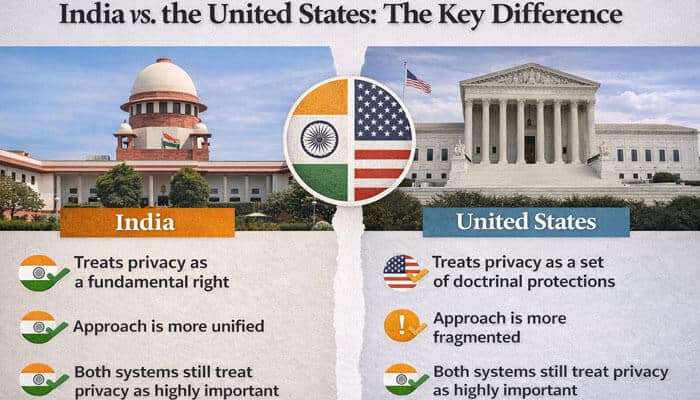
The central difference is straightforward. In India, the Supreme Court has expressly said that privacy is a fundamental constitutional right tied to liberty, dignity, autonomy, and personhood. In the United States, the Supreme Court has said that privacy interests are constitutionally protected in several specific areas, but it has not declared one broad, unified privacy clause with the same clarity.
This means Indian privacy doctrine feels more direct and integrated, while U.S. privacy doctrine is more layered and case-specific. That difference is important because it shapes how courts deal with surveillance, data, family autonomy, and state power.
India vs. U.S. comparison
- India treats privacy as a fundamental right
- The U.S. treats privacy as a set of doctrinal protections
- India’s approach is more unified
- The U.S. approach is more fragmented
- Both systems still treat privacy as highly important
What the Right to Privacy Means Today
Today, privacy is one of the most important constitutional issues because technology has changed the scale of intrusion. Courts now deal with smartphones, biometrics, databases, digital identity systems, and detailed location records that can reveal intimate patterns of life.
That is why the question is what the Supreme Court has said about the right to privacy? remains so relevant. It is not only about old case law. It is about how constitutional systems respond to new forms of power built on information, tracking, and data extraction.
What privacy means in real life today
- Protection against unjustified phone and data searches
- Limits on excessive government surveillance
- Respect for bodily autonomy and intimate choice
- Greater concern over personal data and biometrics
- Ongoing legal debate over how old rights apply to new technology
Conclusion
So, what has the Supreme Court said about the right to privacy? The Supreme Court of India has said that privacy is a fundamental right rooted in dignity, autonomy, and personal liberty under the Constitution, especially Article 21. The U.S. Supreme Court has said that privacy is constitutionally important in several areas, including marital decisions, intimate relationships, and protection against some forms of search and digital surveillance, but it has not recognized one single, unlimited privacy clause.
The best practical takeaway is that privacy remains one of the most important constitutional values in modern law, but its exact meaning depends on the legal system, the constitutional structure, and the specific line of cases involved. In both India and the United States, privacy continues to shape major debates about dignity, liberty, state power, and technology.
What has the Supreme Court said about the right to privacy? FAQ
1. Has the Supreme Court called privacy a fundamental right?
In India, yes. The Supreme Court in Puttaswamy held that privacy is a fundamental right. In the United States, the Supreme Court has recognized important privacy interests, but not one all-purpose privacy clause in the same direct way.
2. What has the Supreme Court said about the right to privacy?
The Supreme Court declared the right to privacy as a fundamental right under Article 21 of the Constitution in 2017, recognizing it as essential for personal dignity, autonomy, and freedom.
3. What is the most important Indian privacy case?
The most important Indian privacy case is Justice K.S. Puttaswamy (Retd.) v. Union of India, because it firmly established privacy as a fundamental right under the Constitution.
4. What is the most important U.S. privacy case?
There is no single undisputed answer, but Griswold, Katz, and Carpenter are among the most important because they shaped decisional privacy, reasonable expectation of privacy, and digital surveillance law.
5. Did Dobbs change What has the Supreme Court said about the right to privacy?
Yes, in the United States, Dobbs changed one major part of privacy law by rejecting abortion as a constitutional privacy right. But it did not erase all other privacy-related doctrines.