


If you are facing criminal charges, you might have heard the term Probation Before Judgment (PBJ). This legal option offers a unique opportunity to avoid a formal conviction while still taking responsibility for the offense. PBJ allows you to go on probation rather than having a conviction entered on your record, which could have long-term consequences. This article will explain what PBJ is, how it works, and everything you need to know about it, from employment implications to violating probation.
We’ll answer the key questions:
- What is Probation Before Judgment?
- Does it count as a conviction?
- Can it show up on a background check?
- What happens if you violate PBJ terms?
- Can it be used for a speeding ticket?
By the end of this article, you’ll have a comprehensive understanding of Probation Before Judgment and how it impacts your legal record.
What Is Probation Before Judgment (PBJ)?
Probation Before Judgment (PBJ) is a legal option in some states that allows a judge to withhold a conviction and place a person on probation instead. This means that the person does not get officially convicted of a crime if they successfully complete the probation terms.
In simpler terms:
- The person pleads guilty or is found guilty.
- The judge does not enter a conviction into the person’s record.
- The person must follow specific conditions set by the court.
- If they successfully complete the probation, there is no conviction on the record.
PBJ allows the offender to avoid a criminal conviction if they complete their probation successfully. However, PBJ is not available for all offenses, and eligibility depends on the jurisdiction.
How Does Probation Before Judgment Work?
When someone is eligible for PBJ, here’s how it generally works:
1. Admission of Guilt: The person pleads guilty or agrees to an agreed statement of facts (meaning they don’t contest the charges but accept the facts as they are). This is sometimes referred to as “not guilty with agreed statement of facts.”
2. Judge’s Decision: The judge will review the case and decide if probation is an appropriate option instead of a conviction.
3. Conditions of Probation: The judge sets the terms of probation, which could include community service, counseling, fines, or other forms of restitution.
4. Completion of Probation: If the person follows all conditions during the probation period, the conviction is never officially entered, and they avoid a criminal record. PBJ is not automatic. It’s typically granted only for certain minor crimes and depends on the state and specific case circumstances.
Is Probation Before Judgment a Conviction?
No, Probation Before Judgment is not considered a conviction in most states.
For example, in Maryland, PBJ means the court will not officially enter a conviction if the person follows the probation terms. This is why PBJ is often used for first-time offenders or individuals who commit minor offenses.
- No conviction entered on record – The person doesn’t get a criminal conviction, allowing them to avoid the long-term consequences of being marked as a convicted criminal.
- Probation completion is key – As long as the individual successfully completes the probation, no conviction will appear on their record. If the person violates the probation terms, a conviction could be entered.
Will Probation Before Judgment Show Up on a Background Check?
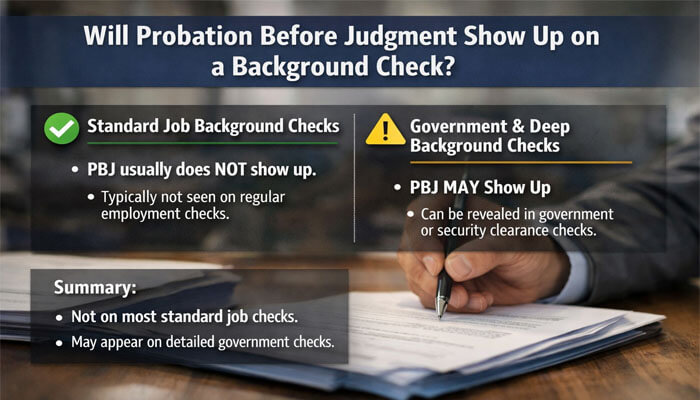
It depends on the type of background check being conducted:
- Basic Background Checks (for employment, etc.): In most cases, PBJ will not appear on a basic background check, since no conviction is entered.
- Detailed or Government Background Checks: For more thorough background checks, such as those required for government jobs or security clearances, PBJ could appear in some instances. These checks may uncover your probation status even if a conviction was not entered.
To summarize:
- PBJ often does not show up on standard job background checks.
- Government or deep background checks may still reveal the PBJ, depending on the depth of the investigation.
Does Probation Before Judgment Go on Your Record?
PBJ can appear in your court record, but it is not considered a conviction.
- Court Record: It will be visible in court and law enforcement records, but as long as probation is completed, it won’t be treated as a conviction.
- Expungement: In many states, individuals with PBJ records can later expunge (seal) their records. This means you can have the record cleared after a certain period or if you meet specific conditions.
Always consult with a legal professional to see if this is an option. While PBJ may be part of official records, it’s not automatically a conviction in the eyes of the law.
Probation Before Judgment and Employment
PBJ generally does not count as a conviction on most job applications. This is one of the primary benefits of PBJ — it allows people to avoid the stigma of a criminal conviction when applying for work.
Key points about PBJ and employment:
- Question on job applications: Many employers ask about criminal convictions, not arrests. With PBJ, the answer may legally be “no” to the conviction question.
- Job opportunities: PBJ is not considered a conviction for most employers, meaning you are still eligible for many jobs. However, for certain positions, especially those requiring background checks (such as government or high-security roles), it may still appear.
- Fair hiring practices: Some states have laws that limit when employers can ask about criminal history, especially during the early stages of hiring. However, remember that PBJ eligibility and its treatment in employment law vary by state.
What Happens if You Violate Probation Before Judgment?
If you violate the terms of your probation, the judge has the right to:
1. Enter a conviction: If you violate the terms, the judge may enter the original conviction against you, which could mean a criminal record.
2. Re-sentence you: The judge may impose additional sentences, such as jail time, additional fines, or extended probation.
3. Other consequences: In some cases, violating PBJ can also affect your eligibility for expungement or sealing your record. It is important to follow all the rules of probation to avoid these negative consequences.
Can Probation Before Judgment Be Used for a Speeding Ticket?
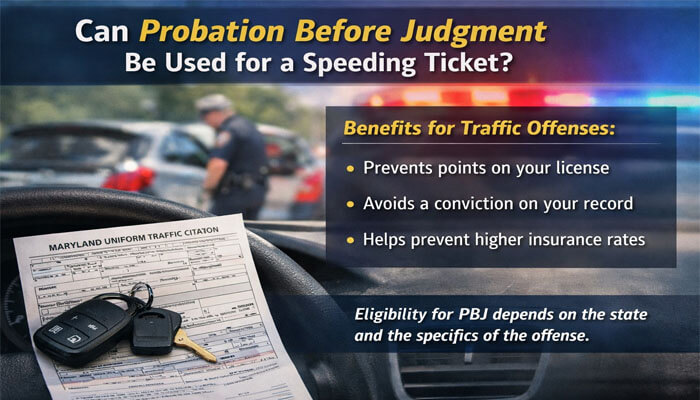
Yes, PBJ can be used for minor traffic offenses, such as speeding tickets, in some states.
Benefits for traffic offenses:
- PBJ may prevent points from being added to your driver’s license.
- It could help you avoid a conviction on your driving record, which can lead to higher insurance rates and other consequences. However, eligibility for PBJ in traffic cases depends on the state and the specifics of the offense.
Summary: Key Points at a Glance
| Topic | What It Means |
| Probation Before Judgment (PBJ) | A legal option where no conviction is entered if probation is completed. |
| Conviction? | Not a conviction if you comply with terms. |
| Background Checks | Often not visible on regular checks. |
| Employment | Generally doesn’t count as a conviction for job applications. |
| Violation | Can lead to conviction and punishment. |
| Traffic PBJ | Possible for speeding and other minor traffic charges. |
Conclusion
Probation Before Judgment (PBJ) offers an opportunity to avoid a criminal conviction by completing probation instead. It allows individuals to take responsibility for their actions while preventing a conviction from appearing on their record, but eligibility and rules vary by state. Understanding PBJ’s terms and implications is essential to making an informed decision.
If you’re considering PBJ, consulting a legal professional is crucial to ensure it’s the right choice for your case. With proper legal guidance and adherence to probation terms, PBJ can provide a second chance without the long-term consequences of a criminal conviction.
Probation Before Judgment FAQs
1. Can PBJ be granted for all types of offenses?
No, PBJ is generally only available for certain types of minor offenses. Serious crimes, especially felonies, are typically not eligible for PBJ.
2. How long is the probation period under PBJ?
The probation period for PBJ can vary, but it usually ranges from several months to a few years, depending on the case and state law.
3. Can PBJ be applied to a DUI charge?
In some states, PBJ can be granted for DUI offenses, but it depends on the circumstances and whether it’s a first-time offense. Some states have stricter rules regarding DUIs.
4. Does PBJ affect my ability to own a firearm?
In most cases, PBJ does not count as a conviction and therefore should not affect your ability to own a firearm. However, it’s best to consult with a lawyer, as certain offenses may still restrict gun ownership.
5. Can I apply for PBJ if I have a prior criminal record?
It may be more difficult for individuals with prior convictions to qualify for PBJ. Many states limit eligibility for PBJ to first-time offenders, but some exceptions may apply depending on the offense.
Disclaimer:
This article is for informational purposes only and does not constitute legal advice. Laws on Probation Before Judgment (PBJ) vary by state, and each case is unique. Consult a qualified attorney for advice tailored to your situation. The author and website are not responsible for actions taken based on this information.