



If you are asking how much compensation for medical negligence, the honest answer is: it depends on the injury, the long-term impact, and the state where the case is filed.
In the United States, medical negligence (also called medical malpractice) laws are controlled by state law, not federal law. That means compensation amounts can vary widely from state to state.
This guide explains:
- Average medical negligence settlement amounts
- How compensation is calculated
- How much compensation for medical negligence resulting in death
- What affects how much compensation you will get
- When you may need a lawyer
What Is Medical Negligence?
Medical negligence happens when a doctor, nurse, hospital, or healthcare provider fails to meet the accepted standard of care, and that failure causes harm.
Common examples include:
- Surgical mistakes
- Misdiagnosis or delayed diagnosis
- Birth injuries
- Medication errors
- Anesthesia errors
Not every bad outcome is negligence. The patient must prove the provider acted unreasonably and caused measurable harm.
How Much Compensation for Medical Negligence on Average?
When people search medical negligence settlement amounts, they are usually looking for a number.
In the U.S., many malpractice settlements fall roughly between:
- $250,000 to $500,000 for moderate injuries
- $500,000 to $1 million+ for severe or permanent injuries
- Several million dollars in catastrophic cases (brain damage, paralysis, wrongful death)
However, these are broad national estimates. Individual results vary.
Some high-value cases (such as permanent disability or major surgical errors) can reach multi-million dollar verdicts. But those are not the majority of cases.
How Is Medical Negligence Compensation Calculated?
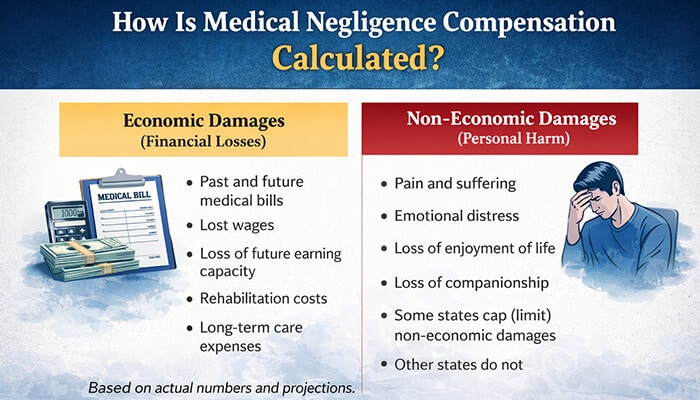
Courts usually divide compensation into two main categories:
1. Economic Damages (Financial Losses)
These include:
- Past and future medical bills
- Lost wages
- Loss of future earning capacity
- Rehabilitation costs
- Long-term care expenses
These are based on actual numbers and projections.
2. Non-Economic Damages (Personal Harm)
These include:
- Pain and suffering
- Emotional distress
- Loss of enjoyment of life
- Loss of companionship
Some states cap (limit) non-economic damages. Others do not.
For example, states like Ohio have damage caps in many cases, while other states allow higher recoveries depending on circumstances.
How Much Compensation Will I Get for Medical Negligence?
If you are wondering, how much compensation will I get for medical negligence, ask these questions:
- Was the injury temporary or permanent?
- Did it affect your ability to work?
- Are future surgeries required?
- Is there lifelong disability?
- Does your state have damage caps?
How Much Compensation for Medical Negligence Resulting in Death?
When negligence leads to death, it becomes a wrongful death medical malpractice claim.
Compensation may include:
- Funeral and burial costs
- Medical bills before death
- Lost financial support
- Loss of companionship
- Emotional suffering of family
Wrongful death cases often have higher values, especially if:
- The deceased was young
- The deceased was a primary income earner
- There are dependent children
Serious cases can reach $1 million or more, depending on the state and financial losses, but again, state law and facts matter.
What Types of Cases Get the Highest Payouts?
Generally, the largest medical negligence settlement amounts involve:
- Birth injuries causing lifelong disability
- Brain damage
- Paralysis
- Failure to diagnose cancer early
- Surgical errors causing permanent harm
The key factor is long-term financial impact.
How Long Do You Have to File a Claim?
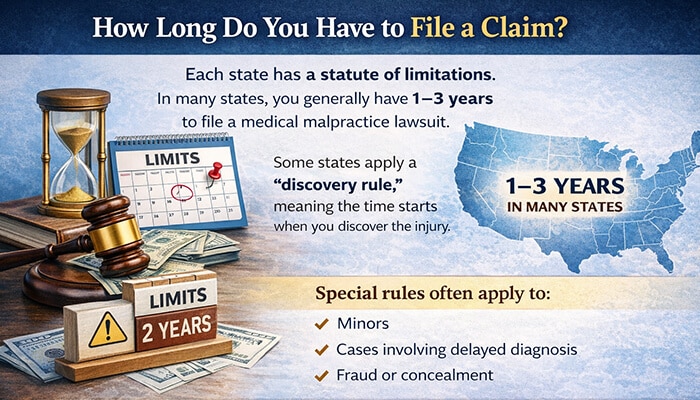
Each state has a statute of limitations.
In many states, you generally have 1–3 years to file a medical malpractice lawsuit. Some states apply a “discovery rule,” meaning the time starts when you discover the injury.
Special rules often apply to:
- Minors
- Cases involving delayed diagnosis
- Fraud or concealment
Missing the deadline usually ends your right to compensation.
Do You Need a Medical Expert to File a Case?
In most states, yes.
Medical malpractice cases usually require:
- Expert testimony
- A certificate or affidavit of merit (in many states)
- Proof that the provider violated the standard of care
Without expert support, a case is unlikely to succeed.
Do All Medical Negligence Cases Go to Trial?
No.
Most cases settle before trial. Trials are expensive and risky for both sides.
However:
- Strong evidence increases settlement value
- Weak expert testimony reduces value
- Clear documentation improves outcome
Does Every State Have Damage Caps?
No. But many states limit non-economic damages.
For example:
- Some states cap pain and suffering damages
- Some states increase caps for catastrophic injuries
- A few states do not cap damages at all
Because laws change, compensation can vary significantly depending on jurisdiction.
Do I Need a Lawyer for a Medical Negligence Case?
Medical malpractice cases are complex.
You usually need:
- Medical expert testimony
- Detailed record analysis
- Proof of causation
- Financial damage calculations
Most lawyers handle these cases on a contingency fee (they take a percentage if you win).
You might consider speaking with a lawyer if:
- The injury is permanent
- The medical costs are high
- The hospital denies responsibility
- A loved one died
Minor injuries with small damages may not justify the cost and time of a lawsuit.
Common Myths About Medical Negligence Compensation
Myth 1: All cases are worth millions.
Fact: Most are not.
Myth 2: If there was a mistake, you automatically win.
Fact: You must prove negligence and causation.
Myth 3: Settlements are quick.
Fact: Many cases take 1–3 years.
Conclusion: How Much Compensation for Medical Negligence?
If you are asking how much compensation for medical negligence, there is no fixed number. Compensation depends on injury severity, long-term financial impact, strength of evidence, and your state’s laws.
Minor injuries may settle for thousands. Serious permanent injuries or wrongful death cases can reach hundreds of thousands or millions. Every case is fact-specific, and strong expert support is critical to determining value.
Practical Next Steps
If you believe medical negligence occurred:
- Request complete medical records
- Document all expenses and lost wages
- Avoid discussing the case publicly
- Check your state’s statute of limitations
- Consider consulting a medical malpractice attorney
- Early action is important because deadlines apply.
Disclaimer
This article provides general legal information about medical negligence in the United States. It is not legal advice. Laws vary by state, and outcomes depend on individual facts. For advice about your specific situation, consult a qualified attorney in your jurisdiction.
Frequently Asked Questions About How Much Compensation for Medical Negligence
1. What are 5 examples of medical negligence?
Common examples of medical negligence include:
1. Surgical errors – Operating on the wrong body part or leaving instruments inside the patient.
2. Misdiagnosis or delayed diagnosis – Failing to detect serious conditions like cancer or stroke in time.
3. Medication mistakes – Prescribing the wrong drug or incorrect dosage.
4. Birth injuries – Improper monitoring or delayed C-section causing harm to mother or baby.
5. Anesthesia errors – Giving too much anesthesia or failing to monitor oxygen levels.
Not every mistake qualifies as negligence. The patient must prove the provider failed to meet the accepted standard of care and caused harm.
2. What is the average medical negligence payout?
There is no fixed average. Many medical negligence settlement amounts fall between $250,000 and $500,000 for moderate injuries. Severe or permanent injuries may exceed $1 million, especially when long-term care or disability is involved.
Smaller cases with temporary injuries may settle for less.
3. How long does a malpractice settlement take?
Most medical malpractice cases take 1 to 3 years to resolve.
The timeline depends on:
- Complexity of the medical issues
- Availability of expert witnesses
- Whether the case settles or goes to trial
- Court scheduling delays
Serious cases involving permanent injuries often take longer.
4. Is it worth suing for medical negligence?
It may be worth suing if:
- The injury is permanent or severe
- Medical bills are high
- You lost income or earning ability
- A loved one died
It may not be worth suing if the injury was minor and damages are small, since malpractice cases require expert testimony and can be costly and time-consuming.