

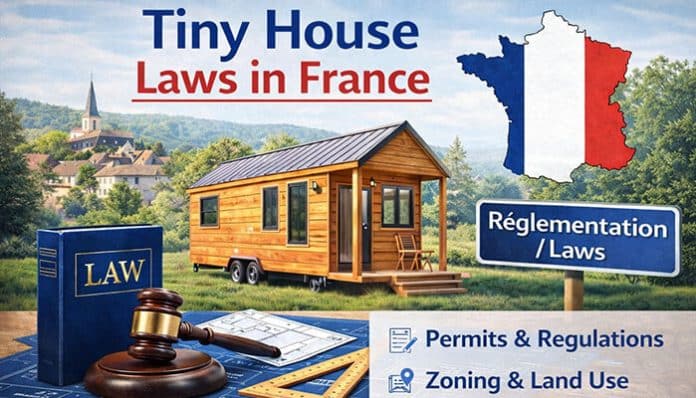

France in Europe is becoming one of the most popular countries for employment and business opportunities due to its economic policies. However, the demand for housing is increasing in urban locations, and many families are looking for other options. As a result, tiny houses are gaining attention in France, which has increased the sales of small properties. However, it is essential to be aware of the tiny house laws in France, as they enable individuals to comply with them. Moreover, they provide ways to minimise legal issues and other complications to a greater extent.
Installing a tiny house in France should meet certain parameters, and those who want to build the same should follow the rules and regulations. The tiny house laws in France involve different legal statuses, and understanding them will help plan everything accordingly. They allow people to adapt to local standards and legislation.
While building a tiny house, one should evaluate the administrative procedures, site criteria, and other factors. This, in turn, gives ways to create a house with the latest amenities to live a comfortable life.
Tiny house laws in France
The real estate laws in France set certain limits for constructing tiny houses. In 2014, the Alur law made a significant turning point in the French legislative landscape. Its primary aim was to reform the housing market in the country. The Loi Alur, also known as the Loi for access to housing and renovated urbanism, introduced a number of measures for the real estate sector in France.
The ALUR law of 2014 granted legal recognition to tiny houses as lightweight housing under different legal statuses. They include:
- Mobile home or mobile leisure residence (MLR): A mobile home is an approved and registered trailer that is subject to road regulations
- Fixed dwelling: A removable frame, considered a chalet, subject to the town planning code
- Temporary housing: Setting up camp on private lands for less than 3 months without mandatory authorization
- Permanent or primary housing: Building a permanent house in a permitted zone according to the local urban development plan, with appropriate authorization
It is wise to evaluate what the tiny house laws in France say about legislation, regulations, and administrative procedures to construct a tiny house.
Understanding tiny house regulations in France
Understanding tiny house regulations in France allows people to reduce fines, penalties, and other legal problems.
Here are some regulations followed in France for tiny house installation.
1. Planning permit
A planning permit is necessary for building a tiny house, and a builder should respect the Regional Planning Regulation when it comes to ceiling height and area. On the other hand, it is not necessary, and a prior declaration is sufficient if the tiny house is less than 40 m² in a U zone and on wheels. However, a permit and a prior declaration are mandatory for tiny houses between 5 and 20 square meters in urban areas.
2. Zoning and land-use regulations
Local zoning and land-use regulations in France determine where and how to place or build a tiny house legally. A builder should check these regulations with the local council before setting up a tiny house on private land.
3. Complying with standards
Tiny houses in France should comply with certain structural requirements to ensure more safety and durability. They should follow the Local Urban Development Plan (PLU) rules of their municipality.
4. Tax implications
An annual tax of €150 may apply if a tiny house is used as a main residence.
What are the requirements needed for a trailer home?
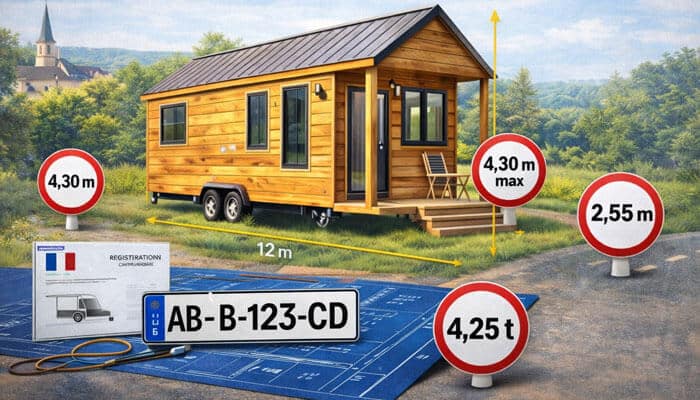
A mobile home should meet certain requirements, and the tiny house laws in France have set some regulations for a trailer.
Here are the things needed for a trailer home.
- Registration is necessary for any trailer exceeding 500 kg
- It must adhere to specific measures with a width of 2.55 meters
- A length limited to 12 meters, excluding the towing vehicle
- The height should comply with road traffic, which is generally less than 4.30 meters.
- A BE license for driving if the total weight of the vehicle and the trailer exceeds 4.25 tonnes
- A registration certificate for driving the vehicle on French and European roads
What are the regulations applicable to tiny houses in France?
1. For tiny houses considered as leisure accommodations
An owner’s agreement is necessary while installing a tiny house on private land. At the same time, one should apply for prior authorisation to the town hall if it is public land.
2. For tiny houses considered as primary residences
A builder or individual should respect the local urban development plan (PLU) or site development plan (PAS). Moreover, they should apply for a building permit or a prior declaration of works, depending on the surface area and impact of the project.
3. Insurance coverage
Insurance coverage is essential for the trailer portion when it’s being moved. For a tiny house that is permanently attached to the ground, comprehensive home insurance is the appropriate policy.
4. Parking and construction areas
A tiny house can remain on private land, just like farmland. It is not allowed to park in areas such as protected areas, such as woods, forests, and parks classified by PLU. Agricultural areas are not suitable for constructing a tiny house. However, the PLU may include an STECAL (Sector of Limited Size and Capacity), which permits lightweight construction.
What are the tax and administrative constraints for installing tiny houses in France?
It is important to know the tax and administrative constraints before installing tiny houses in France to help make informed decisions. The tax implications depend on the chosen legal status and the duration of land occupancy.
- Property tax is only applicable if the structure becomes permanently fixed to the ground, which distinguishes mobile housing from permanent housing.
- Placement in a temporary housing zone or a mobile home zone might result in specific tax regimes or exemptions depending on the type of residence.
- Setting up a structure in a non-building zone remains subject to a thorough review of local planning documents.
- Transfer taxes only apply if the house comes under a permanent residential building category.
Tiny house vs mobile home in France: A comparison
| Criteria | Tiny house | Mobile home |
| Location | Variable, depending on the owner’s choice | Camping areas and parks |
| Permit | Prior declaration required for certain areas | Authorisation from the town hall is required |
| Standards | Local urban planning regulations | Specific standards for recreational areas |
| Taxation | Problematic according to usage | Initial tax advantage |
| Regulation | Impact of local urban planning regulations | Standards established for specific areas |
| Use | Independent living | Holiday home or main residence |
What is the main criterion for the location of tiny houses in France?
- Area: Less than or more than 20 m², depending on the type of application to be submitted
- Landscape integration: Respect for the setting and local regulations
- Materials: High-quality, recyclable, with appropriate insulation
- Duration: Less than or more than three months, less than or more than eight months per year
Network connection options and landscape integration
Those who want to construct a tiny house should know the network connection options and landscape integration with attention. Besides, they should understand tiny house laws in France from different sources to gain more insights about a project.
Setting up a tiny house needs installing essential utility connections. Building a house in a U zone requires connection to water, electricity, and sewage systems. For installations lasting more than 3 months, a prior notification to the town hall is mandatory.
New owners can create a garden tailored to the available space while adhering to local planning regulations defined by the PLU. This approach allows them to preserve the natural character of the land and the privacy of the residents.
Key points to consider regarding the traffic and insurance of tiny houses in France
Road regulations in France require registration, specific insurance, and a BE driving license for towing a mobile house weighing over 3.5 tonnes. Moreover, a mobile house should comply with European regulations guaranteeing the possibility of driving on all European roads.
However, a permanent tiny house in France requires comprehensive home insurance to ensure more protection. Insurance companies often require guarantees regarding the quality of materials used, insulation, and structural ability.
What are the mistakes to avoid in tiny house installation in France?
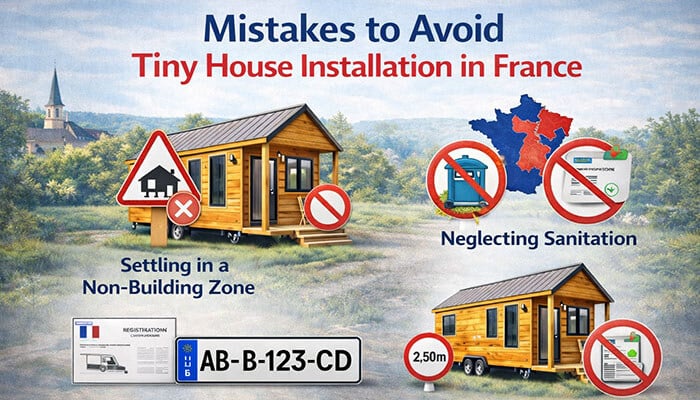
1. Settling in a non-building zone
Agricultural zones and protected areas are not suitable for constructing a tiny house in France, which leads to high penalties. Therefore, owners should know the locations that suit a tiny house installation.
2. Neglecting sanitation
Neglecting sanitation in tiny house installation can lead to high fines and legal problems. It is wise for owners to understand tiny house laws in France before constructing a house.
3. Ignoring the subdivision regulations
If the land is in a house development area, the regulations might prohibit lightweight or mobile structures. Even with planning permission, the development might prevent an owner from building.
4. Believing that wheels exempt an owner from needing authorization
A tiny house on wheels that remains in the same location for more than three years requires a valid permit. New owners should keep in mind that keeping the wheels makes no difference if the tiny house is effectively stationary.
What are the things to follow before constructing a tiny house in France?
1. Awareness of French regulations and standards
New owners should be aware of tiny house laws in France because the French legislation regulates the dimensions of houses.
2. Choice of suitable land and materials
It is important to choose a suitable piece of land that fits a tiny house construction or a mobile trailer to get the desired outcomes.
3. Preparing a detailed budget and cost estimate
The total budget for a tiny house might vary significantly depending on the construction choices. A typical tiny house requires an average investment of €25,000. New owners should prepare a detailed budget and cost estimate before building a tiny house.
Common misconceptions about tiny houses in France
- Parking regulations are not required for a mobile vehicle on private land
- Insurance is not mandatory for a tiny house
- Temporary housing zones allow for stays longer than 8 months
- Protected areas or classified areas don’t impose any additional restrictions
- Trailer homes don’t require any road regulations and are allowed to park anywhere
- The construction costs are cheap and don’t involve any taxes
- A prior declaration or permit is not necessary.
Is legal advice necessary for constructing a tiny house in France?
Anyone who is new to France should know the tiny house laws in France when they want to build a trailer home or a permanent construction. They can approach the local authorities for gathering information on the latest updates. This will help them to handle complex issues during the construction process. Otherwise, they can seek advice from an expert attorney to overcome complications considerably.
Challenges and opportunities for tiny house owners in France
Challenges
- The lack of a clear legal framework can often lead to disputes and different interpretations by the authorities
- Finding a suitable piece of land for the construction of a tiny house might become difficult in urban areas
- Getting funds for tiny houses will become more complex
- Applying for a permit requires a proper understanding of laws
Opportunities
- Municipalities and local authorities conduct pilot projects to facilitate the installation of tiny houses
- A network of tiny house owners is growing in France, and they aim to promote mutual support and exchange of information
Conclusion
Building a tiny house in France involves several challenges, and many owners are not properly aware of them. They should get details on tiny house laws in France from different sources that help create a house accordingly. Moreover, they can avoid penalties and other legal problems while constructing a tiny house.
Although tiny houses focus mainly on minimalism, new owners should understand the legal procedures in France. This is because they will guide them to construct a tiny house with specifications to ensure high-level comfort. Moreover, the competition is increasing in France for tiny houses, and constructing an illegal house might lead to a violation of laws that require advice from legal experts.