

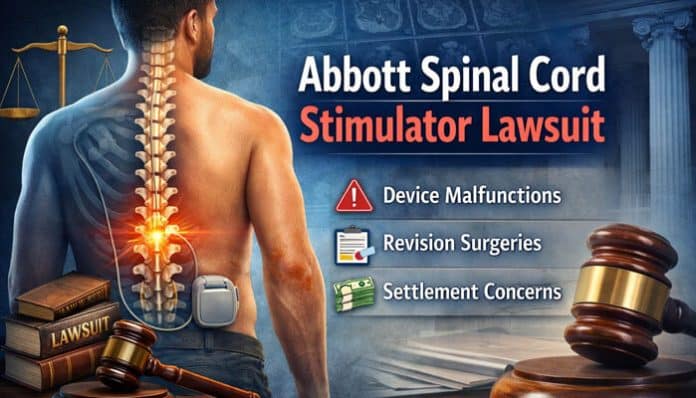

The abbott spinal cord stimulator lawsuit has emerged as a significant area of medical device litigation in the United States. Patients across multiple states allege that certain spinal cord stimulator (SCS) systems manufactured by Abbott Laboratories malfunctioned, failed prematurely, or required painful revision surgeries.
For many patients already suffering from chronic pain, device complications can be physically, emotionally, and financially devastating.
This comprehensive guide explains:
- What Is an Abbott Spinal Cord Stimulator?
- How they are regulated by the FDA
- Why lawsuits are being filed
- Reported complications and injuries
- The latest abbott spinal cord stimulator lawsuit update
- Potential settlement values
- Who may qualify to file a claim
- Filing deadlines and legal process
- What to do if you have this device
What Is an Abbott Spinal Cord Stimulator?
A spinal cord stimulator (SCS) is an implanted medical device designed to manage chronic, treatment-resistant pain. The device works by delivering low-level electrical pulses to the spinal cord to disrupt pain signals before they reach the brain.
Abbott manufactures several SCS systems widely used in the U.S., including:
- Proclaim™ series
- Infinity™ series
- Eterna™ series
These systems generally include:
- Leads (thin insulated wires) placed near the spinal cord
- An implanted pulse generator (IPG) that powers stimulation
- A handheld controller allowing the patient to adjust therapy
They are typically prescribed for:
- Failed back surgery syndrome
- Chronic lower back pain
- Neuropathic pain
- Complex regional pain syndrome (CRPS)
- Post-surgical nerve damage
For many patients, these devices are recommended after medications, injections, or surgeries fail to provide relief.
FDA Regulatory Background
Spinal cord stimulators are classified as Class III medical devices under U.S. Food and Drug Administration (FDA) regulations. Class III devices are those that sustain life or present potential significant risk and therefore require Premarket Approval (PMA).
Premarket approval requires:
- Clinical testing
- Safety and effectiveness data
- Ongoing post-market monitoring
FDA Recalls and Safety Concerns
Certain Abbott spinal cord stimulator models have been subject to FDA recalls and safety communications. Some recalls were classified as Class I recalls, the FDA’s most serious designation, indicating a reasonable probability of serious injury.
Reported recall-related issues have included:
- Failure to exit MRI mode
- Inability to resume therapy after MRI
- Premature battery depletion
- Software communication errors
- Device resets
An FDA recall does not automatically establish liability. However, recall classification and safety warnings often become central issues in product liability litigation.
What Is the Abbott Spinal Cord Stimulator Lawsuit?
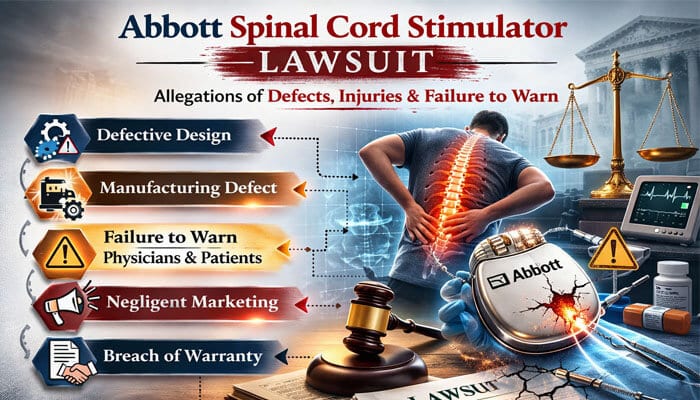
The abbott spinal cord stimulator lawsuit refers to individual product liability claims filed by patients who allege device malfunction or injury.
These lawsuits typically claim:
- Defective design
- Manufacturing defect
- Failure to warn physicians and patients
- Negligent marketing
- Breach of warranty
Unlike class actions, most of these cases are filed individually. Some may be coordinated in mass tort proceedings if filings increase.
Why Are Patients Filing Lawsuits?
Plaintiffs generally allege that certain Abbott SCS devices:
- Malfunctioned unexpectedly
- Delivered inconsistent or painful stimulation
- Stopped working prematurely
- Required costly and risky revision surgeries
- Failed after MRI procedures
- Migrated from their intended position
Many lawsuits argue that patients were not adequately warned about malfunction rates or long-term device risks.
Reported Complications and Injuries
Lead Migration
Lead migration occurs when the implanted wires shift from their intended location. This may cause:
- Loss of pain relief
- Increased nerve pain
- Erratic stimulation
- Need for corrective surgery
Lead migration is one of the most common complications cited in litigation.
Battery or Generator Failure
If the implanted pulse generator malfunctions:
- Therapy may abruptly stop
- Reprogramming may fail
- Surgical replacement may be required
Premature battery depletion has been cited in some complaints.
MRI Mode Malfunctions
Certain SCS systems include MRI-safe modes. However, lawsuits allege that some devices:
- Failed to exit MRI mode
- Did not resume therapy
- Required explant surgery after MRI exposure
Revision or Removal Surgery
Revision surgery may involve:
- Repositioning leads
- Replacing the generator
- Removing the entire device
Each additional surgery increases the risk of:
- Infection
- Scar tissue formation
- Nerve injury
- Long-term disability
For patients already living with chronic pain, repeated surgeries can significantly worsen quality of life.
Abbott Spinal Cord Stimulator Lawsuit Update (2026)
- Cases are ongoing in multiple U.S. jurisdictions.
- There is no confirmed nationwide global settlement.
- Courts continue evaluating device defect allegations.
- Individual lawsuits remain the primary legal pathway.
An official abbott spinal cord stimulator lawsuit settlement program has not been publicly announced.
Litigation trends may evolve if filings increase or consolidation occurs.
Abbott Spinal Cord Stimulator Lawsuit Settlement Values
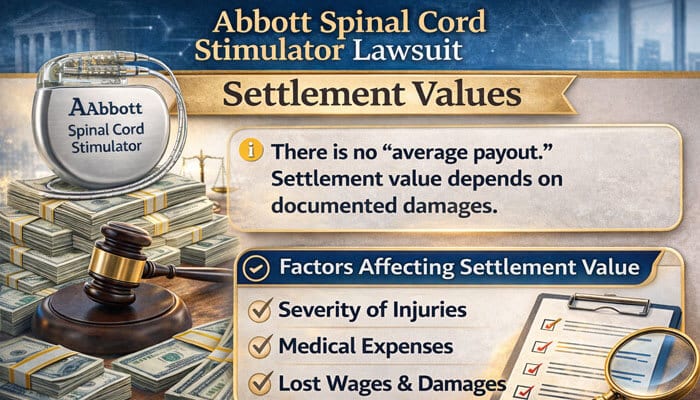
Many patients ask: How much is the abbott spinal cord stimulator lawsuit worth?
There is no “average payout.” Settlement value depends on documented damages.
Factors That Influence Compensation
| Factor | Why It Matters |
| Revision surgery | Significantly increases damages |
| Permanent nerve damage | Raises long-term value |
| Medical expenses | Economic damages must be documented |
| Lost wages | Compensable financial loss |
| Pain & suffering | Non-economic damages |
| Age & overall health | Impacts long-term impact calculation |
General Product Liability Context
In similar U.S. medical device cases:
- Moderate injury cases may fall in the tens of thousands to low six figures
- Multiple surgery cases may reach higher six figures
- Severe permanent injury cases may exceed that range
Compensation is never guaranteed and varies widely.
Who May Qualify to File a Claim?
You may qualify if:
- You received an Abbott spinal cord stimulator implant
- You experienced device malfunction
- You required revision or removal surgery
- A physician linked your complications to the device
- You suffered measurable damages
Wrongful death claims may be possible in rare fatal complication cases.
Statute of Limitations (Critical for U.S. Patients)
Each state has strict deadlines for filing product liability claims.
In many states:
- The clock begins when the injury occurred, or
- When you reasonably discovered the device caused harm
Deadlines often range from one to four years.
Failure to file within the statute of limitations may permanently bar recovery.
How the Legal Process Works
1. Case evaluation
2. Medical record review
3. Device model confirmation
4. Filing in state or federal court
5. Discovery (exchange of evidence)
6. Settlement negotiations or trial
Most firms handle these cases on contingency, meaning no upfront fees.
What To Do If You Have an Abbott Spinal Cord Stimulator
If you currently have this device:
- Do not attempt to adjust or remove it without medical supervision.
- Document symptoms such as shocks, therapy loss, or battery issues.
- Request device model and serial information from your physician.
- Keep copies of operative reports and revision surgery records.
- Consult a qualified product liability attorney promptly.
Timely action protects your legal rights.
FAQ’s: Abbott Spinal Cord Stimulator Lawsuit
1. Is there an abbott spinal cord stimulator lawsuit settlement?
As of 2026, no nationwide settlement program has been publicly confirmed. Individual cases may resolve privately.
2. Is this a class action?
Most claims are filed individually as product liability lawsuits, not class actions.
3. How much compensation can I receive?
Compensation depends on medical evidence, surgeries required, and documented losses. There is no guaranteed payout.
4. Which models are involved?
Complaints often reference Proclaim™, Infinity™, and Eterna™ systems, but eligibility depends on case specifics.
5. How long do I have to file?
Filing deadlines vary by state, often between one and four years from injury discovery.
Key Takeaways
- The abbott spinal cord stimulator lawsuit involves allegations of device malfunction and inadequate warnings.
- Certain devices have been subject to FDA recalls and safety scrutiny.
- No universal abbott spinal cord stimulator lawsuit settlement exists at this time.
- Settlement value depends on injury severity and documentation.
- State filing deadlines apply.
Conclusion
The abbott spinal cord stimulator lawsuit involves allegations that certain devices manufactured by Abbott Laboratories malfunctioned and required revision surgery. While some systems have faced FDA recall scrutiny, no nationwide abbott spinal cord stimulator lawsuit settlement has been announced as of 2026. Cases continue individually across U.S. courts. Patients experiencing complications should document symptoms, review medical records, and be mindful of state filing deadlines, as eligibility and potential compensation depend on the specific facts of each case.