

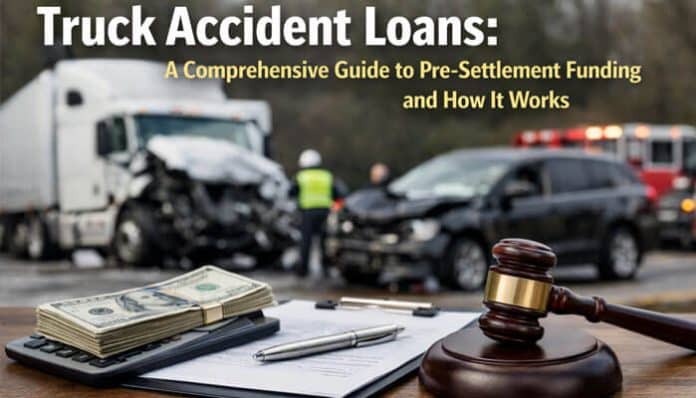

Truck accident loans are a type of pre-settlement funding designed to provide financial relief to individuals injured in truck accidents while they await the outcome of their lawsuit. Unlike traditional loans, these are non-recourse advances, meaning the loan is repaid only if the case is successful, usually deducted directly from the settlement or court-awarded compensation.
In the aftermath of a truck accident, victims often face significant medical expenses, lost wages, and living costs that continue to accumulate while the legal process moves forward. Truck accident loans help ease this financial burden, providing quick access to cash to cover immediate needs, including medical bills, rent, and other daily expenses.
While these loans can be a lifesaver, it’s essential to understand the terms, fees, and repayment structure, as borrowing against your settlement may reduce your final payout. In this guide, we’ll explore how truck accident loans work, their benefits and risks, and how to determine whether they’re the right option for you.
What Are Truck Accident Loans?
Truck accident loans usually refer to cash advances given to injured claimants before their case settles. In most situations, these are not standard personal loans from a bank or credit union. Instead, the funding company evaluates the legal claim and offers money based on the expected value of a future recovery.
If the case settles successfully or results in a favorable judgment, the funding company is repaid from those proceeds. For that reason, many of these arrangements are better described as settlement advances rather than ordinary consumer loans.
This is one of the most important things readers need to understand. The word “loan” is widely used in search, but the product itself is often structured differently from traditional borrowing.
How Truck Accident Loans Usually Work
The process usually begins when a funding company reviews the legal claim. It may examine:
- liability
- injuries and treatment history
- insurance coverage
- attorney representation
- estimated settlement value
- available case documents
If the company believes the case is strong enough, it may approve an advance. The claimant then receives a contract explaining the amount funded and the repayment terms.
If the case settles or results in a judgment, the company is repaid from those proceeds. That is why the contract is the most important part of the transaction. Advertising language matters far less than the actual written terms.
Documents You May Need to Apply
When applying for truck accident loans, a provider may request:
- your lawyer’s contact information
- a summary of the truck accident
- insurance details
- medical records or treatment updates
- the status of the legal claim
- Demand materials or supporting case documents
The reason is simple: the provider is evaluating the strength of the legal claim, not just your financial profile.
How to Qualify for Truck Accident Loans
Qualification usually depends more on the quality of the case than on the claimant’s credit history. A provider may look for:
- serious documented injuries
- evidence of negligence
- active legal representation
- available insurance coverage
- a reasonable likelihood of recovery
Truck accident cases may sometimes attract funders because the damages can be larger than in standard car accident claims. Even so, every case is evaluated individually. If liability is weak or insurance coverage is limited, approval may be harder to obtain.
How Much Can You Borrow?
There is no universal borrowing amount for truck accident loans. The amount typically depends on:
- the estimated value of the case
- the seriousness of the injuries
- the available insurance or other recovery source
- how much room remains after attorney fees, case costs, and other deductions
A stronger truck accident case may support a larger advance. But larger funding is not always better. The more money taken up front, the greater the chance that repayment will consume a substantial part of the final settlement.
Pros and Cons of Truck Accident Loans
Pros
- May provide fast access to money during a pending case
- May be available even if the claimant has poor credit
- Usually based more on case strength than credit score
- Nonrecourse structure may reduce ordinary repayment risk if the case fails
- Can help a claimant avoid accepting an early low settlement offer
Cons
- Often expensive compared with traditional forms of borrowing
- Can significantly reduce net settlement recovery
- Terms and consumer protections may vary by state
- Some contracts are difficult to understand
- Multiple advances can quickly increase repayment exposure
The biggest issue is cost. A funding offer may look helpful upfront, but the eventual payoff can be much larger than expected.
Why Truck Accident Claims Are Different From Regular Car Accident Claims
Truck accident claims often involve more legal and factual complexity than standard passenger-vehicle collisions. Commercial trucking is heavily regulated, and federal rules may affect issues such as driver hours, rest requirements, inspection duties, maintenance obligations, and electronic log compliance.
A truck crash may also involve multiple parties beyond just the driver. Depending on the facts, responsibility may extend to the trucking company, trailer owner, cargo-loading company, maintenance provider, broker, or another business involved in the trip.
Evidence in these cases can include:
- electronic logging device data
- maintenance and inspection records
- dispatch communications
- driver qualification files
- company safety policies
- cargo and loading records
Because truck accident cases often require more investigation and documentation, they may take longer to settle. That delay is one reason many injured people explore truck accident loans in the first place.
How Truck Accident Legal Funding Works
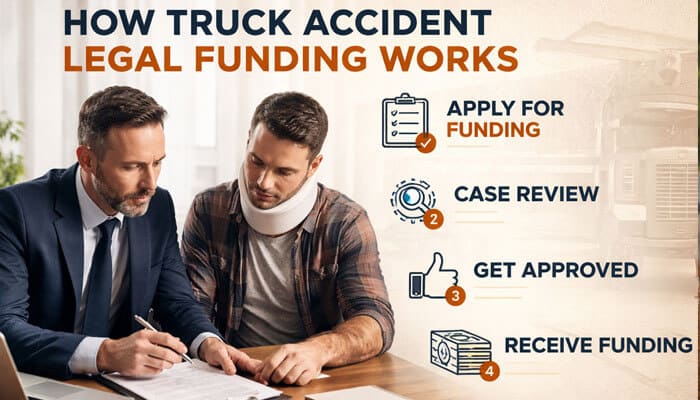
Unlike traditional loans, truck accident legal funding isn’t a typical loan. Instead, it’s a cash advance against your future settlement or court-awarded compensation. This form of pre-settlement funding helps individuals cover immediate expenses while they wait for the outcome of their lawsuit.
Step 1: Apply for FREE
The process begins with a simple application. To start, you’ll need to provide:
- Your attorney’s contact information.
- Your estimated settlement or compensation amount.
- Your attorney’s expected timeline for case resolution.
- The value of the damages you’re pursuing compensation for.
Before applying, ensure you have legal representation. We cannot assess your case’s value or timeline without your attorney’s input.
Step 2: Approval Process
After you submit the application, our underwriting team reviews the details of your truck accident lawsuit. If we determine our funding is a good fit for your situation, we’ll approve your application.
- Attorney involvement: We may reach out to your attorney for further information or clarification.
- No credit checks: Your credit score does not impact your ability to qualify.
Step 3: Receive the Funds
Once approved, you can expect the funds to be in your bank account in as little as 24 hours. Depending on your case, we can approve up to $1 million in pre-settlement funding for your truck accident lawsuit.
You are free to use the funds for any immediate needs, including:
- Medical bills
- Legal expenses
- Rent or mortgage payments
- Daily living expenses
Step 4: Repay the Funding
Repayment is simple and risk-free for you:
- Repayment is deducted directly from your settlement once your case concludes.
- No repayment required from personal finances.
- Non-recourse: If you lose your case, you owe nothing.
This means you don’t have to worry about making payments if your case is unsuccessful, making it a safe option for those involved in truck accident lawsuits.
How Truck Accident Loans Can Help During a Lawsuit
A truck accident lawsuit can take many months or longer to resolve. During that time, an injured person may still need money for:
- rent or mortgage payments
- groceries and utilities
- prescriptions and medical travel
- child care
- transportation
- other basic living expenses
In that sense, truck accident loans can provide short-term financial relief. They may also reduce pressure to accept a low early settlement offer simply because bills cannot wait.
That benefit can be real, especially in severe injury cases where the victim cannot work. However, the tradeoff is that the advance must usually be repaid from the settlement if the claim succeeds. So while the money may solve an immediate problem, it may also shrink the final payout.
Why Truck Accident Victims Look for Funding
| Reason for Seeking Funding | Explanation |
| Severe Injuries | Truck accident injuries are often more serious and require longer recovery. |
| Longer Treatment | Extended treatment leads to higher medical costs. |
| Extended Work Absences | Victims may lose significant income due to long work absences. |
| Slower Legal Process | The legal process is slower, causing delays in compensation. |
| Contingency Fee Doesn’t Solve Cash Flow | Contingency fees don’t fix short-term cash flow issues. |
Truck-Specific Evidence That Can Affect Approval
Truck accident funding may be influenced by evidence that does not exist in ordinary car crash claims. Approval may be stronger when the file includes evidence such as:
- driver log violations
- electronic logging device data
- maintenance failures
- inspection problems
- cargo-loading mistakes
- dispatch pressure or policy violations
- hours-of-service violations
These details can strengthen liability and increase the perceived value of the case. A stronger evidence picture may improve funding chances, while weak documentation may reduce them.
Truck Accident Loans vs. Traditional Loans
| Feature | Truck Accident Loans | Traditional Loans |
| Repayment source | Usually from a settlement or judgment | Monthly repayment by borrower |
| Approval focus | Strength of legal claim | Credit, income, and debt |
| Credit score importance | Often less important | Usually very important |
| Risk structure | Commonly nonrecourse | Usually full repayment required |
| Cost transparency | Can vary widely by provider | Often more standardized |
| Main purpose | Short-term lawsuit-related funding | General personal or business borrowing |
This comparison helps explain why truck accident loans should not be evaluated like ordinary financial products.
Repayment Terms: What You Need to Know
Repayment terms are the most important part of any truck accident loans agreement. Before signing, a claimant should understand:
- the exact amount being advanced
- how the payoff may increase over time
- whether extra fees apply
- whether charges are fixed or variable
- How repayment will work if the case takes longer than expected
It is also important to remember that the funding payoff may come out of the same settlement pool as:
- attorney contingency fees
- litigation costs
- medical liens
- reimbursement claims
- other case-related deductions
Because of that, the final amount left for the injured person may be far smaller than the gross settlement number suggests.
How Funding Can Shrink Your Final Settlement
Many claimants focus on the total settlement value without looking closely at the net recovery. That can be a mistake.
A settlement may need to cover:
- attorney fees
- legal expenses
- medical liens
- reimbursement obligations
- funding repayment
As a result, even a significant truck accident settlement can feel much smaller after all deductions are applied. That does not mean funding is always the wrong choice. It means the right question is not just how much the case may settle for, but how much the claimant may actually keep.
State Laws on Truck Accident Loans Can Vary
The legal-funding industry is not governed by one simple nationwide rule. State law may affect:
- disclosures
- cancellation rights
- fee restrictions
- contract enforceability
- consumer protections
That means the same type of funding contract may be treated differently depending on where the claimant lives or where the agreement is issued. Anyone considering truck accident loans should remember that state-law differences matter.
Red Flags to Watch for With Truck Accident Loan Providers
Some warning signs should make claimants pause before signing anything. Red flags may include:
- unclear repayment language
- pressure to sign quickly
- vague explanations about fees
- No written example of total payoff
- Refusal to provide full contract terms upfront
- missing cancellation or disclosure details
A trustworthy provider should be able to explain clearly what the claimant may owe after several months and how the payoff grows over time.
When You Should Avoid Truck Accident Loans
A truck accident loan may not be the right choice when:
- Cheaper financial options are available
- The case is weak or heavily disputed
- The provider cannot explain the total repayment clearly
- The claimant wants more money than is actually necessary
- The contract contains confusing or aggressive terms
Funding works best as a limited emergency measure, not as a long-term financial plan.
Alternatives to Truck Accident Loans
Before accepting lawsuit funding, it may be worth considering other short-term options, such as:
- payment plans for medical bills
- disability benefits
- health insurance support
- family assistance
- emergency savings
- lower-cost credit alternatives, if available
It can also help to speak with the attorney handling the case about timing, expected deductions, and whether funding makes financial sense at all.
Are Truck Accident Settlements or Funding Recoveries Taxable?
Tax treatment depends on the facts. Compensation related to personal physical injuries may be treated differently from other types of damages, and not every part of a settlement is automatically treated the same way.
That does not mean every truck accident settlement is tax-free, and it does not mean funding arrangements answer the tax question by themselves. When significant money is involved, claimants should get case-specific advice from a qualified tax professional.
Is a Truck Accident Loan Right for You?
A truck accident loan may make sense when:
- The case appears strong
- Essential bills cannot wait
- There is no better short-term option
- The contract terms are clear
- The likely repayment is understood in advance
But the best decision depends on more than approval alone. The real question is whether the funding still makes sense after reviewing its cost, its effect on the final settlement, and the alternatives available.
How to Find the Best Truck Accident Loans Provider

The best provider is not necessarily the one with the loudest ads or the fastest promises. A better provider is one that offers:
- clear written terms
- realistic repayment explanations
- transparent fee information
- straightforward answers to basic questions
- a contract your attorney can review easily
When comparing providers, ask what you would owe after 3 months, 6 months, and 12 months. Ask whether extra fees apply. Ask whether every charge is in writing. If the answers are vague, move on.
Questions to Ask Before Signing
Before agreeing to any truck accident loans contract, ask:
- Is this funding nonrecourse?
- What will I owe after 3, 6, and 12 months?
- Are there processing fees or extra charges?
- How much could this reduce my final settlement?
- Are all terms clearly explained in writing?
- Does my state regulate this type of funding?
These questions are often more useful than any marketing promise.
Key Takeaways About Truck Accident Loans
- Truck accident loans are usually a form of pre-settlement funding, not standard bank loans
- Approval often depends more on case strength than credit score
- Funding may help with urgent bills during a long truck accident claim
- The main downside is cost and reduced net settlement recovery
- Truck cases often involve more evidence and complexity than regular car accident claims
- Contract terms, fees, and state-law protections can vary significantly
Final Thoughts on Truck Accident Loans
Truck accident loans can provide meaningful short-term relief for injured claimants facing serious financial pressure during a pending case. In the right circumstances, they may help cover basic expenses and reduce the temptation to accept a low settlement too early.
Still, these products should be approached carefully. They are better understood as pre-settlement funding than as ordinary loans, and that difference matters. Even when repayment is tied to a successful recovery, the total cost can still be substantial.
The smartest approach is to focus on the full financial picture. Review the contract closely, compare providers carefully, ask direct questions about repayment, and discuss the decision with your attorney before signing. What matters most is not just getting funding today, but protecting as much of your eventual recovery as possible.
1. What Are Truck Accident Loans?
Truck accident loans are cash advances against your expected settlement, providing funds while your case is pending. You only repay if you win or settle your case.
2. How Do Truck Accident Loans Work?
Truck accident loans offer immediate cash, repaid directly from your settlement if successful. These loans are non-recourse, meaning you owe nothing if you lose your case.
3. How Much Can I Borrow with Truck Accident Loans?
The amount you can borrow with truck accident loans depends on your case’s value and the severity of your injuries, typically ranging from $500 to $1 million.
4. Do I Need Good Credit to Get Truck Accident Loans?
You don’t need good credit for truck accident loans as approval is based on the strength of your case, not your credit score or financial background.
5. What Are the Risks of Truck Accident Loans?
The main risk of truck accident loans is high fees that can reduce your settlement, so it’s important to understand all terms and repayment structures before applying.
Disclaimer: This article is for general informational purposes only and is not legal, tax, or financial advice. Laws vary by state, contract terms differ by provider, and the right decision depends on the facts of the specific case.
