



When people ask, is embezzlement a felony?, the answer is often yes, but not always. Embezzlement is commonly charged as a felony when the amount of money is large, the person was trusted with the property, or the case involves government funds, pension plans, or other serious financial misconduct. In some lower-value cases, however, state law may allow misdemeanor charges instead.
Embezzlement is a serious white-collar crime that can bring jail or prison time, restitution, fines, probation, and a lasting criminal record. Beyond court penalties, a conviction can also lead to job loss, licensing problems, damaged credit, and long-term harm to a person’s reputation and future opportunities.
Embezzlement happens when a person is trusted with someone else’s money or property and then wrongfully uses it for their own benefit. The key point is that the person usually had lawful access in the beginning. The crime happens when that person fraudulently takes, hides, transfers, or uses the money or property without permission.
In plain language, embezzlement usually involves these facts:
- A person was trusted with money or property
- The money or property belonged to someone else
- The person used it without permission
- The person acted knowingly and dishonestly
Common examples include:
- An employee moving company money into a personal account
- A bookkeeper creating fake invoices and paying themselves
- A nonprofit treasurer using charity funds for private bills
- A payroll employee issuing extra checks to themselves
- A trustee taking money meant for a client or beneficiary
So when someone asks what is embezzlement, the easiest answer is this: it is the dishonest misuse of money or property by someone who was trusted to handle it.
Is Embezzlement a Felony or a Misdemeanor?
Now to the main question: is embezzlement a felony? The answer is yes in many cases, but it depends on several things:
- The amount of money or property involved
- Whether the case is charged under state or federal law
- The kind of victim or institution involved
- Whether the accused held a position of trust
- Whether the conduct was part of a larger fraud scheme
In many states, embezzlement becomes a felony once the value crosses a certain threshold. But thresholds vary from state to state, so there is no one nationwide number for all state cases. Federal law also varies by statute. For example, under 18 U.S.C. § 641, embezzlement of U.S. government money or property can be punished by up to 10 years if the value exceeds $1,000, while lower-value conduct may be punished as a misdemeanor.
Yes, embezzlement is often a felony, but not every case is automatically a felony.
What Prosecutors Must Usually Prove
Although the exact wording depends on the law used, prosecutors usually must prove several basic points in an embezzlement case:
- The defendant had lawful access to the money or property
- The money or property belonged to another person, company, or institution
- The defendant took, used, or transferred it without permission
- The defendant acted intentionally and dishonestly
This matters because a bookkeeping mistake, a disputed reimbursement, or poor internal controls do not automatically equal embezzlement. In most real cases, the prosecution must show fraudulent intent, not just a missing balance.
That is why embezzlement cases often turn on records, account activity, invoices, emails, audit trails, and proof of intent.
Jail Time for Embezzlement
A major search term is jail time for embezzlement, and the answer is straightforward:
Yes, jail time for embezzlement is possible, and in serious cases prison time is possible too.
The sentence can depend on many things, including:
- The amount of money taken
- Whether the defendant has a criminal record
- Whether the case is charged as a misdemeanor or felony
- Whether there were multiple victims
- Whether the conduct lasted a long time
- Whether records were falsified
- Whether the person abused a position of trust
- Whether the case is charged in state or federal court
Possible outcomes may include:
- County jail
- State prison
- Federal prison
- Probation
- Restitution
- Fines
- Community service in some cases
In federal economic-crime cases, the loss amount can strongly affect sentencing calculations, which is one reason higher-dollar cases usually carry more risk.
Main Federal Embezzlement Laws
One reason this topic confuses readers is that there is not just one federal embezzlement law. Here are three major federal statutes people should know:
1) 18 U.S.C. § 641
This law covers embezzlement, theft, or knowing conversion of U.S. government money, property, or records. If the value exceeds $1,000, the law allows up to 10 years in prison. If the value does not exceed $1,000, it may be punished as a misdemeanor.
2) 18 U.S.C. § 666
This law applies to theft, fraud, or misuse involving an agent of an organization or government entity that receives more than $10,000 in federal benefits in a one-year period, where the property or transaction is worth $5,000 or more.
3) 18 U.S.C. § 664
This law covers theft or embezzlement from an employee welfare or pension benefit plan. It can carry up to 5 years in prison.
This is why the answer to is embezzlement a felony? can change depending on the kind of property involved and which statute applies.
Is Embezzlement a Felony for First-Time Offenders?

Many people hope that first time embezzlement charges will be treated lightly because they have never been arrested before. A clean record can help, but it does not make the case disappear.
A first-time defendant may still face:
- Misdemeanor charges
- Felony charges
- Arrest and booking
- Court appearances
- Restitution demands
- Job loss
- Plea negotiations
- A permanent record if convicted
In some cases, a first-time defendant may have a better chance at:
- Reduced charges
- Diversion or deferred judgment in some jurisdictions
- Probation instead of jail
- A plea agreement
- Less severe sentencing
But none of that is automatic. A first offense involving a large loss, long-running conduct, false records, or public money can still be treated very seriously.
What Can Increase a Sentence in an Embezzlement Case?
Not every embezzlement case is punished the same way. Even when two cases look similar on the surface, one sentence may be much harsher because of the details. Facts that can increase sentencing risk include:
- A large loss amount
- Abuse of a position of trust
- Multiple victims
- A long-running scheme
- False records or hidden transactions
- Related crimes such as wire fraud or tax offenses
- Harm to a government agency, nonprofit, or benefit plan
In federal cases, financial-loss figures can affect recommended ranges in economic crimes.
Embezzlement Charges in State Court vs. Federal Court
Embezzlement charges are often filed under state law, but some cases are handled in federal court.
State embezzlement charges
Most workplace or business-related embezzlement cases are prosecuted under state criminal statutes. Each state has its own rules for:
- Felony thresholds
- Misdemeanor limits
- Sentencing ranges
- Restitution requirements
- Diversion options
- Probation rules
- Statute of limitations
That is why the same dollar amount may be treated differently from one state to another.
Federal embezzlement charges
A case may become federal when it involves:
- U.S. government money or property
- Federal agencies or contractors
- Pension or employee benefit plans
- Federally funded organizations or programs
- Related federal crimes such as mail fraud, wire fraud, or identity theft
Federal cases are often more document-heavy and may carry more severe sentencing exposure, depending on the statute.
How Much Stolen Money Is Considered a Federal Offense?
There is no single dollar amount that automatically makes embezzlement a federal offense. Federal jurisdiction usually depends first on the kind of property, the institution involved, and the statute that applies. The dollar amount still matters, but it is not the only issue.
Examples:
- Under 18 U.S.C. § 641, value above $1,000 affects how the offense is punished.
- Under 18 U.S.C. § 666, the statute uses a $5,000 threshold tied to qualifying federally funded organizations and a $10,000 federal-benefits requirement.
- Under 18 U.S.C. § 664, the focus is on theft from benefit plans, not a single general dollar threshold.
So if someone asks, how much stolen money is considered a federal offense, the better answer is: Federal charges depend on the type of property and the legal basis for federal jurisdiction, not only the amount of money involved.
Is Misappropriation of Funds Civil or Criminal?
Another common question is: is misappropriation of funds civil or criminal? The answer is: it can be civil, criminal, or both.
A victim may bring a civil claim to recover money or property, while the government may bring criminal charges if the conduct meets the elements of embezzlement, theft, or fraud. Legal definitions of fraud also recognize that the same underlying conduct can create both civil and criminal exposure.
Civil side
Possible civil claims may include:
- Conversion
- Fraud
- Breach of fiduciary duty
- Breach of contract
- Unjust enrichment
Criminal side
Possible criminal charges may include:
- Embezzlement
- Theft
- Fraud
- Forgery
- False records offenses
- Identity theft in some cases
So when asking, is misappropriation of funds civil or criminal, the correct answer is often both.
Consequences of Embezzlement
The consequences of embezzlement can be life-changing. Common consequences include:
- Arrest or criminal investigation
- Misdemeanor or felony conviction
- Jail or prison time
- Probation
- Restitution to the victim
- Fines and court costs
- Loss of employment
- Trouble finding future work
- Loss of a professional license
- Credit and financial problems
- Reputation damage
- Immigration consequences for some non-citizens
These risks are not just theoretical. A conviction can affect work, housing, occupational licensing, benefits, and other opportunities long after the sentence ends.
Restitution, Fines, and Forfeiture: What Is the Difference?
Many readers confuse these terms, but they mean different things.
- Restitution is money paid back to the victim for qualifying losses caused by the crime.
- Fines are money paid to the government as punishment.
- Forfeiture is the loss of property connected to criminal conduct or traceable to criminal proceeds, when the law allows it.
A person can be ordered to pay restitution and a fine in the same case. Paying the victim back does not automatically erase the criminal case.
Can You Go to Jail If You Return the Money?
Yes. This is one of the biggest myths in embezzlement cases. Returning the money may help during plea talks or sentencing, but it does not automatically end the case. Once prosecutors believe the money was intentionally misused, the case can still move forward.
Common Defenses to Embezzlement Charges
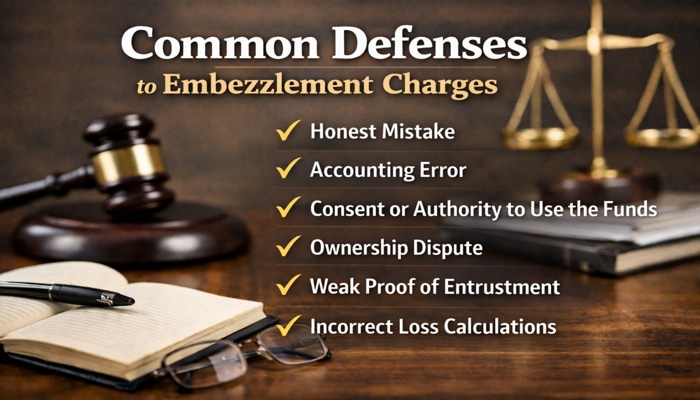
Every case is different, but common defense themes may include:
- Lack of intent
- Honest mistake
- Accounting error
- Consent or authority to use the funds
- Ownership dispute
- Weak proof of entrustment
- Incorrect loss calculations
- False accusation by an employer or partner
Some cases are not as clear as they first appear. Shared account access, verbal permission, unclear reimbursement rules, or sloppy bookkeeping may create doubt about whether the conduct was actually criminal.
Statute of Limitations for Embezzlement
The statute of limitations for embezzlement is the time limit the government has to file charges.
- The deadline can vary by state
- Federal and state time limits may be different
- Some rules may pause or extend the clock
- Related charges may have different deadlines
For many federal non-capital offenses, the default limitation period is five years under 18 U.S.C. § 3282, unless another law provides a different rule. But that does not mean every embezzlement case has the same deadline, because states and related charges may differ.
The statute of limitations for embezzlement depends on the state, the kind of charge, and whether federal law applies.
What To Do If You Are Being Investigated for Embezzlement
If a person thinks they are under investigation for embezzlement, the safest approach is to take the matter seriously from the start.
- Do not destroy records
- Do not create false explanations
- Do not contact witnesses to influence them
- Save relevant documents and communications
- Avoid making statements without legal advice
- Speak with a criminal defense lawyer early
This is especially important because embezzlement investigations often rely on paper trails, digital records, payroll entries, emails, invoices, and bank activity.
State vs. Federal Embezzlement
| Issue | State Embezzlement | Federal Embezzlement |
| Source of law | State criminal statutes | Federal criminal statutes |
| Who prosecutes | State or local prosecutors | Federal prosecutors |
| Thresholds | Vary by state | Vary by statute |
| Common examples | Employee theft, nonprofit misuse, business account misuse | Government funds, pension plans, federally funded programs |
| Punishment | Misdemeanor or felony depending on facts | Can include serious prison exposure |
| Time limits | Vary by state | Often 5 years by default for non-capital offenses, unless another rule applies |
Final Takeaway
So, is embezzlement a felony? In many situations, yes. But the full answer depends on the amount involved, the role of the accused, the kind of property at issue, the victim, the proof of intent, and whether the case is brought under state or federal law.
Embezzlement is not just a bookkeeping problem or a private money dispute. It can lead to serious criminal charges, real jail time, restitution, fines, and long-term damage to work, licensing, and reputation. Federal law also shows clearly that some embezzlement cases are treated very seriously when they involve government funds, federally funded programs, or employee benefit plans.
Is Embezzlement a Felony FAQs
1. Is embezzlement a felony?
Often yes. Many embezzlement cases are charged as felonies, especially when the amount is high or the conduct is serious. But some lower-value cases may be misdemeanors, depending on the law.
2. What are the consequences of embezzlement?
Possible consequences include jail, prison, restitution, fines, job loss, licensing problems, and long-term collateral consequences.
3. What is the statute of limitations for embezzlement?
It varies. For many federal non-capital offenses, the default is five years, but state rules and special statutes can differ.
4. Can first time embezzlement charges still be a felony?
Yes. A first offense does not automatically prevent felony charges.
5. Is misappropriation of funds civil or criminal?
It can be civil, criminal, or both.
6. Does paying the money back end the case?
No. Repayment may help during negotiations or sentencing, but it does not automatically stop criminal charges.
Disclaimer: This article is for general informational purposes only and is not legal advice. Embezzlement laws vary by state, and federal law may apply in some cases. Anyone facing an accusation or investigation should speak with a qualified attorney about the specific facts of the case.
