

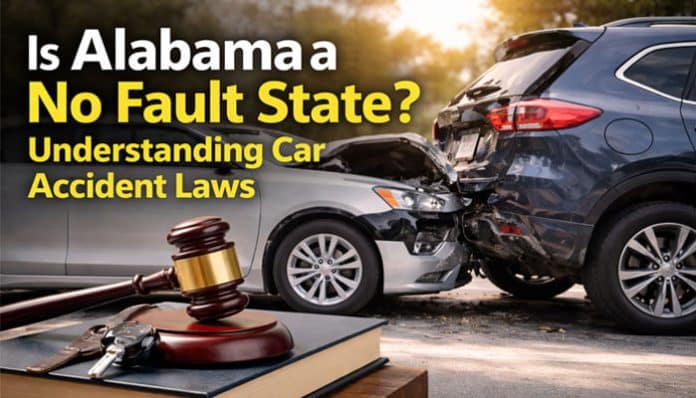

So, is Alabama a no fault state? If you’ve ever been in a car accident in Alabama or you’re just trying to understand how auto insurance works in the state this is one of the most important questions you can ask. The short answer is no. Alabama is NOT a no-fault state. Alabama follows what is called an “at-fault” or “tort” system. That means if someone causes a car crash, that person (and their insurance) is responsible for paying the bills. You won’t just file a claim with your own insurance and call it a day fault matters a lot here.
Understanding whether is Alabama a no fault state is more than just a legal question it has real money consequences for you. In no fault states, your own insurance pays your medical bills no matter who caused the crash. But in Alabama, you must prove the other driver was at fault before you can get paid. That’s a big difference, especially when you’re hurt, missing work, and dealing with medical bills piling up fast.
This guide will walk you through everything from what “no fault” actually means, to how Alabama’s unique rules work, to what you should do after a car accident in Alabama. By the time you finish reading, you’ll have a clear picture of your rights. And if you still have questions, speaking with an experienced Alabama car accident attorney can make a huge difference in your case.
Quick Answer: Is Alabama a No Fault State?
| Is Alabama a No Fault State? | NO. Alabama is an at-fault (tort) state. |
| Who Pays After a Crash? | The driver who caused the crash (and their insurance) |
| Is PIP Insurance Required? | No. Alabama does not require Personal Injury Protection (PIP) |
| Statute of Limitations | 2 years from the date of the accident |
| Negligence Rule | Pure contributory negligence (one of only 4 states) |
What Does “No Fault State” Even Mean?
Before we dig into whether is Alabama a no fault state, let’s make sure we understand the two systems. Think of it this way: imagine two cars collide at a stop sign. Who pays for the injuries?
In a No Fault State: Each driver files a claim with their own insurance company, no matter who caused the accident. Your insurer pays your medical bills through something called Personal Injury Protection (PIP) coverage. You don’t need to prove the other driver was wrong you just file with your own policy and move on. States like Florida, Michigan, and New York use this system.
In an At-Fault State (like Alabama): The driver who caused the accident is responsible for paying everyone’s damages. If the other driver ran a red light and hit you, their insurance pays your medical bills, lost wages, and other losses. But here’s the catch you have to prove it was their fault first.
There are currently only 12 states that use a no fault system in the United States. Alabama is not one of them.
Is Alabama a No Fault State? Understanding the At-Fault System
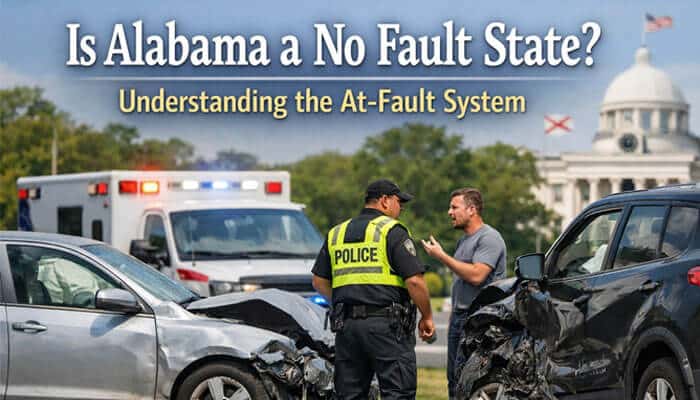
Is Alabama a no fault state? Absolutely not. Alabama is a pure at-fault (tort) state. This means the person who caused the car accident and their insurance company must pay for the damages. This includes:
- Medical bills and hospital costs
- Lost wages if you missed work
- Property damage to your car
- Pain and suffering
- Emotional distress
- Future medical expenses if injuries are long-term
This sounds fair on the surface. The person who messed up should pay, right? But here’s where it gets tricky in Alabama proving fault is not always easy, and Alabama has some of the strictest rules in the country about how fault is determined.
Alabama’s 3 Options for Getting Compensation After a Car Accident
Because is Alabama a no fault state has a clear answer of “no,” accident victims have three main ways to pursue compensation:
- File a Claim With Your Own Insurance: If you have optional coverage like Med Pay (Medical Payments coverage) or Uninsured Motorist (UM/UIM) coverage, you can file a claim with your own insurer first. They will then try to collect from the at-fault driver’s insurer.
- File a Third-Party Claim: This is the most common route. You file directly with the at-fault driver’s insurance company and demand they cover your losses. Their insurer is required to pay up to the limits of the at-fault driver’s policy.
- File a Personal Injury Lawsuit: If the insurance company refuses to pay a fair amount or the at-fault driver has no insurance you can take the case to court. Alabama gives you 2 years from the date of the accident to file this lawsuit. Miss that deadline, and you lose your right to compensation forever.
Alabama’s Minimum Auto Insurance Requirements (2026)
Because Alabama is an at-fault state, every driver must carry liability insurance to cover damages they might cause to others. Here are the required minimum amounts:
| Coverage Type | Minimum Required Amount |
| Bodily Injury (per person) | $25,000 |
| Bodily Injury (per accident) | $50,000 |
| Property Damage (per accident) | $25,000 |
| Personal Injury Protection (PIP) | NOT Required in Alabama |
| Uninsured Motorist Coverage (UM/UIM) | Optional but Highly Recommended |
Alabama’s Contributory Negligence Rule The Strictest in the Country
This is where the question is Alabama a no fault state gets even more important. Not only is Alabama an at-fault state, but it also follows one of the harshest negligence rules in all of America: pure contributory negligence.
Here is what that means in plain language:
| State Type | Rule |
| Most States (46) | Comparative Fault You can recover damages even if you were partly at fault. Your award is reduced by your percentage of fault. |
| Alabama (and 3 others) | Pure Contributory Negligence. If you are even 1% at fault, you get ZERO compensation. |
Example: Imagine a drunk driver runs a red light and crashes into you. However, you were driving 5 miles per hour over the speed limit. Under Alabama law, if a court or insurance company determines you were even 1% responsible for the crash because of the speeding, you could be completely barred from receiving any money even though the drunk driver was 99% at fault.
This harsh rule is why Alabama is considered one of the toughest states in the country for accident victims. Insurance companies know this rule well and will use it aggressively to try to pin even a tiny bit of blame on you.
The only 5 jurisdictions that still use pure contributory negligence are: Alabama, Maryland, North Carolina, Virginia, and Washington D.C.
Exceptions to Alabama’s Contributory Negligence Rule
The rule is strict, but it’s not completely without exceptions. Here are situations where you may still be able to recover money even if you were partially at fault:
- Wanton or Reckless Conduct: If the at-fault driver acted with complete disregard for your safety like driving drunk, excessively speeding, or intentionally running a red light Alabama courts may still allow you to recover damages even if you share some fault.
- Last Clear Chance Doctrine: If the other driver had the last clear opportunity to avoid the accident but failed to do so, this exception may apply and allow you to recover.
- Children Under 7: Children under age 7 are considered legally incapable of negligence in Alabama and cannot be held contributorily negligent.
- Children Ages 7-14: Courts presume that children in this age range are incapable of contributory negligence, though this can be challenged.
- Individuals with Cognitive Impairments: People with mental disabilities or limited competence may be excluded from the rule depending on their ability to understand danger.
What Counts as Evidence of Fault in Alabama?
Since is Alabama a no fault state is definitively “no,” proving fault is everything. You cannot just tell the insurance company someone hit you you must back it up with evidence. Here’s what you need to gather:
- Police Report: Officers who respond to the scene document the accident and often note which driver was cited or appears responsible. This report is crucial.
- Photos and Videos: Take photos of the crash scene, vehicle damage, road conditions, skid marks, and your injuries. If there is dashcam or security camera footage, try to preserve it.
- Eyewitness Statements: People who saw the crash can confirm how it happened. Get their names and contact information at the scene.
- Medical Records: Proof that your injuries were caused by the crash and not a pre-existing condition is vital to your claim.
- Accident Reconstruction Experts: In complex cases, these professionals analyze impact points, vehicle damage, and skid marks to reconstruct exactly what happened.
- Traffic Camera Footage: Many intersections and highways in Alabama have cameras. Your attorney can help subpoena this footage before it’s deleted.
No Fault vs. At-Fault: A Side-by-Side Comparison
| Feature | No Fault States | Alabama (At-Fault) |
| Who pays first? | Your own insurer (PIP) | At-fault driver’s insurer |
| Need to prove fault? | No (for basic claims) | Yes, always |
| PIP required? | Yes | No |
| Can you sue? | Only for serious injuries | Yes, anytime |
| Partial fault effect? | Reduces your award | Can bar all recovery (1% rule) |
| Speed of payment? | Generally faster | Can take longer |
| Examples of states | Florida, New York, Michigan | Alabama, Texas, Georgia |
Is Alabama a No Fault State for Divorce?
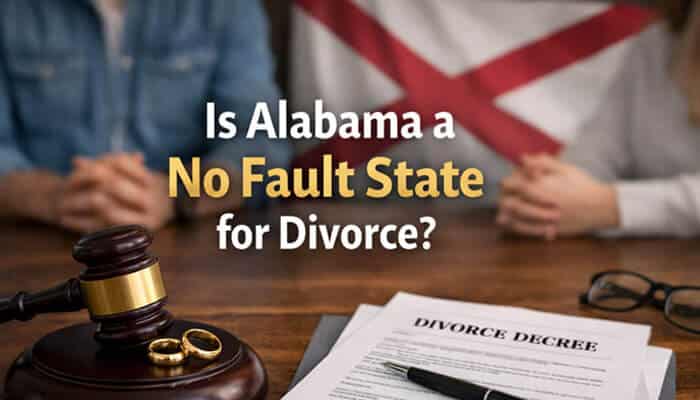
This is a common follow-up question when people search is Alabama a no fault state. The answer is yes but only for divorce. Alabama does allow no-fault divorce. This means you can end your marriage by simply stating there has been an “irretrievable breakdown” of the relationship. You do not have to prove your spouse did anything wrong.
However, Alabama also still allows fault-based divorce. Fault-based grounds include adultery, abandonment, imprisonment, and domestic violence. Whether you file for fault or no-fault divorce can affect decisions about property division and alimony, so it’s wise to consult a family law attorney.
Key point: Alabama’s no-fault divorce option is completely separate from its at-fault car insurance system. So when someone asks is Alabama a no fault state the answer depends entirely on what kind of case you’re talking about.
Optional Insurance Coverage Worth Having in Alabama
Since Alabama is an at-fault state without PIP requirements, your coverage options are especially important. Here are the add-ons you should seriously consider:
- Med Pay (Medical Payments Coverage): Pays your medical bills regardless of who caused the accident. This is like a mini-PIP. It kicks in immediately and covers you and your passengers.
- Uninsured Motorist (UM) Coverage: Protects you when the at-fault driver has no insurance. Since nearly 1 in 5 Alabama drivers is uninsured, this is critical.
- Underinsured Motorist (UIM) Coverage: Kicks in when the at-fault driver’s insurance isn’t enough to cover all your losses. For example, if your injuries total $80,000 but the other driver only has $25,000 in coverage, UIM covers the gap.
- Collision Coverage: Covers damage to your own vehicle regardless of fault. Helpful if the at-fault driver is uninsured or underinsured.
Experts strongly recommend buying as much UM/UIM coverage as you can afford. The few extra dollars per month on your premium could protect you from tens of thousands in out-of-pocket costs.
What to Do Immediately After a Car Accident in Alabama
Knowing the answer to is Alabama a no fault state is important, but knowing what to do after a crash is just as critical. Here’s a step-by-step guide:
- Call 911: Always get police to the scene. The police report is one of your most important pieces of evidence.
- Seek Medical Attention: Even if you feel okay, see a doctor right away. Delays in treatment can be used by insurance companies to argue your injuries weren’t serious or weren’t caused by the crash.
- Collect Evidence: Take photos, get witness information, and note the other driver’s insurance details, license plate, and driver’s license number.
- Do NOT Admit Fault: Don’t apologize or say anything that could be interpreted as taking responsibility even “I’m sorry” can be used against you.
- Avoid Talking to the Other Driver’s Insurance: Their adjuster is not on your side. Direct all communication to your own attorney.
- Contact an Alabama Car Accident Attorney: Given Alabama’s strict contributory negligence rule, having an experienced lawyer early in the process is the best way to protect your rights.
- File Your Claim Within 2 Years: Alabama’s statute of limitations is 2 years. Missing this deadline means losing your right to any compensation.
How Insurance Companies Use Alabama’s Laws Against You
Understanding is Alabama a no fault state is not enough you also need to understand how insurance companies think. Because Alabama follows pure contributory negligence, insurers have a powerful tool to deny your claim: all they have to do is prove you were even 1% at fault.
Here are the tactics insurance companies commonly use in Alabama:
- Looking for Minor Traffic Violations: Were you going 2 mph over the speed limit? Did you fail to signal a lane change? Insurers will look for anything to pin 1% of blame on you.
- Delaying the Claims Process: Financial pressure from mounting medical bills can force victims to accept low settlements. Insurers know this.
- Reviewing Your Medical History: They look for pre-existing conditions to argue your injuries aren’t related to the crash.
- Encouraging Early Recorded Statements: If you speak to their adjuster without a lawyer, you might unintentionally say something that hurts your case.
- Offering a Quick, Low Settlement: Before you know the full extent of your injuries, insurers may push a quick payout that is far less than what you deserve.
This is exactly why most Alabama personal injury attorneys recommend you contact a lawyer before speaking to the other driver’s insurance company.
Final Thoughts
Let’s bring it all together. Is Alabama a no fault state? No and understanding that answer could make or break your case after a car accident.
Alabama is an at-fault state with some of the toughest rules in the country. The at-fault driver pays, fault must be proven, and even a tiny sliver of your own fault can wipe out your entire claim under Alabama’s pure contributory negligence doctrine. For divorce purposes only, Alabama does allow no-fault filings but car insurance in Alabama is a very different story.
The bottom line: if you’ve been in a car accident in Alabama, don’t navigate this alone. The stakes are high. Insurance companies are experienced at using Alabama’s laws to minimize what they pay you. Knowing is Alabama a no fault state is just the beginning protecting your rights requires acting quickly, gathering strong evidence, and ideally working with a skilled Alabama personal injury attorney who knows how to fight back.
Is alabama a no fault state FAQs
1. Is Alabama a no fault state for car accidents?
No. Alabama is definitively not a no fault state for car accidents. It is an at-fault (tort) state. The driver who caused the accident is responsible for paying all damages.
2. Does Alabama require Personal Injury Protection (PIP)?
No. Because is Alabama a no fault state gets a clear “no” answer, there is no requirement to carry PIP insurance. PIP is only mandated in no fault states.
3. What is the time limit to file a car accident claim in Alabama?
You have 2 years from the date of the accident to file a personal injury lawsuit in Alabama. This is called the statute of limitations. Missing this deadline almost always means losing your right to compensation.
4. Can I sue the at-fault driver directly in Alabama?
Yes. In addition to filing an insurance claim, you can file a personal injury lawsuit directly against the at-fault driver. You must do so within 2 years of the accident.
Disclaimer
This article is for informational purposes only and does not constitute legal advice. Laws may change. Always consult a licensed Alabama attorney for advice specific to your situation.
