


TPS to green card is one of the most searched immigration questions because many people with Temporary Protected Status want a stable, permanent future in the United States. The most important rule is simple: TPS by itself does not automatically turn into a green card. A person with TPS usually needs a separate green card basis, such as family, employment, asylum, VAWA, U visa status, SIJ classification, or another category recognized by U.S. immigration law.
At the same time, TPS can still be very helpful. A person with valid TPS is generally treated as maintaining lawful status for certain adjustment purposes during the period TPS remains in effect. That can matter a lot in some cases, especially when a person is trying to file for permanent residence from inside the United States. But there is still a major legal difference between having lawful status and being inspected and admitted or paroled, and that difference often decides whether a TPS holder can adjust status without leaving the country.
What Is Temporary Protected Status?
Temporary Protected Status is a humanitarian benefit for certain nationals of designated countries facing war, natural disaster, or other extraordinary conditions. TPS can protect a person from removal for a limited period, allow them to request work authorization, and let them request travel authorization if it is approved. It is temporary protection, not permanent residence.
TPS Benefit Eligibility: Who Can Qualify?
When people search tps benefit eligibility, they are usually asking who can get TPS in the first place. In general, a person must:
- Be a national of a country that has been designated for TPS, or a person without nationality who last habitually lived there
- Meet the country-specific continuous residence and continuous physical presence dates
- File during the required registration period, or qualify for late initial filing when allowed
- Not be barred by certain criminal or inadmissibility issues, including felony convictions or multiple disqualifying misdemeanors in the United States
This matters because a person cannot build a strong tps to green card strategy unless the underlying TPS case is still valid and well documented. A weak TPS record can create problems later during a green card case, especially if immigration authorities review past entries, criminal history, travel history, or filing gaps.
Can a TPS Holder Apply for Green Card?
Yes, a TPS holder can apply for green card status in many situations, but only if there is a separate immigrant category available. TPS is not a stand-alone green card category.
So the better legal question is not just can a TPS holder apply for green card, but rather:
- Does the person have a qualifying family or employment petition?
- Is a visa immediately available or current?
- Was the person inspected and admitted or paroled, or do they have another rule such as INA 245(i) that may help?
- Are there inadmissibility issues or waiver issues?
- Is the case with USCIS, a consulate, or immigration court?
Main TPS to Green Card Pathways
1. Family-Based Green Card
This is the most common tps to green card route. A TPS holder may qualify through a close family relationship, such as:
- Spouse of a U.S. citizen
- Unmarried child under 21 of a U.S. citizen
- Parent of a U.S. citizen who is at least 21
- Certain family-preference categories through a green card holder or another qualifying relative
Immediate relatives of U.S. citizens usually have a major advantage because immigrant visas are immediately available to them. By contrast, family-preference categories often involve waiting for a priority date.
A key legal point is that immediate relatives are exempt from some adjustment bars related to unlawful status and unauthorized employment, but that does not automatically fix an entry without inspection problem. In other words, marriage to a U.S. citizen can help a lot, but it does not erase every issue by itself.
2. Employment-Based Green Card
Some TPS holders qualify through an employer. This can include EB-2 or EB-3 cases and, in some situations, other employment-based classifications. The employer usually starts the process with an immigrant petition, and the applicant later files for adjustment of status if allowed and if a visa is available.
Employment-based cases can be harder for TPS holders than immediate-relative family cases. That is because many employment-based adjustment applicants are barred if they are not in lawful nonimmigrant status at the time of filing. TPS can help because it may count as lawful status for adjustment purposes while TPS is in effect, but the case still has to satisfy the admission and visa-availability rules.
3. Asylum-Based Green Card
A TPS holder who independently qualifies for asylum may later move from asylum to permanent residence. This is not the right path for everyone, but it can be an important option for people who fear persecution in their home country.
4. Other Humanitarian or Special Routes
Some TPS holders may have another path that is stronger than a normal family or employment case. Common examples include:
- VAWA self-petition
- U nonimmigrant status
- Special Immigrant Juvenile classification
- Other special immigrant or humanitarian categories
For some people, these categories are safer than a regular consular-processing route because they may offer special rules on inadmissibility, abuse, crime-victim protection, or age-related issues.
The Biggest Issue in TPS to Green Card Cases: Admission vs. Status
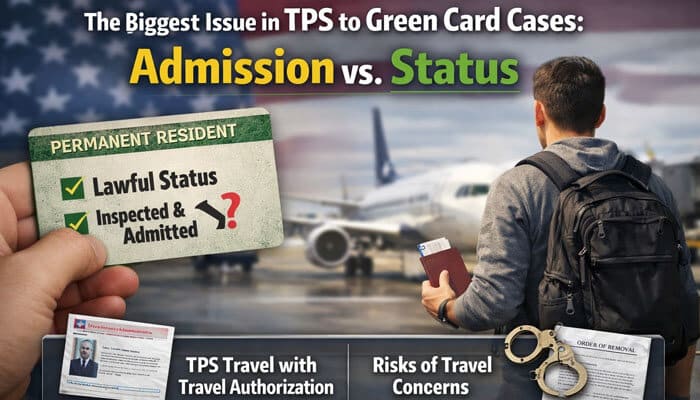
This is where many articles stay too general. The hardest part of many tps to green card cases is understanding the difference between:
- Having lawful status
- Being inspected and admitted or paroled
A grant of TPS by itself is not an admission for adjustment-of-status purposes. So if someone entered the U.S. without inspection, simply receiving TPS later does not automatically cure that problem.
However, there has been an important policy development. If a TPS beneficiary travels with approved TPS travel authorization and returns while TPS remains valid, that person may be admitted on return in a way that can help with adjustment-of-status eligibility. This can be a very important part of a legal strategy in the right case.
That does not mean everyone with TPS should travel. Travel can be risky if there are criminal issues, prior removal orders, inadmissibility concerns, or other case-specific problems. Travel planning should be handled very carefully.
When TPS Holders May Need Consular Processing Instead
If a TPS holder cannot adjust status inside the United States, they may need consular processing abroad after an approved immigrant petition. But this can trigger unlawful-presence problems. Leaving the United States can create three-year or ten-year bars for some applicants, depending on their history.
Another possible solution in older cases is INA 245(i). Some people may still adjust under INA 245(i) if they are grandfathered through a qualifying immigrant petition or labor certification filed on or before April 30, 2001.
Step-by-Step TPS to Green Card Process
A strong tps to green card case usually follows this order:
1. Confirm the green card basis
This could be a family petition, employment petition, asylum-based case, VAWA, U visa, SIJ, or another recognized category.
2. Check whether a visa is available
Immediate relatives of U.S. citizens usually have immediate visa availability. Family-preference and employment-based cases often depend on wait times.
3. Check the admission issue
Did the person enter with inspection? Was the person later paroled? Did the person travel and return with valid TPS travel authorization? Could INA 245(i) apply?
4. File the correct petition
Common cases begin with a family or employment petition.
5. File for adjustment of status if allowed inside the U.S.
This step depends on eligibility and visa availability.
6. Address any waiver issues early
Some applicants may need waivers depending on the ground involved.
7. Check court jurisdiction if the person is in removal proceedings
In some cases, immigration court—not USCIS—may control the adjustment process.
Useful Forms in a TPS to Green Card Case
| Purpose | Common Form | Why it matters |
| TPS application or re-registration | Form I-821 | Keeps or renews valid TPS status |
| Family petition | Form I-130 | Starts many family-based green card cases |
| Employment petition | Form I-140 | Starts many employment-based cases |
| Adjustment of status | Form I-485 | Used to apply for permanent residence from inside the U.S. |
| Travel document | Form I-131 | Can be critical if lawful reentry is part of the strategy |
| Waiver of inadmissibility | Form I-601 | Used for certain waiver requests |
| Provisional unlawful presence waiver | Form I-601A | Limited to unlawful-presence grounds in qualifying cases |
| Old-law grandfathering route | I-485 Supplement A | Used in some INA 245(i) cases |
TPS El Salvador Update

Because many readers search tps el salvador, it is important to note that Salvadoran TPS holders often ask whether they can move from temporary protected status to permanent residence through family or employment options. The answer is case-specific.
For Salvadoran TPS holders, the green card analysis still depends on the same core questions:
- How did the person enter the United States?
- Do they have a qualifying family or work petition?
- Is a waiver needed?
- Is the person in immigration court?
- Is travel history relevant to the admission issue?
So when people ask about tps el salvador, they should understand that TPS may protect them temporarily, but permanent residence still requires a separate legal path.
Common Mistakes in TPS to Green Card Cases
Many TPS holders lose time because they make one of these mistakes:
- Thinking TPS automatically becomes a green card
- Assuming marriage to a U.S. citizen fixes an unlawful entry problem by itself
- Traveling without understanding the risks or without approved travel authorization
- Ignoring visa-bulletin wait times in family-preference or employment-based cases
- Leaving the U.S. without analyzing unlawful-presence bars first
- Forgetting that immigration-court jurisdiction can change where the case must be filed
Final Thought
A smart tps to green card strategy starts with one honest review: What is your actual green card basis, and are you eligible to adjust inside the United States? For many people, the case turns on one or two details, such as the way they entered the country, whether they later traveled with TPS authorization, whether a visa is immediately available, or whether INA 245(i) still helps.
For a legal site, the most useful message for readers is this: TPS can be a bridge, but it is not the destination. The strongest explanation should make clear that temporary protected status may keep a door open, yet permanent residence usually requires a separate legal path and a careful review of admission, waivers, petitions, and court jurisdiction.
TPS to Green Card FAQs
1. Can TPS to Green Card lead directly to U.S. citizenship?
No, TPS to Green Card does not directly lead to citizenship because a person must first qualify for permanent residence through another legal path.
2. Can a person with TPS file Form I-130 for a spouse or child?
No. TPS alone does not give a person the right to petition for a spouse or child. That benefit usually belongs to a U.S. citizen or lawful permanent resident.
3. Do a spouse or children get TPS automatically through one family member?
No. TPS is not automatic for family members. Each person must qualify and apply separately if eligible.
4. Can a TPS holder file the immigrant petition and green card application at the same time?
Sometimes. This may be possible when a visa number is immediately available, such as in some immediate-relative cases.
5. Do TPS holders need biometrics for a green card case?
Usually yes. Biometrics may include fingerprints, a photo, and a signature during the green card process.
6. Are biometrics required in a TPS to Green Card application?
Yes, a TPS to Green Card application usually requires biometrics like fingerprints and a photo.
Disclaimer: This article is for general informational purposes only and is not legal advice. Immigration rules can change, and the right tps to green card strategy depends on a person’s entry history, family or work petition, waiver issues, and any immigration court case.