

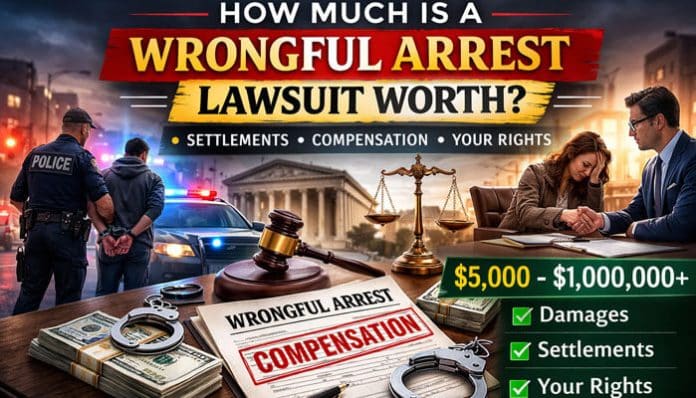

If you are asking how much is a wrongful arrest lawsuit worth, you are likely trying to understand whether pursuing a case makes financial and practical sense.
In the United States, a wrongful arrest lawsuit (also called an unlawful arrest or false arrest claim) is usually filed under:
- State false imprisonment laws, or
- Federal civil rights law, most commonly 42 U.S.C. § 1983 (for constitutional violations by police)
There is no fixed average payout, and results vary widely by state, facts, and evidence. Below is a realistic breakdown of what affects value, what typical settlement ranges look like, and whether hiring a lawyer is usually necessary.
What Is a Wrongful Arrest Lawsuit?
A wrongful arrest happens when law enforcement detains someone without probable cause.
Under the Fourth Amendment to the U.S. Constitution, police must have:
- A valid warrant, or
- Probable cause that a crime was committed
If neither exists, the arrest may violate your constitutional rights.
However, not every dropped charge equals wrongful arrest. That’s one of the biggest misunderstandings online.
Common Misconception
“My charges were dismissed, so I automatically have a lawsuit.”
Not necessarily.
Courts look at whether officers had reasonable grounds at the time of arrest, not whether the case later failed.
How Much Is a Wrongful Arrest Lawsuit Worth on Average?
There is no true nationwide average settlement for wrongful arrest, but here are general patterns:
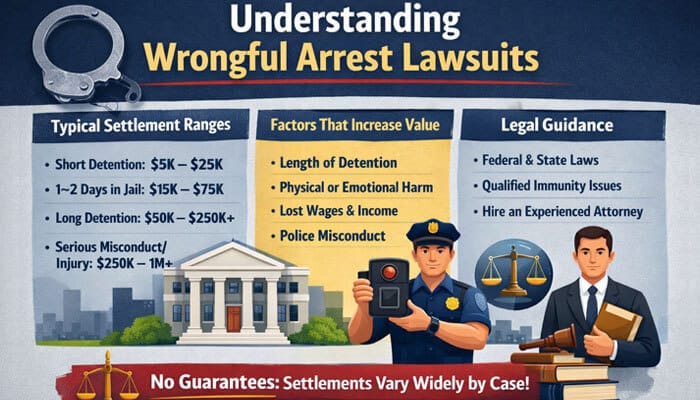
Typical Settlement Ranges
- Short detention (hours, no injury): $5,000 – $25,000
- 1–2 days in jail: $15,000 – $75,000
- Longer detention (weeks/months): $50,000 – $250,000+
- Serious misconduct or injury: $250,000 – $1,000,000+
Large verdicts (seven figures or more) usually involve:
- Physical abuse
- Fabricated evidence
- Long incarceration
- Permanent reputation damage
- Clear constitutional violations
Most routine unlawful arrest cases settle far below viral headline numbers.
What Increases the Value of a Wrongful Arrest Lawsuit?
Courts and insurance carriers typically consider:
1. Length of Detention: Spending 2 hours in a holding cell is valued differently than 30 days in jail.
2. Criminal Charges Filed: Felony charges that affect employment or reputation increase damages.
3. Physical or Emotional Harm: Documented injuries, PTSD, or medical treatment significantly raise value.
4. Malice or Intentional Misconduct: If officers fabricated evidence or knowingly ignored facts, damages increase.
5. Lost Wages and Financial Loss: Missed work, job termination, and business loss are recoverable.
6. Strength of Evidence: Body camera footage and documented police misconduct make cases stronger.
What Is the Average Settlement for Wrongful Arrest by State?
There is no published official “state average.” However, payouts often vary based on:
- Jury tendencies
- Local civil rights history
- State damage caps
- Municipal insurance policies
For example:
- California and New York often see higher civil rights settlements.
- States with stricter damage caps may limit recovery.
- Smaller counties may settle faster to avoid litigation costs.
If you are researching in a specific state, the legal standards for false imprisonment and immunity defenses may differ.
- Federal Civil Rights vs. State Law Claims
- Most wrongful arrest lawsuits fall under:
- Section 1983 federal civil rights claims
- State tort claims (false imprisonment)
Federal cases may allow:
- Compensatory damages
- Punitive damages (in cases of reckless misconduct)
- Attorney’s fees
However, police officers are often protected by qualified immunity, which can block recovery if the right was not “clearly established.”
This is why many cases fail even when arrests feel unfair.
How Long Does a Wrongful Arrest Lawsuit Take?
Most cases take:
- 6–18 months if settled
- 1–3 years if litigated fully
The process usually involves:
1. Filing a notice of claim (often required against cities)
2. Federal or state court complaint
3. Discovery (body cam, police reports, depositions)
4. Settlement negotiations
5. Trial (if no agreement)
Municipal defendants rarely move quickly.
Do I Need a Lawyer for a Wrongful Arrest Lawsuit?
When You Usually Need a Lawyer
The case involves police or government entities
- Qualified immunity is raised
- You were charged with a felony
- You suffered jail time or serious harm
- The city denies wrongdoing
Civil rights litigation is procedurally complex.
When Some People Try Without a Lawyer
- Small claims false imprisonment cases (private security, not police)
- Very short detention situations
- Clear documentation and minimal damages
However, suing a city or police department without legal representation is extremely difficult.
How Lawyers Get Paid
Most wrongful arrest attorneys work on contingency fees, meaning:
- You pay nothing up front
- They take 30%–40% of the settlement or verdict
- If you lose, you usually owe no fee
Some civil rights cases also allow attorneys’ fees to be recovered from the government if you win.
Cost Comparison: Hiring a Lawyer vs. Filing a Wrongful Arrest Lawsuit Alone
If you are deciding whether to hire an attorney for a wrongful arrest lawsuit or file on your own, the real question is not just cost — it is risk vs. outcome.
Below is a practical comparison based on how civil rights and false arrest cases typically work in the United States.
Quick Comparison Table
| Factor | Hiring a Lawyer (Contingency) | Filing Alone (Pro Se) |
| Upfront Cost | $0 in most cases | Filing fees ($400–$500 federal court) |
| Attorney Fees | 30%–40% of settlement | None |
| Court Costs | Often advanced by attorney | Paid by you |
| Chance of Dismissal | Lower (if case is screened properly) | High in police cases |
| Qualified Immunity Defense | Attorney handles legal arguments | Very difficult to overcome alone |
| Settlement Negotiation | Experienced negotiation | You negotiate directly |
| Access to Experts | Attorney arranges | Rare without funds |
| Time Investment | Moderate involvement | Heavy time commitment |
| Emotional Stress | Shared with counsel | You handle everything |
| Average Settlement Outcome | Often higher due to leverage | Often dismissed or low settlement |
Why Big Wrongful Arrest Verdicts Are Rare
Those cases usually involve:
- Years of wrongful incarceration
- DNA exonerations
- Systemic misconduct
- Prosecutorial wrongdoing
Basic unlawful arrest cases without long-term harm typically settle modestly. Setting realistic expectations is important before filing.
What Evidence Helps a Wrongful Arrest Lawsuit?

Strong cases often include:
- Body camera footage
- Witness statements
- Proof no crime occurred
- Dismissed charges
- Medical records
- Employment termination records
Documentation matters more than emotion.
What If Charges Are Still Pending?
If criminal charges are ongoing:
- Filing a civil lawsuit may need to wait
- Your criminal defense attorney should advise first
- Civil statements can impact your criminal case
Always resolve the criminal side strategically before filing civil claims.
Risks of Filing a Wrongful Arrest Lawsuit
Before pursuing a claim, consider:
- Statutes of limitations (often 1–3 years depending on state)
- Government notice requirements
- Litigation stress and time commitment
- Possibility of dismissal under immunity defenses
Not every unfair arrest becomes a successful lawsuit.
Practical Next Steps
If you believe you were wrongfully arrested:
1. Obtain arrest records
2. Request body cam footage (if available)
3. Preserve all documentation
4. Track lost wages and expenses
5. Schedule consultations with civil rights attorneys
Many lawyers offer free evaluations.
Even if the case is not worth six figures, a consultation can clarify your options.
Final Thoughts: Is It Worth Filing?
The value of a wrongful arrest lawsuit depends on:
- Strength of constitutional violation
- Length of detention
- Documented damages
- State law
- Quality of evidence
Minor, short-term arrests may result in modest settlements.
Serious rights violations with long detention can result in substantial compensation.
The key is not chasing headline numbers — it is realistically assessing risk, cost, and outcome.
Disclaimer:
This article provides general legal information for U.S. readers and is not legal advice. Laws vary by state, and outcomes depend on individual facts.